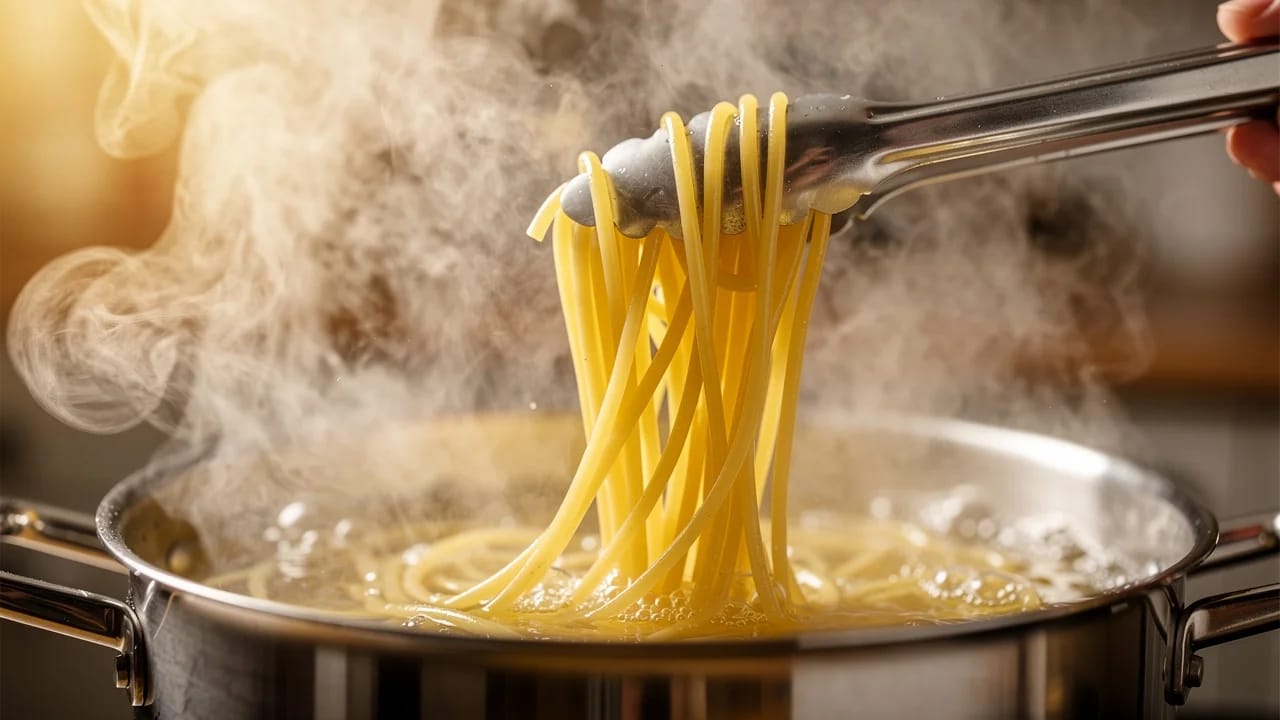
 Bastien
Al Dente
Italian for "to the tooth" — food cooked so it's tender but still firm when you bite into it, most often applied to pasta.
Al dente is an Italian phrase that translates literally to "to the tooth." It describes food — most often pasta — cooked so that it offers a slight resistance when you bite through it. Not crunchy, not soft, but somewhere in between where the texture has real presence in your mouth.
If you have ever eaten pasta in Italy, you already know the difference. Pasta served al dente has a satisfying chew. Pasta cooked a minute or two past that point turns limp and starchy, losing the texture that makes a simple plate of spaghetti worth eating. The concept sounds fussy, but once you know what to look for, nailing al dente becomes second nature.
What does al dente actually feel like
Bite through a piece of pasta. If it is al dente, you will feel a very slight firmness at the center — not a hard crunch, just the faintest pushback before the noodle gives way. Some people describe it as a thin white line visible when you cut a strand of spaghetti in half. That pale core is starch that has not fully gelatinized yet, and it is exactly what you want.
If there is no resistance at all, the pasta is overcooked. If there is a distinct chalky snap, it needs more time. Al dente sits in the narrow window between those two.
The science behind it
When dried pasta hits boiling water, two things happen simultaneously. Water penetrates the noodle from the outside in, and heat causes the starch granules to absorb water and swell — a process called gelatinization. At the same time, the gluten protein network firms up as it cooks, giving the noodle structure.
Al dente pasta has a fully hydrated, gelatinized exterior with a slightly under-hydrated core. That gradient is what creates the textural contrast. Cook it longer and the entire cross-section gelatinizes uniformly, producing a softer, mushier noodle.
This is also why al dente pasta has a lower glycemic index than fully cooked pasta. The intact starch in the center digests more slowly, resulting in a more gradual rise in blood sugar. Studies have shown a meaningful difference — roughly 20-25% lower GI for al dente versus soft-cooked pasta. It is one of those rare cases where the tastier option is also the healthier one.
How to test for al dente
Forget throwing pasta at the wall. That tells you nothing useful. Instead:
The bite test. Pull out a single piece of pasta 1-2 minutes before the package time suggests. Bite through it. You should feel slight resistance at the center. If it is still too firm, test again in 30 seconds.
The cross-section test. Cut or bite a piece of spaghetti and look at the cross-section. A thin pale dot or line in the center means it is al dente. No pale center means it has cooked through entirely.
Start tasting early. The window between al dente and overcooked can be as short as 30-60 seconds, depending on the shape. Start tasting at least 2 minutes before the low end of the package time.
Remember that pasta continues cooking after you drain it — this is carryover cooking. If the pasta will go into a hot sauce or a baking dish, pull it while it is still slightly firmer than your target.
Timing guide by pasta shape
The package gives you a range, but for al dente, subtract 1-2 minutes from the lower end. These are starting points — always taste.
| Pasta shape | Package time | Al dente target |
|---|---|---|
| Angel hair / capellini | 3-4 min | 2-3 min |
| Spaghetti | 8-10 min | 7-8 min |
| Linguine | 9-11 min | 8-9 min |
| Fettuccine (dried) | 10-12 min | 9-10 min |
| Penne | 10-12 min | 9-10 min |
| Rigatoni | 12-14 min | 10-12 min |
| Farfalle | 10-12 min | 9-10 min |
| Orecchiette | 10-12 min | 9-10 min |
| Fresh pasta | 2-4 min | 1-3 min |
Fresh pasta cooks much faster and has a narrower al dente window. Watch it carefully.
Beyond pasta
Al dente is not just for noodles. The concept applies anywhere you want firm-but-tender texture.
Vegetables. Green beans, broccoli, asparagus — cooked al dente, they retain their snap and bright color. This is closely related to blanching, where vegetables are briefly boiled and then shocked in ice water to lock in that crisp-tender state.
Rice. Risotto is traditionally cooked al dente. Each grain should be creamy on the outside with a subtle bite at the center. Overcooked risotto turns to porridge. The same idea applies to pilafs and grain bowls — a slight chew makes the dish more interesting.
Grains. Farro, barley, and freekeh are all better with a bit of chew. Cook them al dente and they hold their shape in salads and soups instead of turning to mush.
Tips for consistent al dente pasta
Use plenty of water. At least 4 liters per 500g of pasta. Crowded pasta sticks together and cooks unevenly.
Salt the water generously. The pasta absorbs seasoned water as it cooks. This is your main chance to season the noodle itself, not just the sauce.
Stir during the first minute. Pasta is stickiest right after it goes in. A good stir in the first 60 seconds prevents clumping.
Save pasta water before draining. That starchy water is liquid gold for finishing sauces — it emulsifies and thickens without adding fat.
Never rinse pasta. Rinsing washes away surface starch that helps sauce cling to the noodle. The only exception is pasta for cold salads.
Finish in the sauce. Drain the pasta while it is a touch firmer than al dente, then toss it in the sauce over heat for 1-2 minutes. The pasta finishes cooking while absorbing flavor from the sauce. This is how Italian cooks do it, and it makes a noticeable difference. Avoid common pasta cooking mistakes like draining too late or skipping this step.
Al dente in Fond
Fond's recipe timers help you hit al dente consistently. When a recipe calls for pasta cooked al dente, Fond factors in the specific shape, suggests a timer, and reminds you to start tasting before the timer runs out. For recipes where pasta finishes cooking in the sauce, the timer accounts for that carry-over time so you drain at the right moment.
Cook smarter
Join the waitlist for Fond. Recipes, meal plans, and a little AI sous-chef that learns how you cook.
Related terms
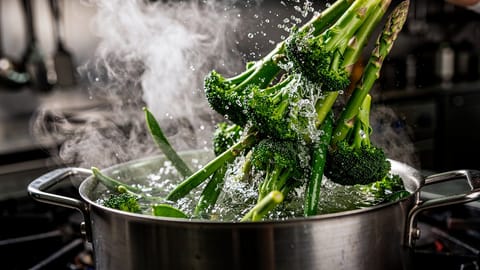
Blanching
Briefly boiling food then plunging it into ice water to stop cooking — used to preserve color, texture, and nutrients.
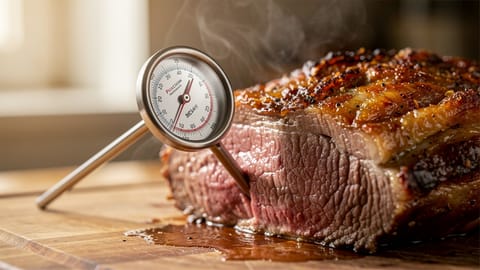
Carryover Cooking
The phenomenon where food continues to cook after being removed from heat, as residual thermal energy from the exterior migrates to the cooler interior.
12 pasta cooking mistakes ruining your dinner
Most pasta problems come down to technique, not ingredients. These twelve common mistakes are easy to fix once you understand the science behind them. Correct even three and your weeknight pasta will taste noticeably better.