 Bastien
Carryover Cooking
Carryover cooking is the rise in internal temperature that food keeps gaining after it leaves the heat. Pull meat below your target so it lands on it after resting.
Carryover cooking is the rise in internal temperature that food keeps gaining after it is removed from the heat. In culinary terms it is defined as the continued cooking caused by residual heat: the outer layers of a roast or steak are much hotter than the center, and that stored heat keeps flowing inward while the meat sits on the board. For home-sized cuts the rise is typically 3–8°C (5–15°F); large, dense roasts can climb further, up to around 14°C (25°F). It is the reason you pull meat before it reaches your target doneness.
How does carryover cooking work?
Heat flows from hot to cold. During cooking the outside of a piece of meat is far hotter than the inside. When you take it off the heat:
The process takes 5–20 minutes depending on the size of the cut. The rise happens whether or not you rest the meat, but resting also lets juices redistribute, so the two go together.
How long does carryover cooking last?
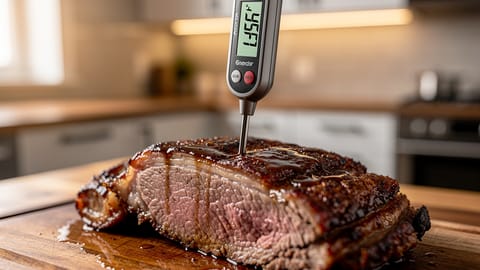
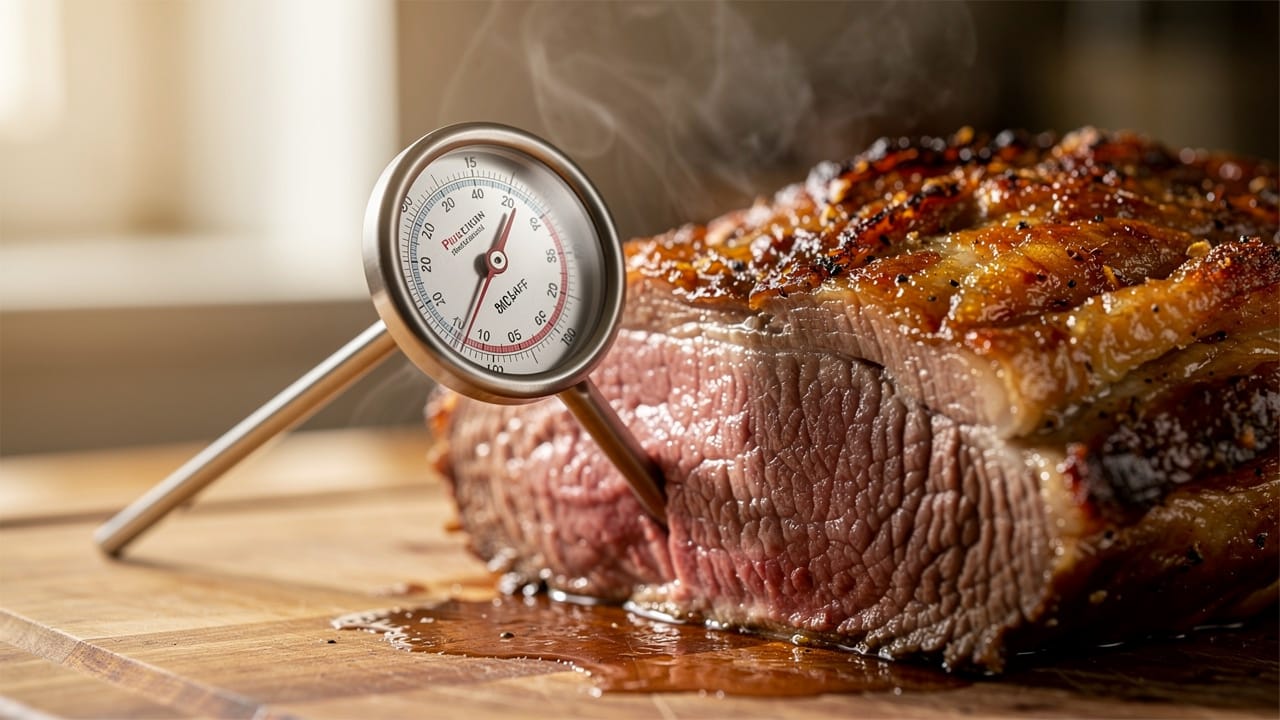
Roughly 5 to 20 minutes. A thin chop is done climbing within a few minutes; a large roast keeps rising for 15–20 minutes and then holds its temperature for a long time because of its mass. Check with an instant-read thermometer at the pull and again after the rest to see your own numbers.
How much does meat rise during carryover cooking?
The table gives rule-of-thumb expectations, not measurements. Verify them with a thermometer for your cut and method.
| Protein | Cut / size | Cooking method | Expected carryover |
|---|---|---|---|
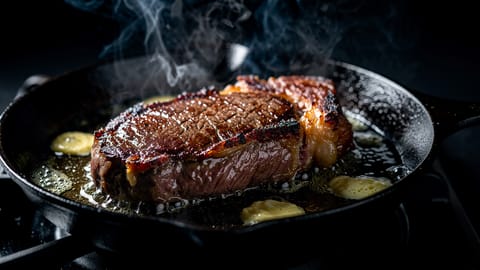
| Beef steak | 2.5 cm (1") | Searing / grill | 3–5°C (5–10°F) |
| Beef steak | 5 cm (2") | Searing / grill | 5–8°C (10–15°F) |
| Prime rib / rib roast | 2–4 kg | Oven roast | 5–8°C (10–15°F) |
| Beef tenderloin | Whole, 1.5–2 kg | Oven roast | 5–8°C (10–15°F) |
| Pork loin roast | 1–2 kg | Oven roast | 5–8°C (10–15°F) |
| Pork tenderloin | 400–600 g | Oven / sear | 3–5°C (5–10°F) |
| Pork chop | 2.5 cm (1") | Pan / grill | 3–5°C (5–10°F) |
| Whole chicken | 1.5–2 kg | Oven roast | 3–5°C (5–10°F) |
| Turkey | 5–8 kg | Oven roast | 5–8°C (10–15°F) |
| Chicken breast | Boneless | Pan / oven | 2–3°C (3–5°F) |
| Lamb leg | 2–3 kg | Oven roast | 5–8°C (10–15°F) |
The pattern
Thicker and heavier cuts store more heat, so they carry over more. A thin chicken breast may only rise 2°C; a 3 kg prime rib can climb 8°C or more. Higher cooking temperatures create a bigger gap between surface and center, which also means more carryover. Low-and-slow methods such as sous vide or braising produce very little.
When should you pull meat off the heat?
Pull early and let the rest finish the job. These pull temperatures assume a proper rest.
Beef
Thick roasts (prime rib, tenderloin) sit at the low end of each pull range. Steaks sit at the high end because they carry over less. These are doneness preferences; Health Canada's published minimum for whole cuts of beef is 63°C (145°F).
Poultry (chicken and turkey)
| Target | Pull temp (whole bird) | Pull temp (breast) |
|---|---|---|
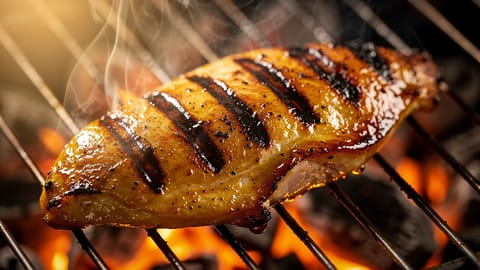
| 74°C (165°F), Health Canada and USDA figure for poultry pieces | 68–71°C (155–160°F) | 71°C (160°F) |
Food safety is a time-and-temperature pair, not a single number. The Canadian Food Inspection Agency's validation tables for cooked poultry show that holding chicken at 62.8°C (145°F) for 8.4 minutes gives the same Salmonella reduction as reaching 73.9°C (165°F), where the hold time is under 10 seconds. Those tables are written for processors with calibrated equipment; the home-safe rule stays simple: pull poultry a few degrees early, then confirm it reads 74°C after resting. Do not lean on carryover alone for chicken or ground meat.
Pork
| Target | Pull temp (roast) | Pull temp (chop) |
|---|---|---|
| 63°C (145°F) + rest, USDA figure for whole cuts | 57–60°C (135–140°F) | 60°C (140°F) |
| 71°C (160°F), Health Canada figure for pork and ground meat | 66°C (150°F) | 66°C (150°F) |
What factors increase or decrease carryover?
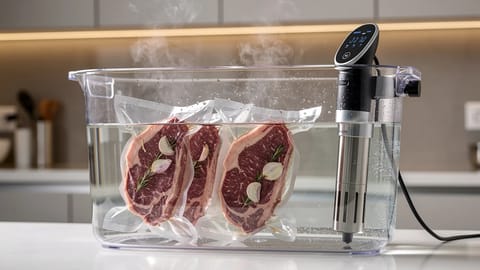
Why sous vide has almost no carryover
Sous vide holds food at one precise temperature for a long time, so the inside and outside end up equal and there is no gradient to drive carryover. Pull a steak from a 54°C bath and there is no hotter exterior to push heat inward. A quick sear afterward creates a brief, thin hot zone; expect only 1–2°C of carryover.
The science of heat transfer in meat
Meat conducts heat slowly compared with metal. During high-heat cooking a steep gradient forms: the surface may be above 200°C while the center is still 40°C. That gradient is the engine of carryover. Once the heat source is gone, the energy stored in the outer layers has nowhere to go but inward, and the center keeps rising until the gradient flattens.
The same physics is behind resting meat. As the temperature evens out, muscle fibers relax and reabsorb some of the juice that was pushed toward the center. Cutting too early gives you both an undercooked center and juice on the board.
Carryover in baking
Bread keeps cooking inside after it leaves the oven, which is why bakers check internal temperature and cool loaves on a rack. King Arthur Baking's testing puts most yeast loaves at 190°F (88°C) at the center, with dense whole-grain rounds better at 205–210°F (96–99°C). Cookies firm up on the hot sheet after baking for the same reason, so pull them while the centers still look slightly soft.
What are the most common carryover mistakes?
You are probably cooking to your target temperature instead of your pull temperature. For a thick steak aiming at medium-rare (54°C), pull at 49°C. For a roast, pull 5–8°C early. Use the charts above.
The amount depends on thickness, cooking temperature, and how you rest. Note pull and final temperatures for two or three cooks of the same cut and you will have your own number. An instant-read thermometer is the only way to see it.
You are tenting too tightly with foil. Trapped steam softens the seared exterior. Rest uncovered or tent loosely with gaps for steam to escape.
Thin cuts (under 2 cm) barely carry over. If the center is under, return it to the heat briefly. For thin steaks and chops, cook closer to the final target since carryover adds only 1–2°C.
Tips
Reverse-seared steaks (low oven, then a hot sear) carry over less because the gradient is smaller. Braised meat carries over very little too: it cooks in liquid at a low, even temperature.
Carryover cooking in Fond
Fond hasn't launched yet. This is how it will work at launch. Join the waitlist for early access.
Fond's Cook mode shows one step at a time, and steps that mention a duration carry a tappable timer. When a recipe says "rest 10 minutes before slicing", that step becomes a countdown, so the rest is not the part you skip.