 Bastien
Julienne
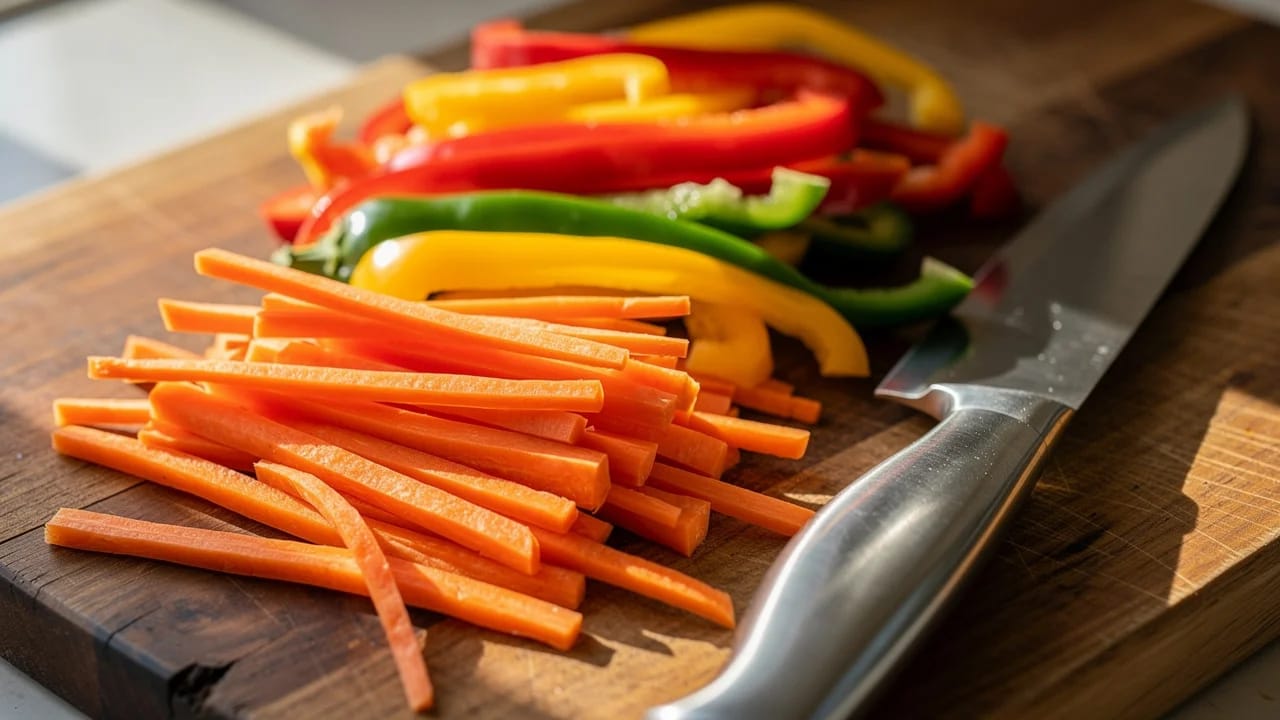
Julienne is a classical French knife cut that produces thin, uniform matchstick strips, about 3 mm (1/8 inch) square and 5 cm (2 inches) long in the American standard, used in stir-fries, salads, garnishes, and any dish where vegetables must cook evenly.
Julienne is a classical French knife cut that produces thin, uniform strips resembling matchsticks. In the American culinary-school standard the strips are about 3 mm × 3 mm × 5 cm (1/8" × 1/8" × 2"); the classical French julienne is finer still. It's a foundational knife skill that makes food cook evenly and look polished, taught in culinary schools and used daily in professional kitchens.
The point of the cut is uniformity, not looks. A pile of carrot sticks in six different sizes cooks unevenly: the thick pieces are still crunchy when the thin ones have turned to mush. Matching strips finish together.
What size is a julienne cut? Dimensions in mm and inches
Knife-cut sizes are codified so that a "julienne" means the same thing on every station. The American culinary-school standard, the one the Escoffier School of Culinary Arts and most English-language references teach, is:
| Cut | Cross-section | Length | Typical use |
|---|---|---|---|
| Fine julienne | 1.5 × 1.5 mm (1/16 × 1/16 in) | about 5 cm (2 in) | Garnishes, consommé |
| Julienne | 3 × 3 mm (1/8 × 1/8 in) | about 5 cm (2 in) | Stir-fries, salads, spring rolls |
| Batonnet | 6 × 6 mm (1/4 × 1/4 in) | 5-6 cm (2-2.5 in) | Crudités, fries, roasted vegetables |
| Brunoise | 3 × 3 × 3 mm dice, cut from julienne | Sauces, garnishes |
Two things to know before you measure with a ruler. First, the classical French julienne is thinner than the American one: Larousse and French school programs describe strips of 1 to 2 mm on 4 to 5 cm, which is roughly what American schools call fine julienne. Second, length follows the vegetable; a julienne of ginger is short because the root is, and nobody trims carrot sticks to the millimetre. Aim for a consistent cross-section and let the length land between 4 and 6 cm.
How do you julienne step by step?
The technique varies slightly depending on the vegetable, but the principle is the same: create flat surfaces, then cut into planks, then cut planks into strips.
Carrots and firm vegetables
Onions
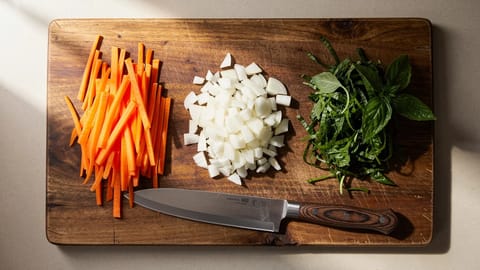
Onions are easier because the layers separate naturally into strips.
Bell peppers
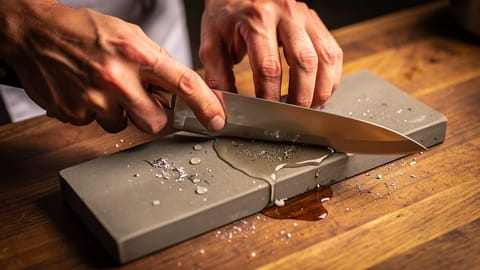
Tip: A sharp knife is the single biggest factor in clean julienne cuts. A dull blade crushes the vegetable instead of slicing cleanly, which leads to ragged edges, uneven strips, and more slipping. If your knife struggles to cut through a tomato skin, sharpen it before attempting julienne.
How does julienne compare to other knife cuts?
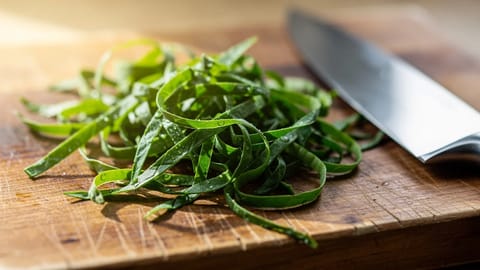
The chiffonade cut is sometimes confused with julienne, but they're different techniques for different ingredients. Chiffonade involves rolling up leafy herbs or greens and slicing them into thin ribbons. You wouldn't chiffonade a carrot, and you wouldn't julienne basil.
For a complete overview of all the standard cuts and when to use each, check our knife cuts guide.
What should you julienne, and when?
Stir-fries: Julienne is the default cut. Thin, uniform strips cook in 2-3 minutes over high heat. Carrots, peppers, snow peas, and zucchini all work well.
Salads and slaws: Raw julienned vegetables add crunch and visual structure. Carrots, beets, jicama, and daikon are common choices.
Spring rolls and wraps: Julienne strips pack neatly into wrappers and distribute evenly across each bite.
Garnishes: A small pile of julienned scallions, ginger, or radish on top of a finished dish adds color and texture.
Soups: Julienned vegetables in a clear broth look elegant and cook in minutes. Classic julienne soup (potage julienne) is the original use case.
What tools do you use for julienne?
A chef's knife is all you need; an 8-inch (20 cm) blade on a stable board handles every vegetable on this page. That said, two tools can speed things up:
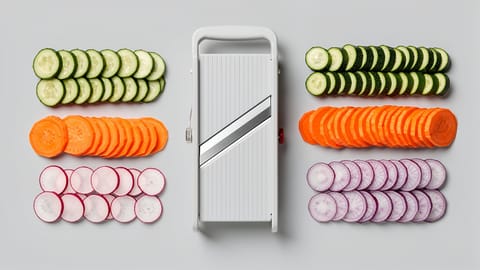
A mandoline with a julienne blade produces perfectly uniform strips at high speed. It's worth it if you're cutting large quantities for restaurant service or batch cooking. Always use the hand guard; a mandoline blade does not care whether it is cutting carrot or fingertip.
A julienne peeler (a Y-peeler with toothed blades) makes quick work of long vegetables like carrots and zucchini. The strips are thinner than knife-cut julienne and a bit curly, but they work well for raw salads and garnishes.