 Bastien
Brown sugar substitutes: what to use and how much
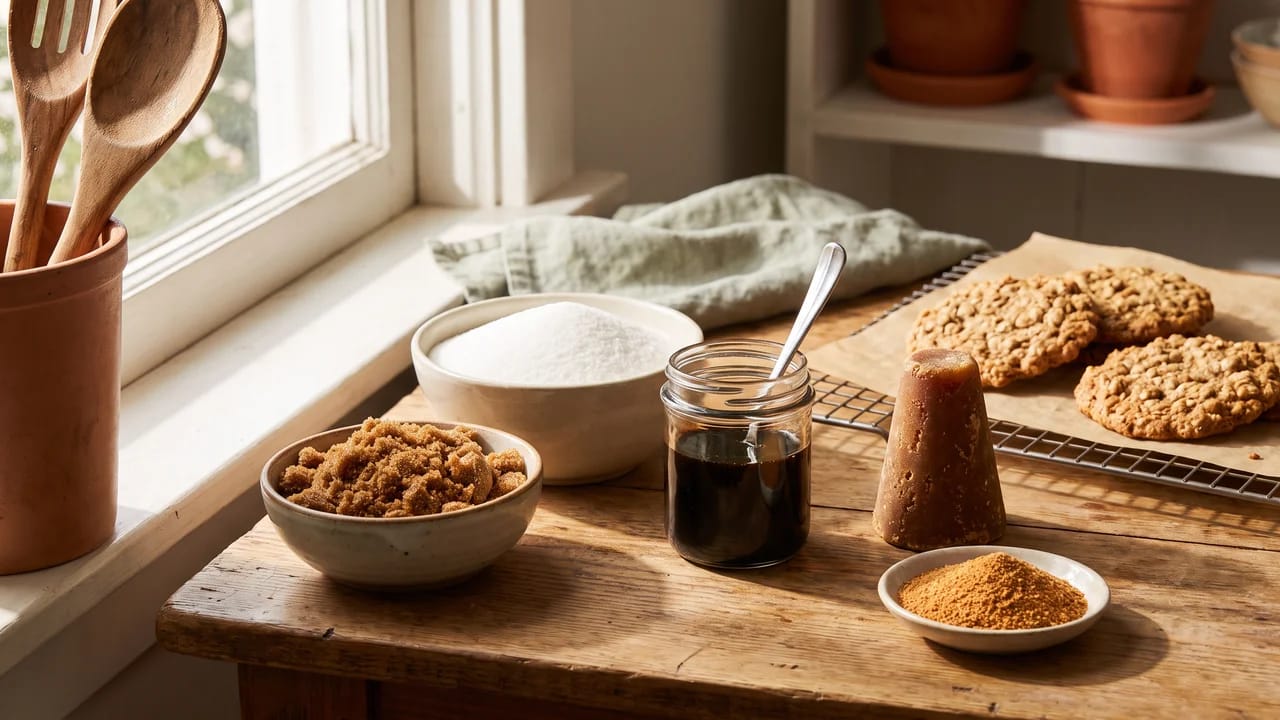
The closest brown sugar substitute is white sugar plus molasses: 1 cup (198 g) of granulated sugar with 2 teaspoons (14 g) of molasses for light brown sugar, or 1 tablespoon (21 g) for dark. Without molasses, muscovado or coconut sugar can stand in by weight, and plain white sugar works with crisper, paler results.
The best brown sugar substitute is the one you can make: white sugar plus molasses. For each cup of light brown sugar, use 1 cup (198 g) of granulated sugar and 2 teaspoons (14 g) of molasses. For dark brown sugar, use 1 tablespoon (21 g) of molasses. That's King Arthur Baking's preferred swap, and it needs no other change to the recipe.
No molasses? Muscovado or coconut sugar will do the job in most recipes, and plain white sugar works in a pinch. They don't behave the same, though. Brown sugar brings moisture and a little acidity, and the swap you choose decides whether your cookies stay chewy and how they rise.
Brown sugar substitutes at a glance
| Substitute | Per 1 cup packed brown sugar | What changes |
|---|---|---|
| White sugar + molasses | 1 cup (198 g) sugar + 2 tsp (14 g) molasses for light, 1 tbsp (21 g) for dark | Least change; closest match |
| Dark or light brown sugar | Same amount | Color and molasses flavor only |
| Muscovado | Same amount, by weight or volume | Stronger molasses flavor, stickier |
| Coconut sugar | Same weight (213 g) | Drier; toffee-like flavor |
| Turbinado or demerara | Same weight, fine-grained only | Coarse crystals may not dissolve; cookies can spread more |
| Granulated white sugar | Same amount | Crisper and paler; lift can change |
| Honey | About 3/4 cup, minus 3 to 4 tbsp other liquid | Moister; browns faster |
| Maple syrup | 1 cup, minus 3 to 4 tbsp other liquid | Moister, cakier cookies |
| Date sugar | Same weight | Doesn't fully melt; can be gritty |
| Golden syrup | About 3/4 cup, minus 3 to 4 tbsp other liquid | Treat like honey; no molasses flavor |
| Unsweetened applesauce | 1 cup, minus 1/4 cup other liquid | Texture takes trial and error |
Every row is a starting point, not a guaranteed match. The liquid sweetener ratios are King Arthur's numbers for replacing sugar in general.
What is brown sugar?
Brown sugar is white sugar with molasses added back. University of Illinois Extension puts light brown sugar at about 3.5% molasses by weight and dark brown sugar at about 6.5%. King Arthur says commercial brown sugar can carry up to 10% molasses by weight.
That small amount of molasses does a lot. America's Test Kitchen explains that molasses is an invert sugar, and invert sugar is especially hygroscopic: it pulls water from wherever it can, including the air. Cookies made with brown sugar stay chewy after they cool for that reason. The Sugar Association adds that brown sugar clumps because it holds more moisture than white sugar. King Arthur's sugar guide points out that molasses also gives brown sugar a slight acidity, which matters for leaveners.
Light and dark brown sugar swap freely. Both King Arthur and America's Test Kitchen treat them as interchangeable unless a recipe says otherwise. Dark gives a deeper color and a more assertive molasses flavor, and King Arthur considers any extra spread from its moisture too small to notice.
How to make brown sugar with white sugar and molasses
Published ratios don't agree, so pick one and stick with it.
King Arthur's weights land at 212 g for light and 219 g for dark, close to the 213 g a packed cup of brown sugar weighs on its ingredient weight chart. America's Test Kitchen uses more molasses, so its version tastes stronger. If you bake by weight, King Arthur's numbers scale easily: about 7 g of molasses per 100 g of sugar for light, 11 g for dark.
You don't need to mix it ahead. King Arthur adds the sugar and molasses to the recipe at the same time. America's Test Kitchen pulses them in a food processor for a ready-to-use brown sugar, or you can work them together with a fork.
Can I substitute white sugar for brown sugar?
Yes, in the same amount, but don't expect the same cookie. King Arthur calls the results unpredictable. Losing the caramel flavor and the color is the obvious part. The change in leavening is easier to miss.
Brown sugar is acidic. Recipes that use it often lean on baking soda, and the soda needs an acid to make gas. Fond's guide to baking soda vs baking powder lists brown sugar among those acids. Swap it out and, according to King Arthur, cookies may spread less or more depending on the rest of the recipe, while cakes and muffins may not rise as well, depending on how they're mixed.
Texture shifts too. America's Test Kitchen's cookie lesson explains that granulated sugar crystallizes as a cookie cools, which makes it crunchier, while brown sugar holds on to moisture during and after baking, which makes it chewier. Swap all the brown sugar for white and a chewy chocolate chip cookie drifts toward crisp.
The swap is safest when brown sugar is a minor ingredient. King Arthur's example is a coffeecake leavened with baking powder that uses 1 1/2 cups of white sugar and only 1/3 cup of brown sugar. That small amount of brown sugar has no effect on the cake's structure, so white sugar is fine there.
Brown sugar substitutes without molasses
If there's no molasses in the cupboard, reach for a sugar that already has some, or accept a slightly different bake.
- Muscovado keeps its molasses. The Sugar Association describes it as an unrefined cane sugar with the molasses left in. It's deep brown, with crystals slightly coarser and stickier than regular brown sugar. King Arthur swaps it for brown sugar by weight or by volume. Expect a stronger molasses flavor.
- Whole cane sugars such as piloncillo or jaggery are made without centrifuging, so the cooked cane juice stays in. King Arthur pairs them with brown sugar by weight. They often come in cones or blocks, so grate them first.
- Coconut sugar is made from coconut blossom nectar and has toffee-like notes. Swap it by weight: on King Arthur's chart a cup weighs about 154 g, against 213 g for packed brown sugar, so a cup-for-cup swap leaves you short. Healthline notes that it doesn't hold as much moisture as brown sugar.
- White sugar with maple syrup. Healthline mixes 1 cup (200 g) of white sugar with 1 tablespoon of maple syrup in place of the molasses.
Plain white sugar works too, with the trade-offs above.
Turbinado and demerara are a gamble. These raw sugars have larger crystals, and King Arthur found grain size varies a lot by brand. A fine-grained one swaps fine. Coarse crystals may not dissolve in a batter, and in King Arthur's own baking turbinado made drop cookies spread more. Save the coarse ones for topping muffins.
Avoiding sugar altogether? Brown-sugar-style sweetener blends are sold for that purpose. King Arthur hadn't tested them when it wrote its substitution guide, so follow the conversion on the package.
Honey, maple syrup, and golden syrup
Liquid sweeteners work, with adjustments. King Arthur's liquid sweetener guide gives these starting points:
- Honey is sweeter than sugar, so use about 3/4 cup per cup of sugar.
- Maple syrup is about as sweet as sugar, so use the same volume.
For either one, cut other liquid by 3 to 4 tablespoons per cup. If the recipe has no liquid to cut, add 3 to 4 tablespoons of flour per cup instead.
Watch the oven. Honey browns quickly because of its glucose and fructose, and fructose starts to caramelize at a lower temperature than table sugar. Maple syrup browns a little faster than sugar. University of Maine Extension suggests lowering the oven by about 25°F (about 14°C) when you bake with these syrups.
Texture changes too. In King Arthur's tests, soft cookies made with liquid sweeteners turned slightly crumbly and cakey and could spread more. Recipes that start by creaming butter with sugar are the riskiest: syrup has no crystals to beat air into the butter.
Golden syrup is an inverted sugar syrup that tastes sweeter than white sugar; about 25% less of it matches white sugar's sweetness. Handle it like honey. King Arthur says its liquid sweetener findings can apply to other syrups, without a guarantee.
Date sugar and applesauce
Date sugar is ground dehydrated dates. King Arthur says it's coarser and darker than white sugar and doesn't melt fully, so it can leave baked goods gritty. Swap it by weight, or follow King Arthur's suggestion and sprinkle it on muffins or quick breads before baking.
Applesauce can replace sugar in some bakes. University of Rhode Island SNAP-Ed uses 1 cup of unsweetened applesauce per cup of sugar and cuts other liquids by 1/4 cup per cup of applesauce. It won't taste of molasses, and Texas A&M AgriLife Extension warns that the texture may take some trial and error.
Measuring brown sugar: packed cups vs grams
American recipes measure brown sugar packed: pressed firmly into the cup, as Fond's guide to reading a recipe explains. Packing changes the amount a lot. USDA FoodData Central lists a packed cup of brown sugar at 220 g and an unpacked cup at 145 g, about a third less.
Weighing removes the guesswork. King Arthur's chart uses 213 g for a packed cup of light or dark brown sugar and 198 g for granulated sugar. A kitchen scale also makes the coconut sugar and demerara swaps above straightforward, and Fond's unit converter handles cups to grams for other ingredients.
How to soften hard brown sugar
Brown sugar hardens when the moisture in its molasses evaporates, Illinois Extension explains. Putting moisture back fixes it, and C&H Sugar splits its methods by how soon you need the sugar.
- Needed now. Spread the sugar on an oven-safe pan at 250°F (about 120°C) and watch it until soft. Or put it in a microwave-safe bowl under two wet but not dripping paper towels, seal with plastic wrap, and heat on high for 1 1/2 to 2 minutes, adjusting for your microwave. Either way, break it up with a fork and measure it right away, because it firms up again as it cools.
- Needed later. Seal the sugar in a container with a damp paper towel wrapped in foil, a dampened terra cotta disk, a slice of bread, or a couple of marshmallows. After about two days, remove it and break up the clumps.
Illinois Extension says a slice of bread can soften it in about a day. To keep it soft, store brown sugar in a tightly sealed container.
Picking the right swap
Start with the recipe's leavener and the texture you want. If it uses baking soda or depends on chew, make brown sugar from white sugar and molasses, or use muscovado. If brown sugar plays a supporting role in a baking-powder cake, white sugar is fine. Whichever you pick, weigh the dry swaps: 213 g of coconut sugar is a much closer match for a packed cup of brown sugar than a cup of coconut sugar.
Sources
- What can I substitute for brown sugar? - King Arthur Baking
- A guide to different types of sugars, how to use them, and when to substitute - King Arthur Baking
- Baking with liquid sweeteners - King Arthur Baking
- Ingredient weight chart - King Arthur Baking
- Brown Sugar Substitute - America's Test Kitchen
- Selecting Sweeteners - America's Test Kitchen
- Manipulating Cookie Texture - America's Test Kitchen
- What Makes Brown Sugar Brown? - University of Illinois Extension
- Types of Sugar - The Sugar Association
- Sugars, brown (SR Legacy 168833) - USDA FoodData Central
- How to soften C&H brown sugar - C&H Sugar
- Reducing Fat & Sugar in Holiday Baking - University of Maine Cooperative Extension
- Holiday Recipe Sugar Swaps - University of Rhode Island SNAP-Ed
- Sugary Snack Alternatives - Texas A&M AgriLife Extension
- Golden syrup - Wikipedia
- 7 Easy Substitutes for Brown Sugar - Healthline