 Bastien
Brunoise
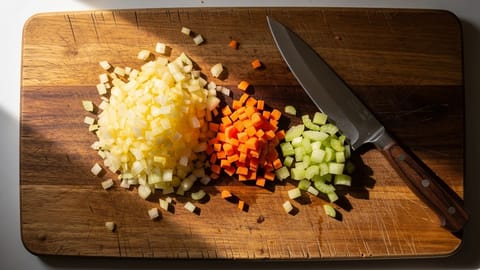
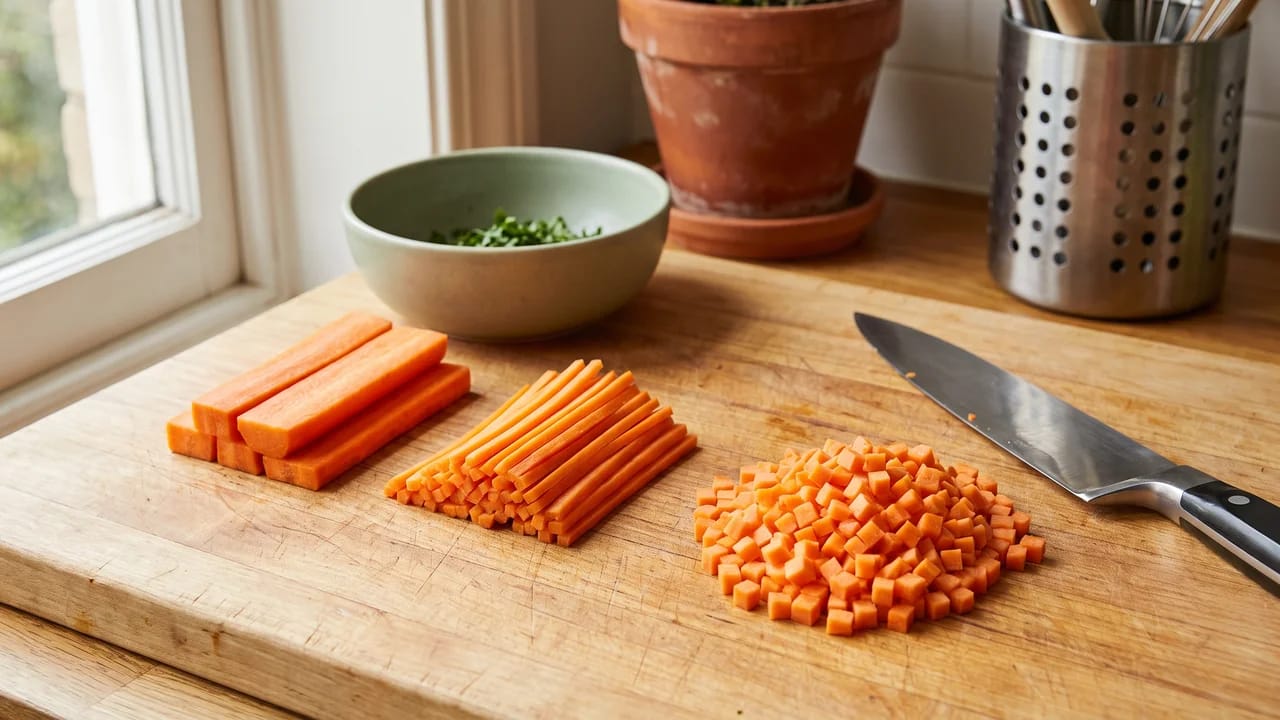
Brunoise is a knife cut producing tiny, even 3 mm cubes, made by first cutting food into julienne matchsticks and then crosswise into dice. It's the finest classic dice in French cooking.
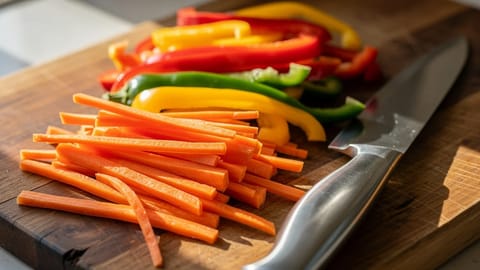
Brunoise is a knife cut that produces tiny, even cubes, classically 3 mm (about 1/8 inch) on each side. You get there in two stages: cut the food into 3 mm julienne matchsticks first, then turn the bundle 90 degrees and cut across at the same interval, so each stick becomes a row of little dice. It's the finest of the standard French dice cuts.
The word is pronounced "broon-WAHZ" and comes from Brunoy, a town south-east of Paris. It's also the cut that separates knife skills you have from knife skills you're still building: most first attempts are a scatter of trapezoids, and the technique clicks once you accept that the julienne stage decides everything, and the dicing is the easy second half.
How do you cut a brunoise, step by step?
The whole cut lives or dies at step 3. If your julienne is ragged, no amount of careful dicing rescues it, because the last cut only sets one of the cube's three dimensions. Keep your guiding knuckles tucked and let the knife tip stay on the board, pivoting rather than lifting. This is exactly the drill the knife cuts guide breaks down with the other classic shapes.
What size is a brunoise?
The classic brunoise is a 3 mm cube on every side, built from 3 mm julienne. Drop to 1.5 mm strips and you get the fine brunoise (brunoise fine), used for the most delicate garnishes. It sits at the small end of the French dice ladder:
| Cut | Approximate size |
|---|---|
| Large dice | 2 cm |
| Medium dice | 1 cm |
| Small dice | 6 mm |
| Brunoise | 3 mm |
| Fine brunoise | 1.5 mm |
Precision here isn't fussiness for its own sake. Cubes of one size finish cooking at one time, and a uniform brunoise scattered through a sauce reads as intentional where a rough chop reads as rushed.
Size also changes texture. At 3 mm, cubes soften into the background of a sauce within a couple of minutes of simmering, contributing flavor and body without a distinct bite; the same vegetable in 1 cm dice stays a recognizable chunk. That vanishing act is the whole reason a shallot brunoise can season a vinaigrette without anyone crunching raw onion.
How do you brunoise an onion?
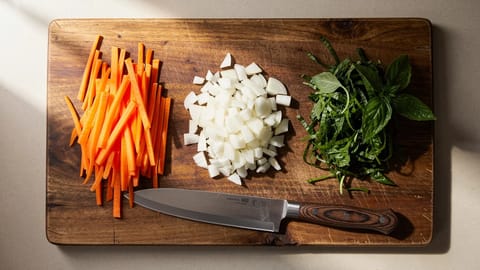
Onions are the exception to the julienne-first method, because their layers already do half the work:
A shallot is cut the same way at a smaller scale. This is the brunoise most home cooks actually use, since a fine, even onion or shallot brunoise is the base of vinaigrettes, tartare, salsas, and pan sauces.
Brunoise vs mince vs dice: what's the difference?
- Brunoise is a precise 3 mm cube. Every piece is the same size and shape.
- Mince is chopped as small as possible without measuring, so the pieces are irregular. Garlic and ginger are usually minced; the goal is to release flavor, not to look tidy.
- Dice is the umbrella term for cube cuts at any size, from 2 cm down. Brunoise is the smallest named dice.
A brunoise can always stand in for a mince. The reverse is not true when the pieces will be seen, because uneven minced onion in a clear consommé or a fresh salsa looks and cooks unevenly.
Brunoise vs mirepoix vs dice: what's the difference?
These get tangled because the same vegetables show up in all three. The distinction is size and destiny:
- Brunoise is a precise 3 mm cut that stays in the dish, seen and eaten.
- Mirepoix is a rough chop of onion, carrot, and celery, cut coarse because it's cooked down or strained out for background flavor.
- Dice is the umbrella term for cube cuts at any size, from 2 cm down.
A useful rule: if you'll notice the pieces on the plate, brunoise them; if they're there to give up flavor and disappear, a mirepoix chop is faster and fine. Cutting a mirepoix into perfect brunoise wastes twenty minutes on vegetables you're about to strain out.
When should you use a brunoise?
Reach for it when the little cubes are part of the finished dish and their size matters. Classic uses are the vegetable garnish floating in a clear consommé, a fine brunoise of shallot melted into a vinaigrette or sauce, tomato brunoise in a fresh salsa, and the aromatic base of a refined risotto or filling where you don't want to bite into a chunk of onion.
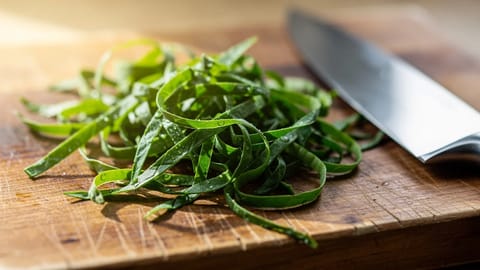
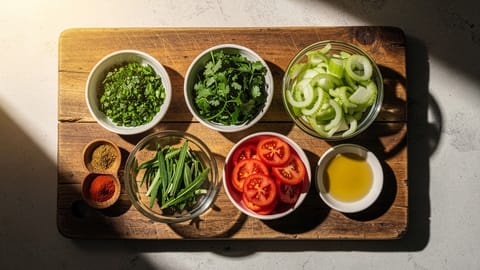
Skip it for anything rustic, long-braised, or blended; there, the extra precision cooks away invisibly. Brunoise is a member of the same knife-skill family as the chiffonade ribbon cut for herbs, and both belong to good mise en place: the calm, prepped station that makes the actual cooking feel easy. In Fond, recipe instructions call the cut by name and link the technique, so "brunoise the shallot" comes with the how, not just the what.