 Bastien
How to Scale a Recipe Up or Down
A practical guide to scaling any recipe for more or fewer servings. Covers the conversion factor method, ingredients that don't scale linearly (spices, leaveners, eggs), baking-specific rules, pan size adjustments, and common mistakes.
Last Thanksgiving, I volunteered to make my grandmother's mac and cheese for twenty people. The original recipe served six. I multiplied everything by 3.3, poured it into the biggest baking dish I owned, and pulled out a bubbling, beautiful disaster two hours later. The pasta was overcooked, the sauce was bland despite tripling the cheese, and the top was burnt while the center was still cold. The recipe wasn't wrong — my scaling was.
That failure taught me something every cookbook assumes you already know: scaling a recipe isn't just multiplication. Some ingredients don't scale linearly. Pan sizes change cooking dynamics. Spices and salt behave differently in large batches. Once I learned these rules, scaling became second nature.
TL;DR: To scale a recipe, divide your desired servings by the original to get a conversion factor, then multiply each ingredient. But not everything scales equally — salt, spices, and leaveners need adjustment. Use weight (grams) instead of volume for accuracy. Match your pan size to the new batch, and adjust cooking time based on depth, not quantity.
The conversion factor method
This is the foundation. Every recipe scaling calculation starts here.
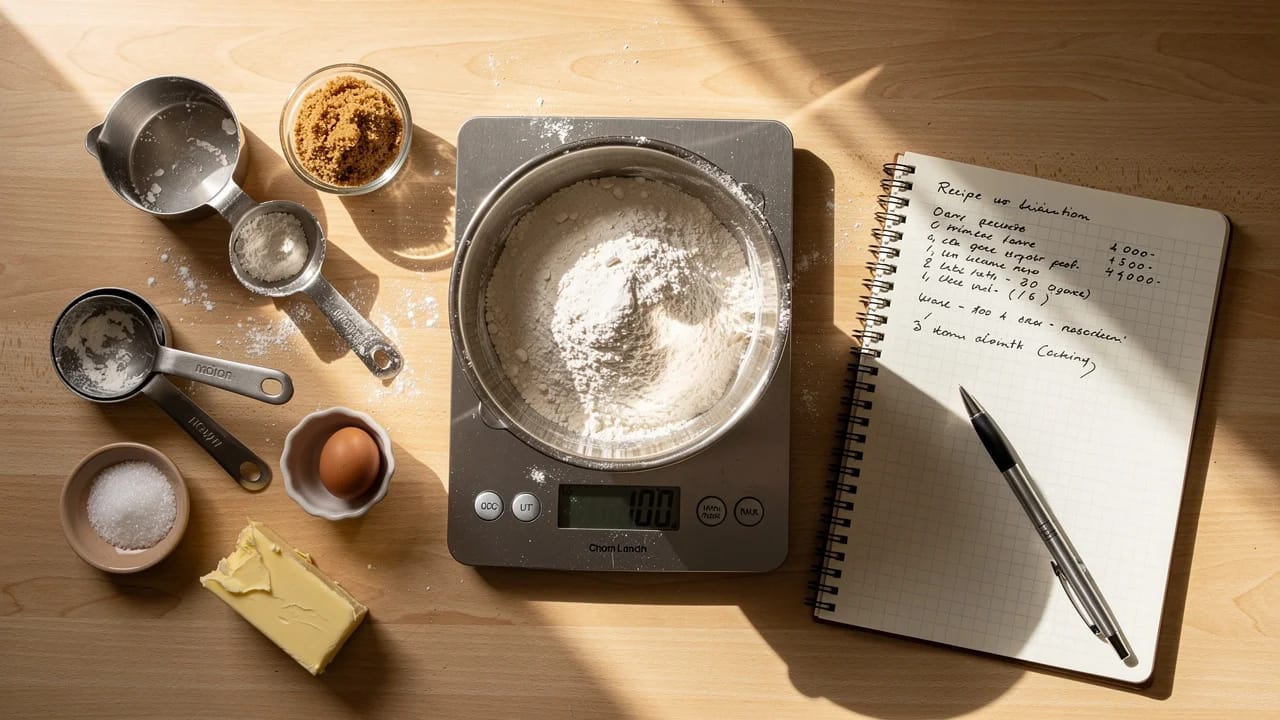
Tip: A kitchen scale makes this trivially easy. Scaling "3/4 cup plus 2 tablespoons" is painful; scaling "185 grams" is one multiplication.
What scales linearly (and what doesn't)
This is where most people get tripped up. Some ingredients behave predictably when scaled. Others don't.
Why spices and salt need adjustment
Flavor compounds in spices and salt distribute more efficiently in larger volumes. If you double a stew recipe and double the salt, it'll taste noticeably saltier than the original. The surface-to-volume ratio changes, concentration effects shift, and your taste buds don't scale linearly either.
My rule: scale salt and spices to 75% of the linear amount, cook, then taste and adjust. For a recipe that calls for 1 teaspoon of salt scaled to 3x, start with 2¼ teaspoons instead of 3.
Why leaveners are tricky
Baking powder and baking soda produce carbon dioxide gas that makes batters rise. Double the leavener and you don't get double the rise. You get an over-inflated batter that collapses, plus a metallic, bitter taste from excess sodium bicarbonate. Active dry yeast is more forgiving but still shouldn't be doubled blindly.
| Scaling factor | Baking powder/soda adjustment | Yeast adjustment |
|---|---|---|
| 0.5x (halving) | Use exactly 0.5x | Use exactly 0.5x |
| 2x (doubling) | Use 1.5-1.75x | Use 1.75x |
| 3x (tripling) | Use 2-2.5x | Use 2.5x |
| 4x+ | Use 2.5-3x, test first | Use 3x, extend rise time |
Scaling baking vs. cooking
Cooking is forgiving. Baking is chemistry. Treat them differently.
For baking, I strongly recommend converting everything to grams before scaling. A recipe that calls for "1 cup flour, 2 tablespoons sugar, 1/2 teaspoon baking powder" becomes "120 g, 25 g, 2.5 g." Those numbers multiply cleanly to any factor.
How to deal with eggs
Eggs are the most awkward ingredient to scale because you can't easily use half an egg.
Beat 2 eggs together until uniform. Weigh the mixture (about 100 g for 2 large eggs). Use 75 g (1.5 eggs worth). Save the rest for scrambled eggs tomorrow.
Use 1 egg plus 1 yolk. The extra yolk adds richness without the structural change of a full extra egg.
Switch to weighing. A large egg weighs about 50 g (without shell). Need 7.5 eggs? Crack 8 eggs, weigh out 375 g.
Scale whites and yolks independently. 1 white ≈ 30 g, 1 yolk ≈ 20 g.
Adjusting pan sizes
If you scale a recipe but keep the same pan, the food will be deeper. Deeper food cooks slower in the center and can overbrown on the outside. The reverse is true when scaling down.
The rule: match the depth of the original. If the original recipe fills a 9-inch round pan 2 inches deep, your scaled version should also be about 2 inches deep, in a different sized pan.
For round pans, area scales with the square of the diameter:
| Original pan | 1.5x recipe | 2x recipe | 0.5x recipe |
|---|---|---|---|
| 8" round | 10" round | 11" round | 6" round |
| 9" round | 11" round | 13" round | 6" round |
| 9×13" sheet | — | Two 9×13" pans | 8×8" square |
Tip: When in doubt, use the water test. Fill your original pan with water and measure the volume. Multiply by your conversion factor. Find a pan that holds that volume.
Scaling for a crowd
Going from 6 servings to 60 is a different challenge than going from 4 to 8. At large scales:
- Cook in batches rather than one giant pot. Four batches of a stew that you know works will beat one mega-batch every time.
- Reduce spices and salt to 50-60% of linear for large batches (10x+), then adjust.
- Use your shopping list. Scaling ingredient quantities is pointless if you forget to buy enough at the store.
- Add buffer: buy 10-15% more of key ingredients for safety.
- Consider meal prep logistics: do you have enough oven space, burners, and cooling racks for the scaled quantities?
I've learned that anything past 4x is better handled by repeating the original batch multiple times than trying to scale a single batch. The physics of heat transfer change at large volumes. A pot of soup that takes 30 minutes for 4 people doesn't take 30 minutes for 40.
Common halving and doubling reference
This table saves you from fraction math when scaling imperial measurements:
| Original | Halved | Doubled |
|---|---|---|
| 1 cup | ½ cup | 2 cups |
| ¾ cup | 6 tbsp | 1½ cups |
| ⅔ cup | ⅓ cup | 1⅓ cups |
| ½ cup | ¼ cup | 1 cup |
| ⅓ cup | 2 tbsp + 2 tsp | ⅔ cup |
| ¼ cup | 2 tbsp | ½ cup |
| 1 tbsp | 1½ tsp | 2 tbsp |
| 1 tsp | ½ tsp | 2 tsp |
| ½ tsp | ¼ tsp | 1 tsp |
| ¼ tsp | ⅛ tsp | ½ tsp |
Note: This is why metric is better. "Half of 185 grams" is 92.5 g. No chart needed.
Tips for scaling success
The most reliable approach I've found: make the recipe once at its original size. Note what works. Then scale with confidence, knowing what it should look and taste like at each step. Scaling a recipe you've never made is flying blind. You won't know if something went wrong because of the scaling or because of the recipe itself.
Frequently asked questions
Divide the number of servings you want by the number the recipe makes. That gives you the conversion factor. Multiply every ingredient by that number. For example, a recipe for 4 scaled to 6: 6 ÷ 4 = 1.5. Multiply all quantities by 1.5.
For most cooking recipes, yes. But some ingredients don't scale linearly. Salt and spices should be increased to about 1.5x when doubling, then adjusted to taste. Leaveners like baking powder need careful adjustment — too much creates a bitter, collapsed result.
Keep the oven temperature the same. If you use the same pan size but increase the recipe, add 10-15% more time and check for doneness early. If you use a larger pan with the same depth of batter, the time stays roughly the same since the depth hasn't changed.
Crack the egg into a bowl and beat it until uniform. Weigh the beaten egg (a large egg is about 50 g / 1.75 oz) and use half. Alternatively, use just the yolk for richness-focused recipes or just the white for structure-focused ones.
Weighing in grams is far easier and more accurate for scaling. With volume measures, you end up calculating fractions like 'half of 3/4 cup.' With a kitchen scale, you just multiply the gram weight by your conversion factor — no fraction math needed.
Salt, spices, and herbs should be scaled to about 75% of the linear amount when increasing, then adjusted to taste. Leavening agents (baking powder, baking soda, yeast) often need reduction — use about 60-75% of the linear amount for large batches. Fat for greasing pans doesn't scale at all.
Sources
Cook smarter
Join the waitlist for Fond. Recipes, meal plans, and a little AI sous-chef that learns how you cook.