 Bastien
What is recipe scaling? Definition and the scaling factor
Recipe scaling means multiplying or dividing every quantity in a recipe by one factor to change the number of servings. Most ingredients scale cleanly; seasoning, leavening, pan size, and cooking time need judgment.
Recipe scaling means changing every quantity in a recipe by the same factor so it makes more or fewer servings. "Scaling a recipe" is the general term; doubling and halving are the two versions most home cooks run into. The arithmetic is easy. The judgment is in knowing which ingredients, pans, and timings do not follow the arithmetic.
For a step-by-step walkthrough of doubling, halving, and adjusting pans and bake times, see how to scale a recipe up or down.
What does scaling a recipe mean?
It means multiplying (or dividing) each ingredient by one number, the scaling factor:
Scaling factor = servings you want ÷ servings the recipe makes
A recipe for 4 scaled to 6 has a factor of 6 ÷ 4 = 1.5. Multiply every ingredient by 1.5.
| Ingredient | Original (4 servings) | Scaled (6 servings) |
|---|---|---|
| Chicken breast | 600 g | 900 g |
| Olive oil | 2 tbsp | 3 tbsp |
| Garlic | 3 cloves | 4–5 cloves |
| Salt | 1 tsp | 1.5 tsp |
| Lemon juice | 2 tbsp | 3 tbsp |
That covers most ingredients in most recipes. The rest of this entry is about the exceptions. If you want a step-by-step walkthrough with a calculator, see the recipe scaling guide; this page explains the concept and the traps.
When doubling a recipe, do you double everything?
Main ingredients, yes: protein, vegetables, grains, pasta, and the liquid in a sauce that is meant to be eaten, all scale in full. A few categories deserve a lighter hand, and these are rules of thumb from practice rather than measured laws:
| Category | What happens | Practical adjustment |
|---|---|---|
| Salt, dried spices, dried herbs | Easy to overshoot; hard to remove | Start around 1.5× when doubling, taste, then add |
| Fresh herbs | Mild; little risk | Scale in full |
| Garlic, onion, chili | Aromatic intensity builds | Start around 1.5×, taste |
| Fat for sautéing | Only needs to coat the pan | Add enough for the pan, not the multiple |
| Leavening (baking powder, soda) | Excess tastes metallic and can make cakes rise fast then sink | Scale in full up to 2× if you weigh precisely; beyond 2×, bake a test batch |
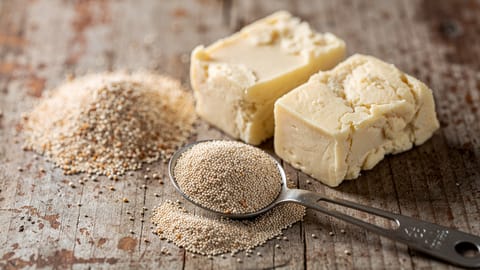
| Yeast | More yeast speeds fermentation | Keep the same baker's percentage of flour |
| Liquid for soups and braises | Depends on the pot, not the servings | Add enough to cover; do not just multiply |
| Eggs | You cannot use 1.5 eggs cleanly | Round to whole eggs, or weigh a beaten egg and use the fraction |
| Gelatin, pectin, cornstarch | Set relative to liquid volume | Follow the package ratio for the new liquid amount |
Seasoning conservatively is not because flavor "concentrates" in a bigger pot. It is because tasting and adding is cheap, and a doubled teaspoon of chili is a common mistake. Salt in baking is different: weigh it and scale it in full, since it affects structure as well as taste.
If you double a recipe, do you double the time?
No. Cooking time follows thickness and pot size, not weight.
| Scenario | Time adjustment |
|---|---|
| Doubled soup or stew, bigger pot | A little longer to come to temperature; same simmer time |
| Doubled casserole in a deeper dish | Longer, sometimes noticeably; check the center |
| Doubled casserole in a wider dish, same depth | About the same |
| Two sheet pans instead of one | A few minutes longer; rotate the pans |
| Halved recipe in a smaller pan | Slightly shorter |
| Thicker roast or loaf | Longer; use a thermometer |
Check doneness with an instant-read thermometer or the recipe's cues rather than the clock. A resized recipe is exactly the case where the original time no longer applies.
Can you double an 8×8 recipe for a 9×13?
Almost. An 8×8 inch pan is 64 square inches; a 9×13 is 117, about 1.8 times the area. Doubling a brownie or bar recipe into a 9×13 gives a slightly thicker layer, which needs a few more minutes. Scaling by 1.75× fills the larger pan to the same depth as the original. King Arthur Baking's guide to reducing recipes uses the same logic in reverse: match the pan area to the new batch size before you touch the ingredient list.
Round pans work the same way with πr². Two 8-inch rounds hold about the same batter as one 9×13.
Should you scale by weight or volume?
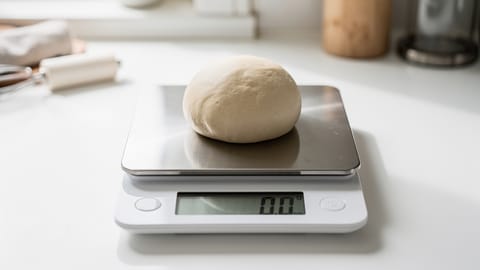
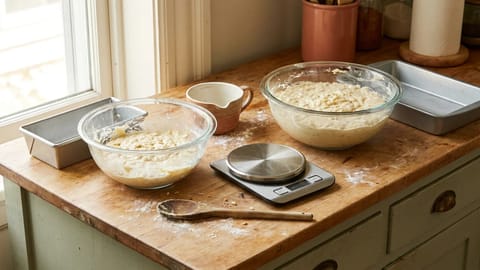
Weight. Halving 250 g is 125 g; halving "1 and 3/4 cups" is a fraction problem. A kitchen scale also removes the packing variability of cups, and King Arthur's ingredient weight chart gives gram equivalents when a recipe only lists volume.
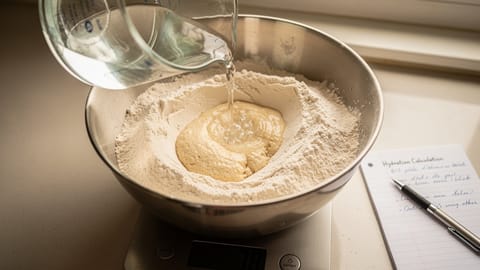
For bread and pastry, use baker's percentages: every ingredient is a percentage of flour weight, so any batch size is the same formula. A coffee brew ratio is the same idea applied to grounds and water.
Common scaling scenarios
Halving (scaling down)
Use 1 egg plus 1 yolk, or 2 small eggs. For baking, whisk one egg, weigh it, and use half the weight.
A kitchen scale that reads 0.1 g handles sub-teaspoon amounts; otherwise use quarter and eighth teaspoons.
Use a smaller pan so the food keeps its depth and searing contact. Empty pan space means scorched fond and steaming food.
A smaller volume in a wide pan evaporates faster, not slower. Reduce by eye and taste rather than by the original timing.
Doubling (scaling up)
Large batches (4× and up)
Beyond about double, home equipment becomes the limit. Ovens hold two sheet pans, stand mixers have a bowl capacity, and a very large pot heats and cools slowly, so the bottom can scorch before the middle is hot. Chemical leavening also gets less predictable in a deep, heavy batter. For meal prep at 4× or more, cooking the base recipe twice is usually more reliable than one giant batch.
Can you double a bread recipe?
Yes, and bread scales better than most baking because it is formula-based. Set your target number of dough balls and the weight per ball, then calculate flour and everything else from the baker's percentages. The baker's percentage calculator does that arithmetic in either direction.
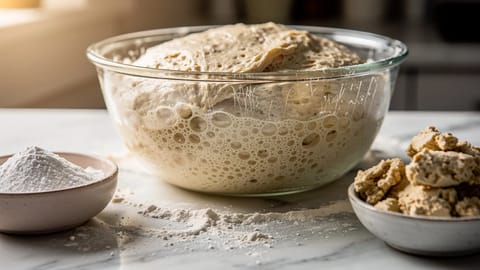
Two things change with a big dough: the mixer may not develop gluten as well when overloaded, and a large mass ferments faster in the middle because it holds its own heat. Judge fermentation by volume and feel rather than time.
Tips for scaling recipes successfully
- Scale by weight with a kitchen scale whenever the recipe allows it
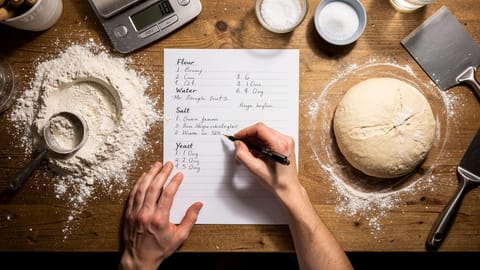
- Write down the scaled quantities before cooking; mental math mid-recipe is where mistakes happen
- Season in stages when scaling up, then taste at the end
- Match the pan to the new volume before you start
- Keep notes the first time you scale a recipe so the second time is automatic
- Read the recipe fully first so you spot eggs, leavening, and pan sizes in advance
Recipe scaling in Fond
Fond hasn't launched yet. This is how it will work at launch. Join the waitlist for early access.
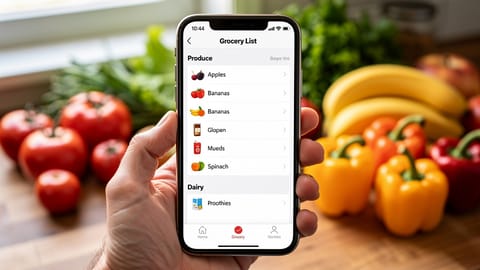
Change the servings on any recipe in Fond and the ingredient quantities rescale with it. When you generate a shopping list from your meal plan, the list uses the planned quantities and combines the same ingredient across recipes. For bread and pizza, the baker's percentage calculator handles dough weights; Fond does not convert between yeast types for you, so apply the conversion above yourself.