 Bastien
Dry Aging
Dry aging is storing whole cuts of beef uncovered at 1-3°C with controlled humidity and airflow for 21-60 days, so enzymes tenderize the meat while moisture loss concentrates its flavor.
Dry aging is the controlled storage of whole cuts of beef, uncovered, at 1-3°C and 75-85% humidity with constant airflow, for three weeks to two months or more. Two things happen in that chamber: the meat's own enzymes dismantle tough muscle proteins, and evaporation concentrates everything that makes beef taste like beef.
It's the technique behind the steakhouse price gap. A 30-day ribeye reads as beef with the volume turned up plus something nutty underneath, and the texture gives way like it had been marinated for a week. Nothing was added; that's the strange part. Things were only taken away.
What happens to meat during dry aging?
Three processes run in parallel. First, enzymatic breakdown: calpains and cathepsins, enzymes native to the muscle, keep working after slaughter and slowly cut the proteins that make meat chewy. This is where the tenderness comes from, and it's mostly complete by day 21. Second, dehydration: the cut loses 15-30% of its water, which concentrates the savory, umami-rich compounds left behind. Third, surface transformation: molds and yeasts colonize the drying rind, and fat slowly oxidizes, together contributing the nutty, aged-cheese notes that define the style.
The rind, called the pellicle, takes the hit for the meat underneath. It's trimmed off completely before the loin is cut into steaks, which is part of why the process is expensive. The rest of the enzyme-and-heat science applies at the stove, but by then the aging has done its work.
How long should beef dry age?
| Days | What you get |
|---|---|
| 14-21 | Most of the tenderness gain, mild flavor change |
| 28-35 | The steakhouse standard: nutty, concentrated, deeply beefy |
| 45-60 | Pronounced funk, dried mushroom and aged cheese notes |
| 90+ | Blue-cheese territory, an acquired taste and priced like one |
The curve isn't linear. Tenderness plateaus early; flavor keeps compounding as long as moisture keeps leaving. America's Test Kitchen aged subprimals at 1°C (34°F) and 76 percent humidity for two to eight weeks and found the same shape: barely a change at two weeks, "melt-in-your-mouth" at four, nutty and funky at six, and blue-cheese aromas with no extra tenderness at eight. A 60-day steak isn't twice as good as a 30-day one, it's twice as funky, which is a different claim. For most palates the ceiling sits around 45 days; past that, the cheese board is a separate course.
Dry aging vs wet aging: what's the difference?
Most supermarket beef is wet aged: vacuum-sealed in its own juices for 1-3 weeks while the same enzymes tenderize it. It works, costs almost nothing, and loses no weight, which is why it's the industry default.
What wet aging can't do is concentrate. No evaporation means no intensified flavor, and the anaerobic bag adds faintly sour, metallic notes instead of nutty ones. Dry aging is curing's close cousin in spirit (controlled decay in service of flavor) though curing works with salt while dry aging works with time and air. If the label doesn't say "dry aged," it wasn't.
Can you dry age beef at home?
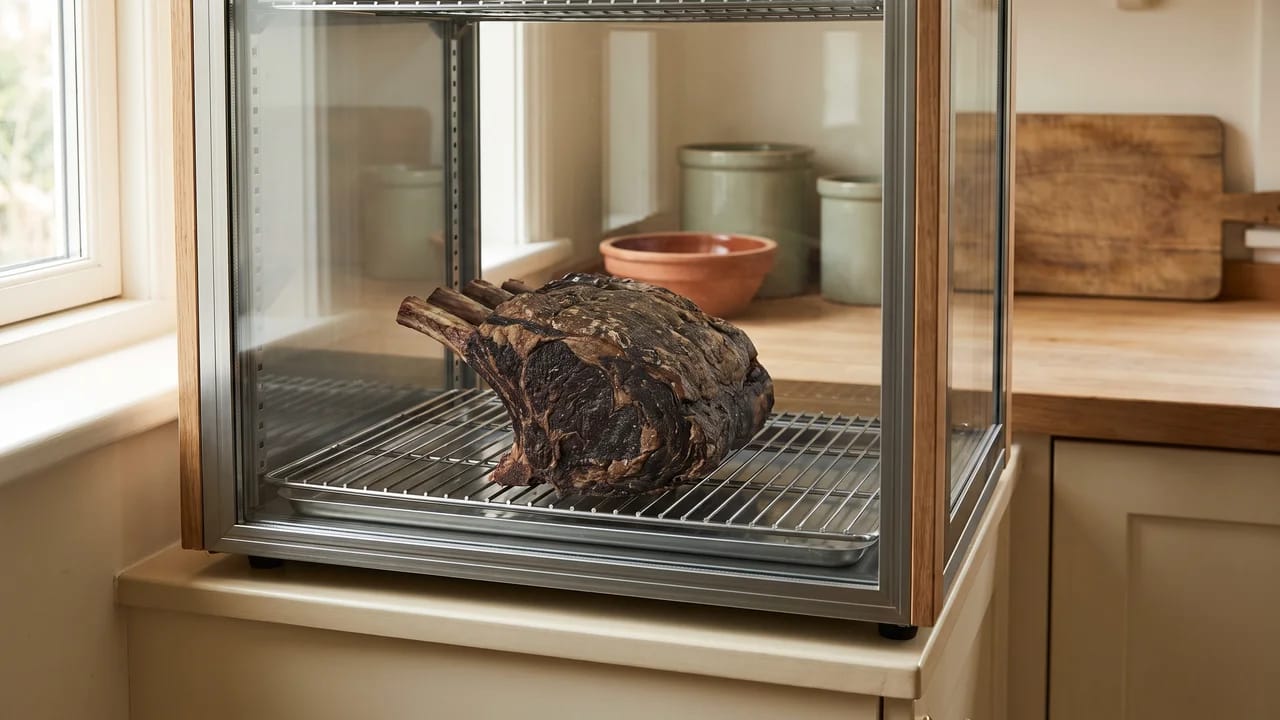
Yes, and the honest version has rules. The workable setups are a dedicated mini-fridge with a small computer fan for airflow, or UMAi-style moisture-permeable bags that let a subprimal dry inside a normal fridge without absorbing its smells. Either way the raw material is a whole bone-in subprimal, 3-4 kg minimum, fat cap intact; the bone and fat are the armor that gets sacrificed.
Dry aged beef in a regular fridge: what you actually get
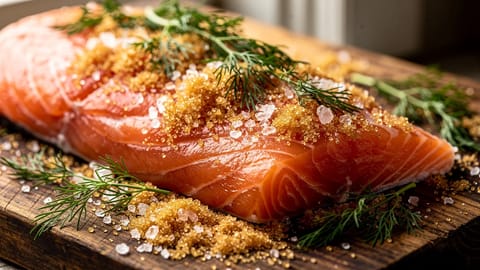
The internet's favorite shortcut, salting a single steak and leaving it on a rack for three days, is not dry aging. It's a light cure plus dehydration: pleasant, but a thin steak has no rind to trim, so real aging would eat the whole thing. America's Test Kitchen tested the honest version of this, thick steaks wrapped loosely in cheesecloth on a rack for four days in a home fridge, and found it gave a drier surface, a denser texture, and a more concentrated flavor, but not the nutty, aged character of a true 30-day subprimal. Call it a four-day surface dry, not dry aging. For actual aging, think in months and kilos, not days and portions.
How do you cook a dry-aged steak?
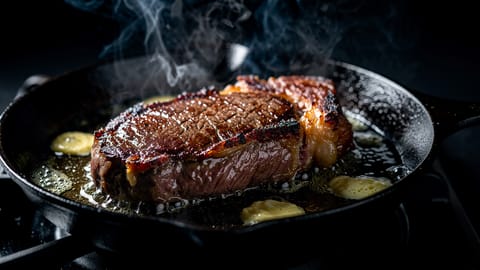
Gently, and less than you think. Aged meat has lost water, so it cooks 20-30% faster than fresh and overshoots easily; a medium-rare target deserves a thermometer and an early pull. The drier surface is a gift for browning: it sears faster and crustier than fresh meat, so a shorter time in the pan buys the same crust.
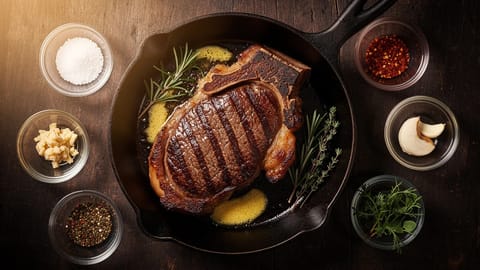
Keep the seasoning at salt and pepper. You paid for 30 days of flavor development; a marinade would argue with it. For thick aged steaks the reverse sear is the safest route: warm the steak through in a 120°C oven to about 46°C at the core, then blast the crust in a screaming pan for a minute per side. The dry surface makes that final sear almost unfairly easy. And serve it closer to rare-plus than you'd dare with supermarket steak. In Fond's cook mode, dropping the pull temperature a few degrees for an aged cut is exactly the kind of note worth saving on the recipe.