 Bastien
The chemical reactions behind everyday cooking
Cooking runs on a short list of chemical reactions: Maillard browning, caramelization, protein denaturation, starch gelatinization, emulsification and fermentation. This food science guide charts each one against the temperature where it gets going, explains which kitchen changes are chemical and which are only physical, and sorts the reliable cooking rules from the myths.
TL;DR: Cooking runs on a short list of chemical reactions. Maillard browning, caramelization, protein denaturation, starch gelatinization and emulsification account for most of what separates a raw ingredient from dinner. The chart below pairs each one with the temperature where it gets going and a dish where you have already tasted it.
Most cooking advice is a rule with the reason stripped out. Pat the steak dry. Don't crowd the pan. Take the sauce off the heat before the butter goes in. Salt the beans early. Every one of those is a chemical reaction wearing a disguise, and knowing which reaction a rule protects tells you when the rule applies and when you can ignore it.
This isn't a molecular gastronomy guide. No liquid nitrogen, no agar gels. Just the food science that explains why a roast chicken tastes like roast chicken.
Chemical reactions in cooking: the full chart
The reference for what's happening inside your food at each temperature. Use it to diagnose a problem (why isn't it browning?), set a target (what temp do I need?), or work out what a recipe is really asking for.
| Reaction | Type | Temperature | What happens | Example dishes |
|---|---|---|---|---|
| Maillard reaction | Browning chemistry | Fast above 140°C / 285°F | Amino acids + reducing sugars → hundreds of new flavor compounds | Seared steak, toast, roasted coffee |
| Caramelization | Sugar breakdown | 160°C / 320°F (sucrose) | Sugar breaks into diacetyl, maltol, furanones | Crème brûlée, caramel sauce, dulce de leche |
| Fructose browning | Sugar breakdown | 110°C / 230°F | Browns at a lower temperature than sucrose | Honey roasted nuts, fruit jams |
| Protein denaturation (egg white) | Coagulation | 62-65°C / 144-149°F | Ovalbumin unfolds and bonds, white sets | Soft-boiled eggs, custards |
| Protein denaturation (chicken) | Coagulation | 68-73°C / 154-163°F | Muscle proteins firm up and the meat reads cooked | Roast chicken breast |
| Collagen-to-gelatin | Hydrolysis | 56-70°C / 133-158°F sustained | Tough connective tissue dissolves into silky gelatin | Braised short ribs, pulled pork |
| Starch gelatinization | Water absorption | 60-80°C / 140-176°F | Starch granules swell and burst, thickening liquid | Pan sauces, gravy, risotto |
| Pectin breakdown | Cell-wall softening | 85°C / 185°F+ | Plant cell walls soften, fruit and vegetables turn tender | Apple sauce, jam set |
| Emulsification | Physical dispersion | Any (cool to warm) | Fat droplets suspended in water by an emulsifier | Mayonnaise, vinaigrette, hollandaise |
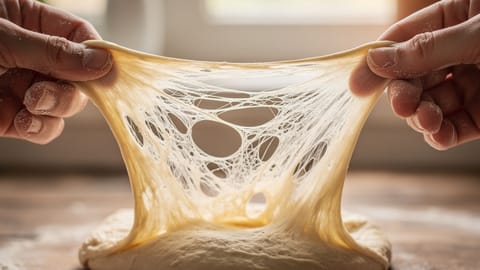
| Gluten development | Protein hydration | Room temp | Glutenin + gliadin + water form elastic network | Bread dough, pizza dough, pasta |
| Yeast fermentation | Microbial | 24-32°C / 75-90°F (peak) | Yeast eats sugars, produces CO₂ + ethanol | Bread, pizza dough, beer |
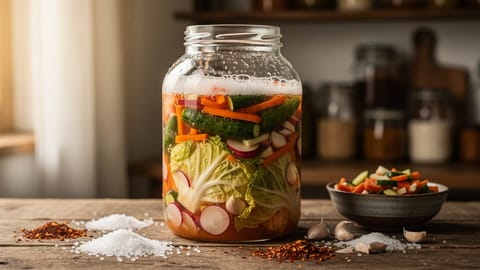
| Lacto-fermentation | Microbial | 18-22°C / 65-72°F | Lactobacillus produces lactic acid, preserves food | Sauerkraut, kimchi, sourdough starter |
| Water boiling | Phase change | 100°C / 212°F (sea level) | Liquid → vapor; surface temp capped while wet | Pasta, blanching, poaching |
| Fat smoke point | Lipid breakdown | 160-260°C (varies by oil) | Oil decomposes, releases acrid compounds | Stir-fry, deep-fry, searing |
| Carryover cooking | Residual heat | Above ambient | Internal temp rises 3-8°C after heat removed | Resting steak, finishing fish |
Which of these are actually chemical reactions?
Not all of them, and the distinction is more useful than it sounds.
A chemical reaction rearranges molecules into different ones, and you can't undo it by changing the temperature back. Maillard browning, caramelization, protein denaturation and fermentation all belong here. The steak that browned is not going to un-brown.
A physical change moves molecules around without rebuilding them. Water boiling is physical: the H₂O leaving your pasta pot as steam is still H₂O, and it condenses back into water on the lid. Emulsification is physical too. Oil droplets get broken small and held apart, but no oil molecule turns into anything else, which is exactly why a broken mayonnaise can be put back together.
Starch gelatinization sits between the two. Granules absorb water and swell, which is physical, but the starch also partly breaks down into shorter chains, which is chemical. Cook pasta and you can't see any of it happening, since the starch hydrolysis that releases glucose produces no color change at all.
The reason this matters: reversible problems and irreversible ones need different responses. A sauce that has separated is a physics problem and you can whisk it back. A sauce that has scorched is a chemistry problem and the only fix is a new sauce.
The Maillard reaction
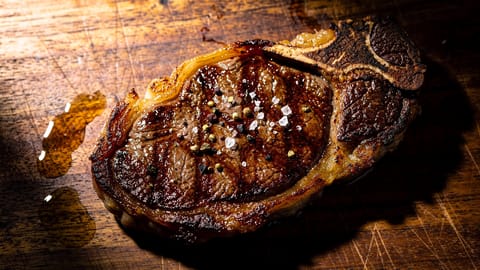
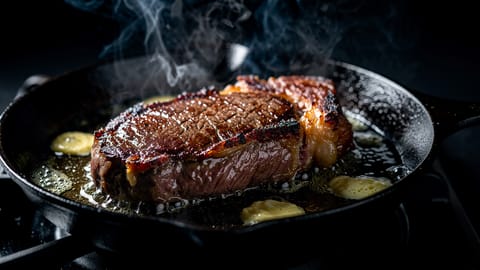
If you only learn one thing from food science, make it this. The Maillard reaction is the chemistry behind the brown crust on a seared steak, the golden top of bread, the smell of roasting coffee, the crisp skin on roast chicken. If it's brown and it smells good, Maillard is usually involved.
Amino acids from proteins react with reducing sugars, producing hundreds of new compounds. Melanoidins give the brown color, pyrazines add the nutty roasted aromas, furanones bring caramel-like notes.
What the 140°C figure really means
Nearly every source, this one included, puts the Maillard reaction "above 140°C." Useful number, slightly misleading framing. It marks the point where the reaction gets fast enough to see.
The chemistry itself runs at almost any temperature. A 2025 review in Foods collects the evidence: Maillard markers keep accumulating in food stored at 4°C over a year, and glycation products have been measured in meatballs held at −18°C for months. What heat changes is the rate, by orders of magnitude. Around 140°C the aroma compounds that read as "roasted," the pyrazines especially, start showing up in quantity.
So read 140°C as the temperature your pan surface needs to reach for browning to happen on a dinner timescale rather than a storage-cupboard one.
Getting it right in practice
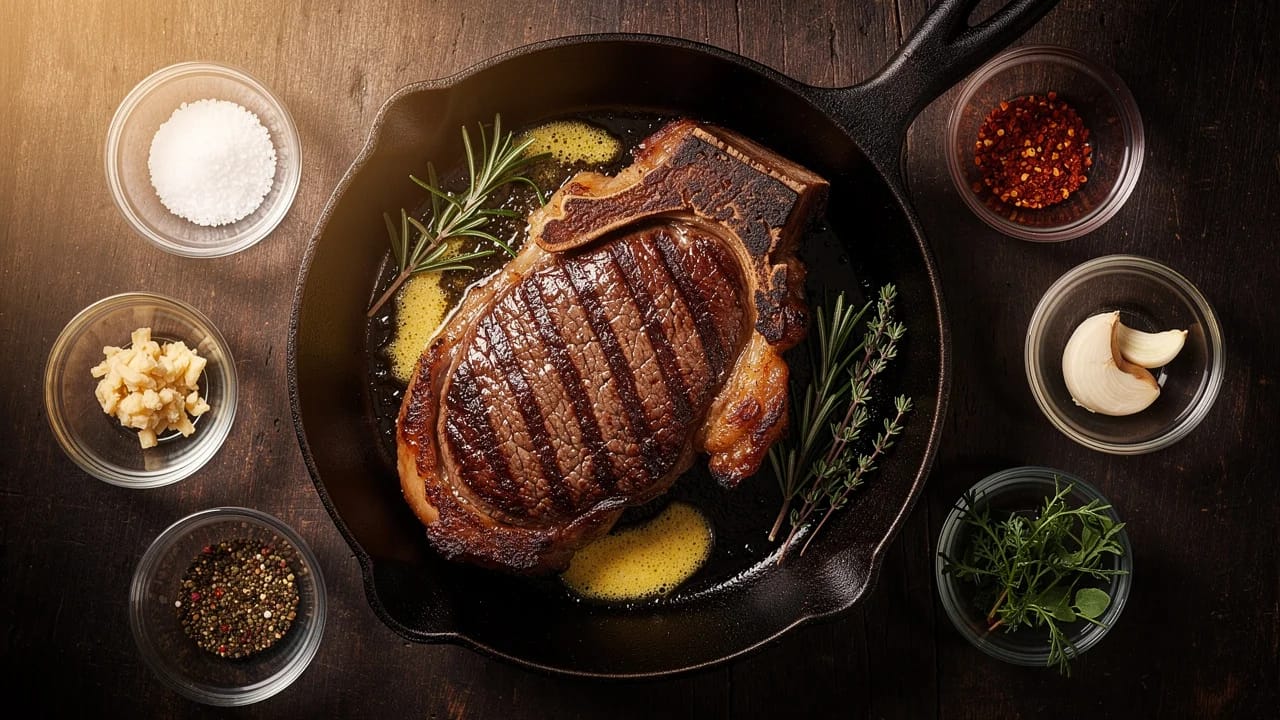
The reaction needs heat, amino acids and sugars present, and a dry surface. That last one trips people up. When you sear a wet steak, the surface stays near 100°C because the water has to boil off first. Water can't get hotter than its boiling point while it's still water, so you get steam instead of browning, and the pan works on evaporation until the surface finally dries.
That's the whole argument for patting proteins dry, and for not crowding the pan: too much food at once floods the surface with released moisture and drops the pan below browning temperature.
Tip: For better roasting, leave proteins uncovered in the fridge for a few hours before cooking. Dry surface, faster browning.
Where to stop
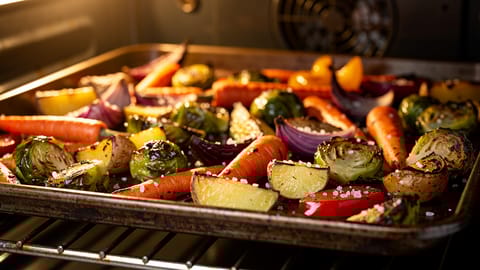
Browning has a ceiling worth knowing about. In starchy foods heated hard and dry, the same reaction that makes potatoes taste good also produces acrylamide, formed from asparagine and sugars at high temperatures. The National Cancer Institute notes that levels vary widely with cooking time, method and temperature, and that avoiding heavy crisping lowers them. Golden is the target for roast potatoes and toast. Dark brown is past it.
The baking soda trick
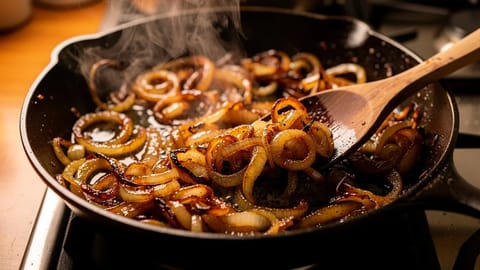
The reaction speeds up in alkaline conditions. Pretzels get dipped in a lye solution before baking, which is why they brown so hard and so fast. The same principle works at home: a pinch of baking soda in a pan of onions gets you dark, jammy caramelized onions noticeably faster than the same pan without it. Use a small pinch. Too much and the onions turn slippery and taste soapy.
Caramelization: different from Maillard
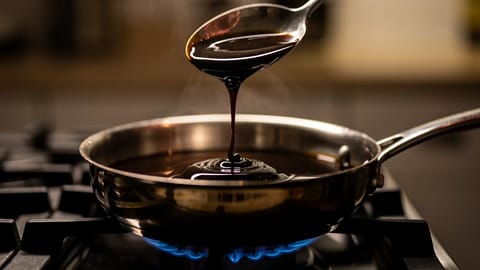
"Caramelization" gets thrown around loosely, but it's specific: the thermal decomposition of sugars with no proteins involved. Sucrose starts caramelizing around 160°C. Fructose goes lower, around 110°C. Glucose sits near 150°C, which is why an onion, rich in fructose and glucose, browns well before pure table sugar would.
As sugar heats it breaks into diacetyl (buttery), maltol (toasty) and furanones (caramel). Go further and bitter compounds appear. Go further still and you get carbon, which is the failure mode behind most ruined pan sauces: the sugars in the reduction pass caramelization and head into pyrolysis while you're looking at something else.
Emulsification: oil meets water
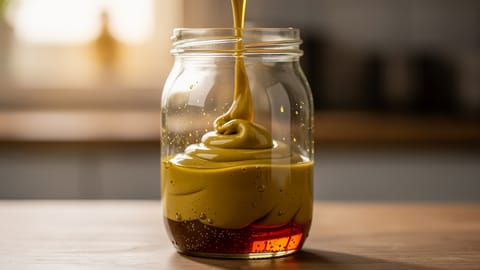
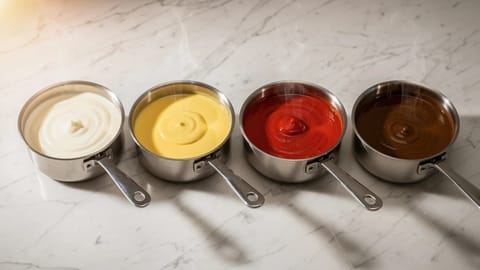
Oil and water separate, unless you force them together with an emulsifier and enough energy. Vinaigrettes, mayonnaise, hollandaise and cream sauces are all emulsions.
The emulsifier sits at the boundary. Lecithin in egg yolks is the textbook example. One end of the molecule likes water, the other likes fat, and it holds tiny oil droplets suspended in the water phase so they can't merge back together.
When emulsions break
Fat droplets merge (coalescence is the technical term) and the sauce separates. Three common causes:
- Temperature shock: cold butter into a screaming-hot reduction, or hollandaise left on the heat too long
- Too much fat: mayonnaise absorbs a surprising amount of oil, but there's a ceiling
- Not enough whisking: bigger droplets are less stable, so they need breaking down small
Because none of this is a chemical change, a broken mayonnaise is recoverable. Put a fresh yolk in a clean bowl and whisk the broken mixture in a tablespoon at a time. The new emulsifier grabs the separated oil and water and pulls the whole thing back together.
Tip: A teaspoon of Dijon mustard in your vinaigrette does more than add flavor. Mustard carries natural emulsifiers that help keep the dressing from separating in the fridge.
How heat moves into food
Why does a 200°C oven take an hour to cook a roast when 100°C water cooks pasta in 10 minutes? Heat transfer.
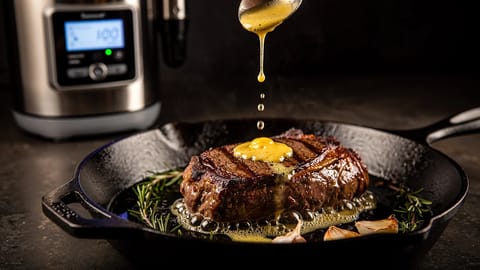
Conduction is contact. Steak on cast iron, heat flows metal to meat. Cast iron works well for searing because it holds a lot of thermal energy and doesn't crash in temperature when cold food lands on it.
Convection moves heat through a fluid, liquid or gas. Hot air circulating in your oven, currents in boiling water. Fan-assisted ovens force the air to move faster, which is why they cook quicker at the same setting.
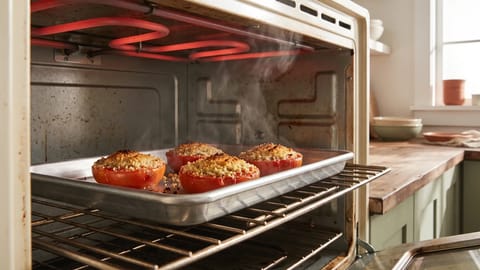
Radiation needs no medium at all. Your oven's broiler sends infrared straight from element to food. That's why it browns the top and leaves the sides alone.
Why sous vide is a different game
Sous vide is conduction through water at low temperatures, usually 50-65°C for proteins. Water carries heat into food far better than air does; Douglas Baldwin puts water's thermal conductivity at about 23 times that of air. Food reaches the target temperature and then just sits there. No overcooked edges, no grey gradient around a pink center. The physics does the hard work while you wait. The practical side, meaning the equipment, the time and temperature charts, and what pasteurizing at 60°C actually requires, is covered in the sous vide beginner's guide.
Protein denaturation: what "cooking" actually means
Proteins are long amino acid chains folded into 3D shapes. Heat unfolds them (denaturation). The unfolded chains then bond to each other (coagulation), building new, firmer structures.
Egg white is close to 90% water and about 10% protein. At 62°C ovalbumin starts denaturing. By 80°C you have a firm, opaque solid. Those 18°C separate a silky soft-boiled egg from a bouncy rubber ball, and temperature precision matters more here than almost anywhere else in cooking.
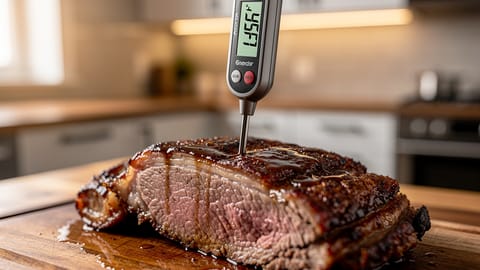
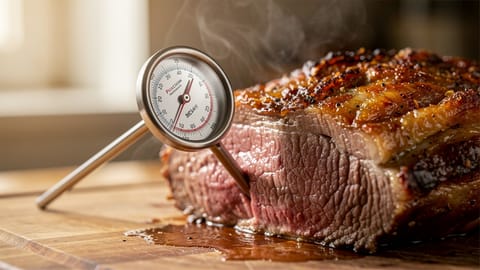
Texture and safety are two different questions, and this table answers only the first one. Chicken tastes best somewhere in the high 60s, but the number to verify with a thermometer before serving is 74°C, which is the target the food danger zone guide explains in full. Pull the bird a little early and let carryover cooking close the last few degrees, since internal temperature keeps climbing 3-8°C after the heat comes off.
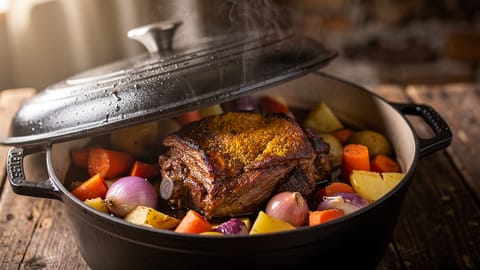
This is also why braising works on tough cuts. Chuck and short ribs are full of collagen. Hold them above 70°C long enough and that collagen converts to gelatin, which is what gives braised meat its silky, fall-apart quality. You can't rush it. The collagen doesn't care how high you crank the heat; it needs sustained time at temperature.
Fermentation: microbes doing the work
Fermentation is microorganisms converting sugars into other things: alcohol, CO₂, organic acids. It gave us bread, beer, cheese, yogurt, sauerkraut and kimchi, and humans worked it out thousands of years before anyone knew what a bacterium was.
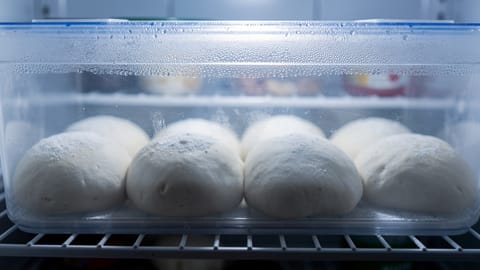
In bread, yeast (Saccharomyces cerevisiae) eats sugars and produces CO₂ and ethanol. The CO₂ gets trapped in the gluten network and makes the dough rise. The ethanol and organic acids build flavor, which is why a 72-hour cold-fermented pizza dough has so much more going on than a same-day batch.
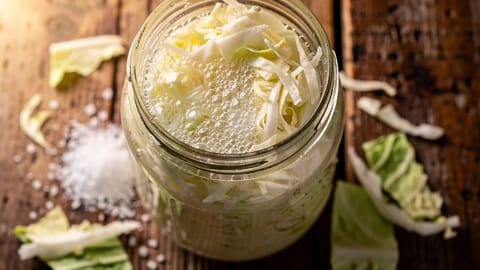
Lacto-fermentation takes a different path. Lactobacillus bacteria turn sugars into lactic acid, which preserves the food and gives sauerkraut and kimchi their tang. Our fermentation for beginners guide covers the full process if you want to try it.
Temperature changes everything
As a rough rule of thumb, yeast activity roughly doubles for each 10°C step up inside its working range. At fridge temperature, around 4°C, yeast barely moves, which is why cold fermentation takes days. The slow pace also produces a different mix of metabolic byproducts, and those byproducts are where the complex flavors come from.
Note: Professional bakers and pizza makers lean heavily on cold fermentation for this reason. The extra time lets enzymes break down starches and proteins, building flavor a quick rise can't replicate.
Flavor and taste
Five basic tastes: sweet, salty, sour, bitter, umami. But flavor involves a lot more than what hits your tongue. Aroma does most of the heavy lifting, and blocking your nose while tasting wine is a humbling demonstration of that. Texture, temperature and even sound play a part. The crunch of a chip belongs to the experience.
Umami is worth understanding on its own. It's the savory, mouth-coating sensation from glutamate and nucleotides. Parmesan, soy sauce, mushrooms, ripe tomatoes, aged meat, with wide gaps between them once you look at the actual glutamate figures. When mother sauces taste deeply satisfying, it's often because they've concentrated glutamate-rich ingredients over hours of cooking.
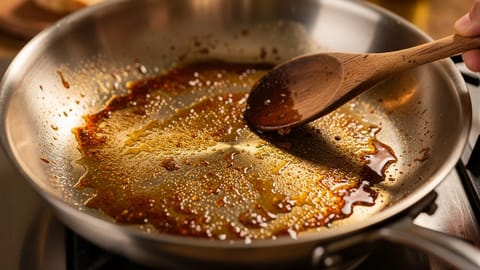
The fond at the bottom of your pan after searing is concentrated Maillard products and umami compounds. Deglaze, scrape that up into a sauce, and you're using some of the most flavorful material in your kitchen. Don't waste it.
Five myths that science has debunked
On that alcohol figure, the USDA Table of Nutrient Retention Factors is specific about it. Stir wine into a hot liquid and 85% of the alcohol is still there. Flame it and 75% remains. Bake or simmer it for 15 minutes and you're down to 40%, at one hour 25%, and only after two and a half hours does it fall to 5%. Splashing wine into a pan sauce removes very little.
Using this in practice
None of this requires a lab. A few habits put the science to work:
Dry your proteins before they hit the pan. Surface moisture delays browning. Paper towels work; salting and leaving uncovered in the fridge works better.
Match your heat to your goal. High for Maillard browning, low and long for collagen conversion. When you're unsure, ask which reaction you're trying to run.
When a dish tastes flat, work out which flavor axis is missing. Usually it's acid (lemon, vinegar), salt, or umami (soy sauce, fish sauce, a bit of parmesan). A splash of something can rescue a whole pot.
Get an instant-read thermometer. Temperature is the most objective measurement you have in the kitchen, and guessing at protein doneness is a losing game.
Deglaze your pans. That fond is free flavor. Wine, stock, even plain water. Scrape, reduce, taste, and you've got a pan sauce in two minutes.
Sources
- Maillard Reaction: Mechanism, Influencing Parameters, Advantages, Disadvantages, and Food Industrial Applications: A Review — Foods (2025)
- Science & Cooking Public Lecture Series — Harvard John A. Paulson School of Engineering and Applied Sciences
- A Practical Guide to Sous Vide Cooking — Douglas Baldwin
- Table of Nutrient Retention Factors, Release 6 — USDA Agricultural Research Service
- Acrylamide and Cancer Risk — National Cancer Institute