 Bastien
Baking powder substitute: what to use for 1 teaspoon
The closest baking powder substitute is 1/4 teaspoon of baking soda plus 1/2 teaspoon of cream of tartar for each teaspoon of baking powder. Lemon juice or buttermilk can take the place of the cream of tartar, and self-rising flour or whipped egg whites can lift some recipes with no baking soda at all.
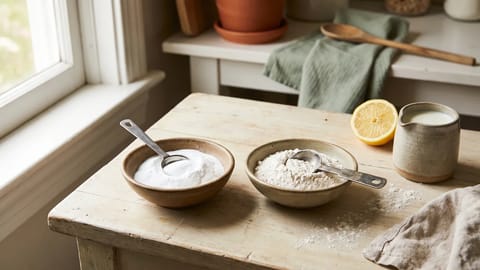
Out of baking powder with the batter half made? For each teaspoon of baking powder, use 1/4 teaspoon of baking soda plus 1/2 teaspoon of cream of tartar. King Arthur Baking and University of Illinois Extension give the same ratio, and it's the closest match because it rebuilds baking powder from its own parts. No cream of tartar? King Arthur swaps in 1/2 teaspoon of lemon juice or white vinegar with the same 1/4 teaspoon of soda.
Whichever you use, get the pan into the oven as soon as the batter is mixed. The other options below depend on what's in your pantry and what you're baking.
Why these substitutes work
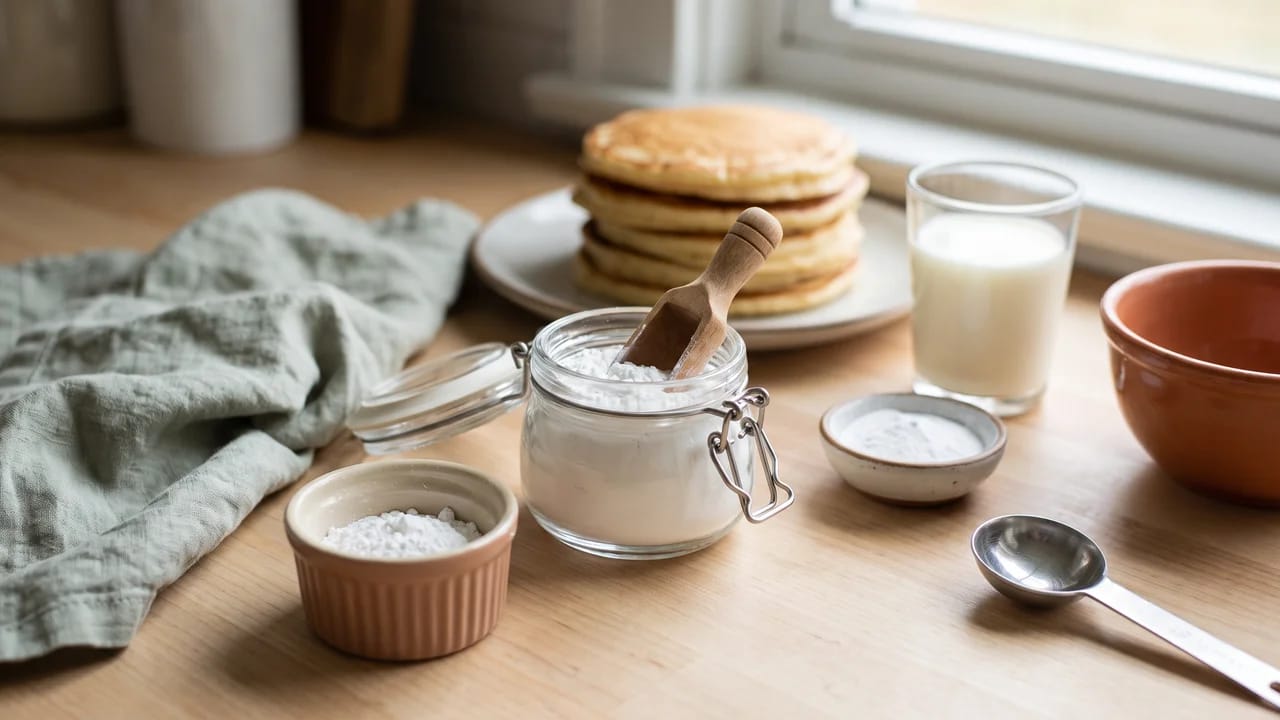
Baking powder is a chemical leavener sold ready-mixed. Wikipedia describes it as a carbonate or bicarbonate plus a weak acid, kept from reacting early by a desiccant such as cornstarch. Once the batter is wet, the acid and the base react and release carbon dioxide, and those bubbles expand in the oven.
A substitute has to do one of two jobs. Either it rebuilds that acid-base reaction from baking soda and an acid you have, or it gets gas into the batter by another route. Baking soda is roughly three to four times stronger than baking powder, which is why the soda amounts below are so small. The chemistry, and the reverse swap, are in the guide to baking soda vs baking powder.
What can I substitute for 1 teaspoon of baking powder?
| Substitute | For 1 tsp baking powder | Best in | Watch for |
|---|---|---|---|
| Baking soda + cream of tartar | 1/4 tsp + 1/2 tsp | Any batter or dough | Reacts at once; bake straightaway |
| Baking soda + lemon juice or vinegar | 1/4 tsp + 1/2 tsp | Recipes that use only a little baking powder | Sour note can come through |
| Baking soda + buttermilk | 1/4 tsp + 1/2 cup buttermilk | Batters with milk you can swap out | Take the same volume out of the other liquid |
| Self-rising flour | Use instead of the all-purpose flour | Recipes with about 1/2 to 1 tsp baking powder per cup of flour | Salt is already in; softer crumb |
| Whipped egg whites | No fixed ratio | Pancakes, sponge-style cakes | Fold gently and cook at once |
Baking soda and cream of tartar
This is homemade baking powder. Cream of tartar is a dry acid, so it plays the part of the acid in the tin, and the 1/4 teaspoon of soda supplies the base. Illinois Extension is candid that the substitute "won't be perfect." It's still the cleanest swap, because it adds no extra liquid.
The catch is speed. Cream of tartar is one of the fast, low-temperature acids, according to Wikipedia, so the mix gives off its gas as soon as it's wet. Supermarket baking powder is usually double-acting and saves part of its lift for the oven. Yours won't. Add the leavener with the dry ingredients and bake as soon as the batter comes together.
Baking soda and lemon juice or white vinegar
King Arthur's second option uses 1/2 teaspoon of lemon juice or white vinegar with 1/4 teaspoon of baking soda. Whisk the soda into the dry ingredients and add the acid with the wet ones, so the reaction starts only when the two meet.
Unlike cream of tartar, lemon juice and vinegar have a taste of their own. Betty Crocker recommends the vinegar version only when a recipe calls for a small amount of baking powder, because the vinegar's sourness can come through, and points the lemon version at lemony or tart bakes.
Baking soda and buttermilk
If the recipe has milk or water you can trade, buttermilk can supply the acid. Utah State University Extension lists 1/4 teaspoon of baking soda plus 1/2 cup of buttermilk or fully soured milk as the equivalent of 1 teaspoon of baking powder. That half cup is extra liquid, so Betty Crocker says to reduce the other liquids to match. In practice, replace 1/2 cup of the recipe's milk with buttermilk and add the soda to the dry ingredients.
What if the recipe already contains buttermilk? Count it: each 1/2 cup can carry 1/4 teaspoon of soda. The exception is a recipe that already uses baking soda. That soda is working on the buttermilk's acid, and Illinois Extension explains that recipes add baking powder on top when there isn't enough acid for the rise they need. More soda there has nothing left to react with, and leftover soda is what gives a bake its soapy taste.
Self-rising flour
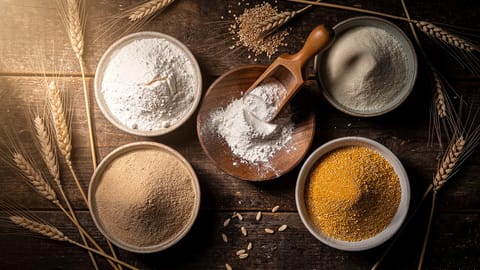
Self-rising flour already contains baking powder and salt. King Arthur's self-rising guide says it works in place of all-purpose flour in recipes that use about 1/2 teaspoon, and up to 1 teaspoon, of baking powder per cup of flour. Swap the flour cup for cup and leave out the recipe's baking powder and salt. If the recipe also calls for baking soda, keep the soda.
Two caveats. A recipe with more than about 1 teaspoon of baking powder per cup will come up a little short on lift, since King Arthur's fix is to add the missing baking powder, which is the one thing you don't have. And the crumb changes: King Arthur puts its self-rising flour at 8.5% protein against 11.7% for its all-purpose, and its self-rising cookies spread more. The types of flour guide has the blend for making your own self-rising flour once you've restocked.
Whipped egg whites
Beaten egg whites leaven by trapping air, with no chemistry involved. In sponge cakes, Wikipedia notes, the egg protein matrix from vigorous whipping provides almost all the structure. Baker Bettie makes pancakes this way with no baking powder at all: whip the whites, stir about a quarter of them into the batter to loosen it, fold in the rest gently, and cook right away before the foam wilts.
This route suits loose batters that already contain eggs. A stiff biscuit or cookie dough is a poor match, since working a meringue into it would knock out much of the air. There's no teaspoon equivalent either, so separate the eggs the recipe already calls for. Baking without eggs as well? The egg substitutes guide covers aquafaba, which whips in place of egg white.
What doesn't work as a baking powder substitute
Baking soda on its own
Using baking soda in the same amount as baking powder is the classic mistake. Soda is several times stronger and needs an acid, and without enough acid it leaves a bitter, soapy taste. Use a quarter of the amount and add an acid, as above. What goes wrong, and why, is covered in baking soda vs baking powder.
Yeast
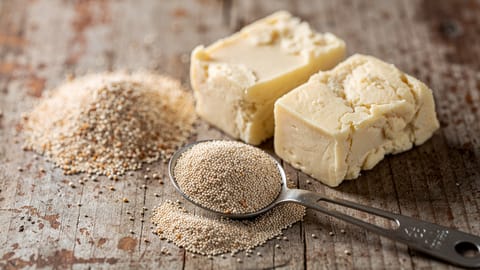
Yeast is alive, and it runs on a different clock. It needs time to ferment before a dough rises, and that waiting is exactly what quick breads are designed to skip. King Arthur notes that baking soda gives quick breads shape and a soft crumb without having to rise for a long time like yeasted bread, and Wikipedia's leavening agent entry says chemical leaveners are used where a long biological fermentation is impractical or undesirable.
So yeast can't drop into a cake or muffin batter in place of baking powder. Switching means a different recipe with a rising period. If you want to work with yeast anyway, yeast types explains how the forms differ.
Cornstarch
Cornstarch is in baking powder, but not as a leavener. Wikipedia describes the starch as a desiccant whose main job is to absorb moisture, keeping the acid and the base dry so they don't react in the tin. On its own it has nothing to react with, so it adds no lift. Its real job in the kitchen is thickening, and if that's what you're out of, the cornstarch substitutes guide covers the swaps.
Homemade baking powder to keep in a jar
If you run out often, mix a small batch. King Arthur's recipe for one teaspoon is 1/4 teaspoon of baking soda, 1/2 teaspoon of cream of tartar and 1/4 teaspoon of cornstarch. Those add up to exactly 1 teaspoon, so the blend replaces store-bought baking powder spoon for spoon.
The cornstarch does the same job it does in the commercial product: it absorbs moisture so the soda and the cream of tartar stay inert in the jar. It can't make the blend double-acting, though. Homemade baking powder has one fast acid, so it gives no second push in the oven and doesn't forgive a batter left on the counter.
Which substitute for which recipe, and what happens if you skip it
Can you leave baking powder out altogether? Sometimes. It depends on how much of the rise it carries. King Arthur explains that high-rise scones and jumbo muffins typically contain a good amount of baking powder because it's what gives them height and lightness. Where whipped eggs share the work, skipping it costs less.
| Recipe | Best substitute | If you skip it |
|---|---|---|
| Pancakes | Whipped egg whites, or soda + cream of tartar | Thin and flat. Wikipedia contrasts unleavened English pancakes, which are thin, with the thick North American kind made with baking powder |
| Butter cakes and cupcakes | Soda + cream of tartar | Lower and denser. Some pound cake recipes add soda or powder for exactly this reason: it makes the cake less dense |
| Muffins and quick breads | Soda + cream of tartar or self-rising flour | Heavy and dense. A quick bread is by definition leavened chemically rather than with yeast |
| Cookies | Soda + cream of tartar | Often the most forgiving; expect less puff. Shortbread contains no leavening at all |
| Biscuits and scones | Self-rising flour, or soda + cream of tartar | Flat and dense. King Arthur's Baking Powder Biscuits use a full tablespoon of it |
| Sponge cakes | Whipped eggs already do the work | The whipped eggs still provide most of the structure and lift |
The pattern is simple. The more a recipe relies on chemical lift alone, the more it needs a real substitute. For a cookie, skipping a small amount of baking powder is a reasonable call. For biscuits or muffins it isn't.
Check the tin before you blame the recipe
Sometimes the problem isn't that you're out of baking powder but that the tin has gone flat. King Arthur's advice is to check expiration dates, because baking powder doesn't last forever. A quick warm-water test tells you in under a minute, and it's laid out step by step in baking soda vs baking powder. If the powder barely fizzes, treat it as missing and use one of the substitutes above.
Scale the substitute with the recipe
Every ratio here is per teaspoon, so multiply it by what the recipe calls for: 2 teaspoons of baking powder becomes 1/2 teaspoon of baking soda plus 1 teaspoon of cream of tartar. Before you swap, read the recipe for acids it already contains, such as buttermilk or natural cocoa, since they change which route makes sense. If you're also doubling or halving the bake, Fond's baker's percentage calculator keeps those small leavener amounts in proportion with the flour.
Sources
- What's the difference between baking soda and baking powder? - King Arthur Baking
- How to substitute self-rising flour for all-purpose flour (and vice versa) - King Arthur Baking
- Baking soda vs. baking powder - University of Illinois Extension
- List of Ingredient Substitutions for Cooking and Baking - Utah State University Extension
- Best Substitute for Baking Powder - Betty Crocker
- Light and Fluffy Pancakes Without Baking Powder - Baker Bettie
- Baking powder - Wikipedia
- Leavening agent - Wikipedia
- Quick bread - Wikipedia
- Pancake - Wikipedia
- Shortbread - Wikipedia
- Pound cake - Wikipedia