 Bastien
Leavening Agents
Leavening agents are substances or techniques that put gas into a dough or batter so it rises and softens. They fall into three groups: biological (yeast, sourdough), chemical (baking soda, baking powder) and mechanical (whipped eggs, creaming, steam from lamination).
A leavening agent is any substance or technique that introduces gas into a dough or batter so that it rises and bakes up lighter and softer. Without leavening, bread is a dense brick and cake is a flat, gummy disc. Nearly every baked good depends on at least one leavener, and many use two or three at once.
Leavening agents in baking fall into three groups: biological (yeast and the microbes in a sourdough starter), chemical (baking soda and baking powder) and mechanical (whipped eggs, creaming, and steam from laminated dough). Each works differently, suits different recipes, and fails in its own way. The gas they produce is nearly always carbon dioxide, and the gluten network or the set starch is what holds the bubbles in place, which is why leavening and crumb structure are two sides of the same subject.
What are biological leavening agents?
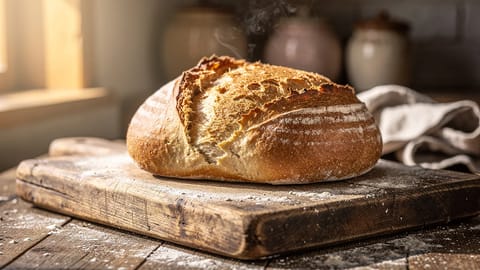
Biological leavening relies on living microorganisms that eat sugars and give off carbon dioxide and alcohol through fermentation. It is the oldest form of leavening and still the basis of almost all bread.
Commercial yeast
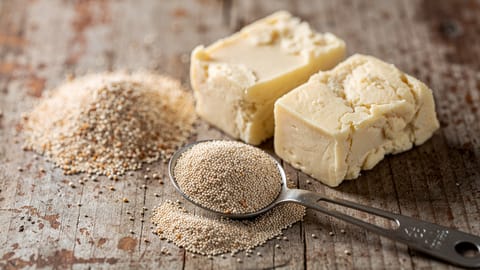
Commercial baker's yeast is the species Saccharomyces cerevisiae, sold in three forms:
- Active dry yeast: dried granules that are traditionally dissolved in warm liquid before use. The upside for beginners is that you can watch it foam and confirm it is alive before it goes into the dough.
- Instant yeast (also sold as rapid-rise or bread machine yeast): finer granules that mix straight into the dry ingredients. The most convenient option for everyday baking.
- Fresh yeast (compressed or cake yeast): a moist block that, per King Arthur Baking, keeps only a week or two in the fridge, opened or not. Preferred by many professional bakers. It is used by weight in larger amounts than dry yeast, so follow the conversion on the package or in yeast types.
All three do the same job: the yeast eats sugar, produces carbon dioxide, and the gas gets trapped in the gluten network. Temperature is the variable that bites. King Arthur's rule is that water hotter than 139°F (59°C) kills yeast, and that yeast prefers to rise between 70 and 100°F (21-38°C), with the cooler end of that range giving the best flavor. Warm liquid that feels comfortable on your hand is warm enough. If you want certainty, a thermometer settles it.
For how the three forms behave in practice and how to convert between them, see yeast types.
Sourdough starter
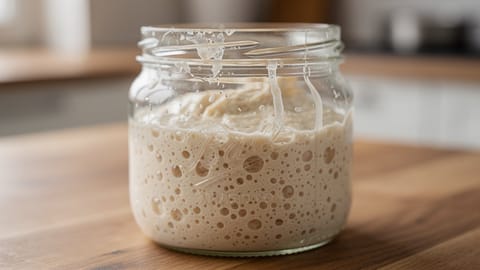
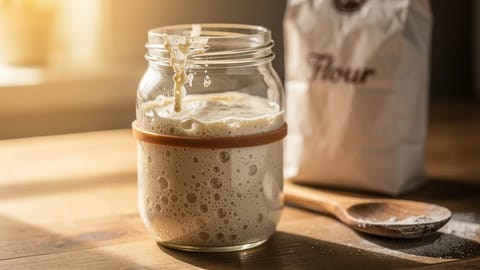
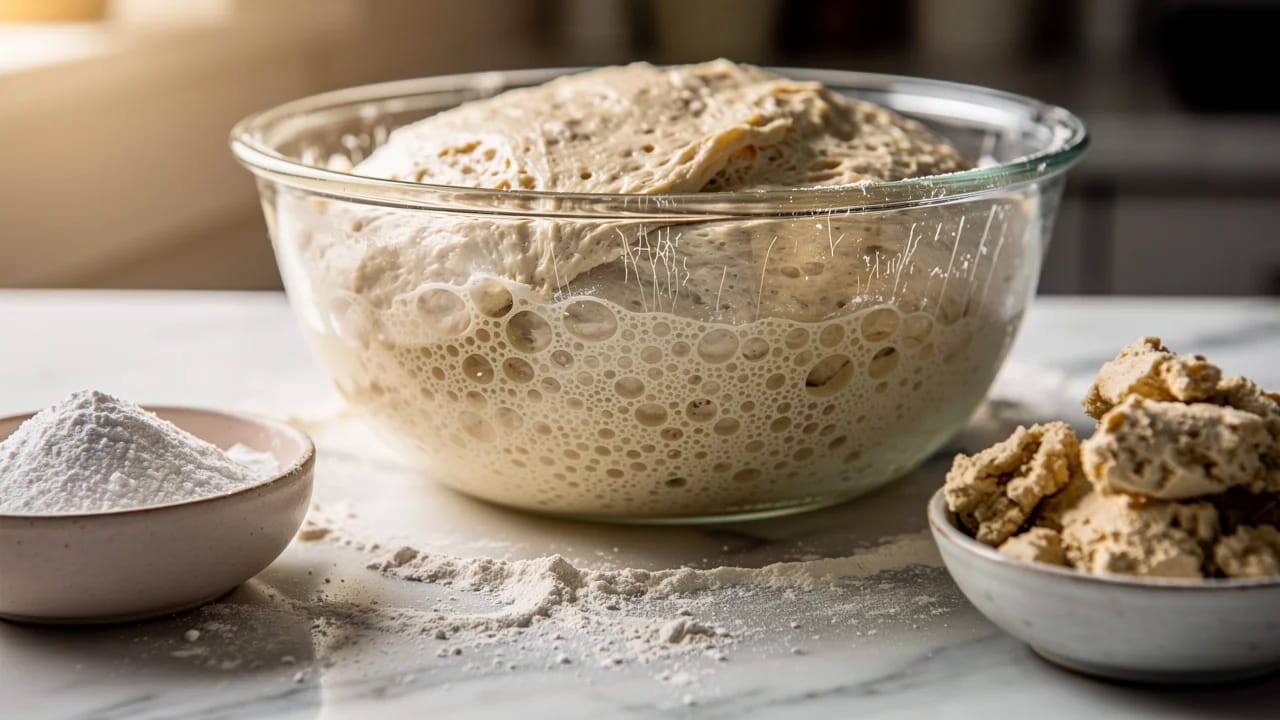
A sourdough starter is a culture of wild yeast and lactic acid bacteria kept alive with regular feedings of flour and water. It leavens on the same principle as commercial yeast, only more slowly: a sourdough bulk fermentation often runs several hours where a commercial-yeast dough takes one or two.
The trade is flavor. The long fermentation and the acids the bacteria produce give sourdough its tang and its keeping quality. If you are starting from nothing, the sourdough starter guide walks through the first week.
What are chemical leavening agents?
Chemical leaveners make carbon dioxide through an acid-base reaction rather than fermentation. They work in minutes, which is why quick breads, muffins, cookies, pancakes and most cakes depend on them.
Baking soda (sodium bicarbonate)
Baking soda is pure sodium bicarbonate, a base. It only produces gas when it meets an acid and moisture:
NaHCO₃ + acid → CO₂ + water + a salt
The reaction begins the moment the batter is mixed, so, as King Arthur Baking puts it, batters that rely on baking soda should go into the oven straightaway. Common acid partners include buttermilk, yogurt, sour cream, lemon juice, vinegar, honey, maple syrup, brown sugar and natural (not Dutch-processed) cocoa.
Baking soda also raises the pH of the batter, and a higher pH speeds the Maillard reaction. That is one reason recipes for deeply browned cookies reach for soda rather than powder.
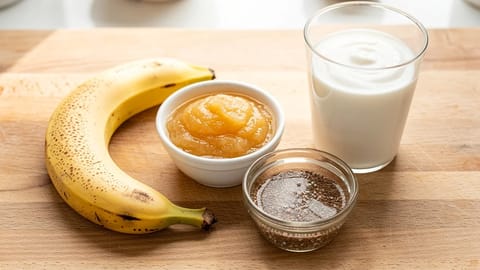
A common starting point is about 1/4 teaspoon of baking soda per cup (120 g) of flour, provided the recipe carries enough acid to react with it. Too much soda, or too little acid, leaves unreacted bicarbonate behind, and that is the metallic, soapy taste in a failed banana bread.
Baking powder
Baking powder is baking soda pre-mixed with a dry acid and a starch that keeps the two from reacting in the tin, as Wikipedia describes it. The acid may be cream of tartar in the old-fashioned versions; most supermarket powders use phosphate or sulfate acids instead. Double-acting baking powder, which is nearly everything sold today, reacts twice: once when it gets wet and again when it heats up in the oven. That second push is why a baking-powder batter is more forgiving of a few minutes on the counter.
The history is short and commercial. The first packaged baking powder went on sale in England in 1842, Alfred Bird sold his own single-acting version in 1843, and Eben Norton Horsford patented a phosphate-based powder in the United States in 1856, then developed the first double-acting formula in the 1860s.
Many recipes use both. The soda neutralizes the acid in the recipe and helps browning, while the powder supplies the bulk of the lift. Because baking powder is roughly a third the strength of baking soda, the two are not interchangeable one for one. King Arthur's swaps: 1 teaspoon of baking powder can be replaced by 1/4 teaspoon of baking soda plus 1/2 teaspoon of cream of tartar, and 1 teaspoon of baking soda by 3 teaspoons of baking powder, with the warning that this much powder can taste slightly bitter and that the recipe's acid then needs cutting back. For how bakers reason about these ratios against flour weight, see baker's percentage.
Cream of tartar
Cream of tartar (potassium bitartrate) is a dry acid left behind by winemaking. Alone it leavens nothing, but paired with baking soda it becomes single-acting baking powder, which is exactly what the substitution above builds. It also stabilizes whipped egg whites, which links it to the next category.
How does mechanical leavening work?
Mechanical leavening involves no reaction and no organism. You trap air or steam in the batter by technique, and the oven expands it. Are eggs a leavening agent? When they are whipped, yes.
Whipped eggs
Whipping egg whites traps air in a protein foam. In the oven the air expands and the proteins set around it, giving structure. This is the main leavening in soufflés, angel food cake, meringue and sponge cakes. Whole eggs can be whipped too: a génoise rises on whipped whole eggs and nothing else.
The skill is keeping the foam intact when it meets the batter. Gentle folding preserves the bubbles; overmixing knocks them out and the cake bakes flat. If you need to replace eggs and keep some of that lift, the egg substitutes guide covers the workable options.
Creaming butter and sugar
Beating softened butter with sugar forces air into the fat. The sugar crystals cut tiny pockets into the butter, and those pockets expand in the oven and give chemical leaveners a head start. "Cream until light and fluffy" is a leavening instruction. The butter should be at cool room temperature: it dents when pressed but still holds its shape. Too warm and it cannot hold air. Too cold and it will not cream.
Lamination and steam
In puff pastry, croissants and Danish, thin layers of butter are folded between layers of dough. In the oven the water in the butter turns to steam and pushes the layers apart, leaving hundreds of separate sheets. No yeast, no baking powder, only steam. Pâte à choux works the same way from a wet paste. Yeasted laminated doughs like croissants combine steam with biological leavening, which is why they end up so light.
How do you store leavening agents?
Chemical leaveners lose strength with time and humidity. Baking soda is stable for years in a sealed container. Baking powder is the fragile one: moisture in the air sets off the reaction inside the tin, a little at a time. Keep both sealed in a cool, dry spot, note the date on the tin, and test a powder that has been open for a while before you trust a cake to it.
Yeast has its own clock. Fresh yeast keeps a week or two in the fridge. Dry yeast in a sealed, unopened packet keeps at room temperature; once open, King Arthur recommends moving it to an airtight container in the freezer, where it stays good for up to a year. There is no need to thaw it first.
What are the most common leavening mistakes?
Too much baking soda. A metallic or soapy aftertaste in banana bread or cookies means unreacted bicarbonate. Reduce the soda or add acid. A quarter teaspoon per cup of flour goes a long way.
Dead baking powder. Flat cakes with a fresh recipe usually trace back to the tin. King Arthur's test: 1/2 teaspoon in 2 tablespoons of warm water should bubble and foam. Weak fizz means replace it.
Killed or sluggish yeast. Liquid above 139°F (59°C) kills yeast. To check a packet, dissolve 1/2 teaspoon of sugar in 1/2 cup of warm water, stir in the yeast, and look for bubbling and a domed, airy surface within 10-20 minutes.
Overmixing after the leavener. Once baking soda is wet the clock is running, and once whipped eggs meet batter every extra stroke costs bubbles. Mix until barely combined and bake.
Confusing baking soda and baking powder. Swapping one for the other without adjusting the acid gives you either a flat result or a bitter one. Use the substitutions above.
Leavening agents in Fond
Fond hasn't launched yet. This is how it will work at launch. Join the waitlist for early access.
Every leavener is a timing problem in disguise: baking soda wants the batter in the oven now, yeast wants an hour or a night, sourdough wants longer still. When you save a recipe in Fond, each step that carries a time becomes a tappable timer in Cook Mode, so a 10-minute yeast check or a 90-minute proof runs from the recipe itself. Recipe notes are the place to record how your kitchen behaves, since the same bulk fermentation takes longer in a cold kitchen than in a warm one.
For the fundamentals of working with yeast, see bread baking for beginners.