 Bastien
Food Danger Zone
The food danger zone is the temperature range from 4°C to 60°C (40°F to 140°F) where bacteria multiply fastest, doubling in as little as 20 minutes. Perishable food should not sit there for more than 2 hours total.
The food danger zone is the temperature range from 4°C to 60°C (40°F to 140°F), where bacteria multiply fastest, doubling in number in as little as 20 minutes at the warm end (NC State Extension). Keep perishable food out of that band (colder than 4°C or hotter than 60°C) and you've done most of what food safety asks.
It's the single most useful number range in a kitchen, and the one home cooks most often break by accident: the roast resting on the counter for three hours, the rice cooling slowly in a deep pot, the groceries left in a hot car.
Why is the danger zone dangerous?
Bacteria are living things with an ideal temperature, and for the species that make us sick (Salmonella, E. coli, Staphylococcus, Listeria) that ideal sits close to human body temperature, right in the middle of the zone. Foodborne microorganisms grow fastest between about 21 and 47°C (Wikipedia). Given water, nutrients, and warmth, their populations can double every 20 minutes or so. At that rate one cell becomes over a thousand in about three and a half hours, and over a million in under seven. That exponential curve is why a small delay early feels harmless and a longer one turns dangerous fast.
Cold doesn't kill these bacteria; it just slows them to a crawl below 4°C. Heat at 74°C does kill them. The danger zone is the gap in between where they thrive, which is why the whole strategy is to move food through it quickly and never park there.
Agencies draw the lines slightly differently. The US and Health Canada use 4-60°C, the FDA Food Code for restaurants uses 5-57°C (41-135°F), and the UK uses 8-63°C. The differences are at the edges; the advice in the middle is the same everywhere.
What is the 2-hour rule?
Perishable food gets a cumulative budget of 2 hours in the danger zone, total, across every stage from prep to leftovers (Wikipedia). Above 32°C (90°F), on a hot day or at an outdoor party, that budget halves to 1 hour (NC State Extension). The critical word is cumulative: the clock does not reset when you chill and re-serve. Ninety minutes on the lunch buffet leaves a dish just 30 minutes for the dinner table before it should be discarded.
Restaurants formalize this as the "2-hour/4-hour rule": under 2 hours in the zone, the food can be chilled and reused; between 2 and 4 hours, it should be eaten right away; past 4 hours, it goes in the bin. The home version is simpler. Set a timer when hot food hits the table, and put leftovers away within two hours (one if it's hot out). "How long has that been out?" is not a question guesswork can answer.
How do you cool food safely?
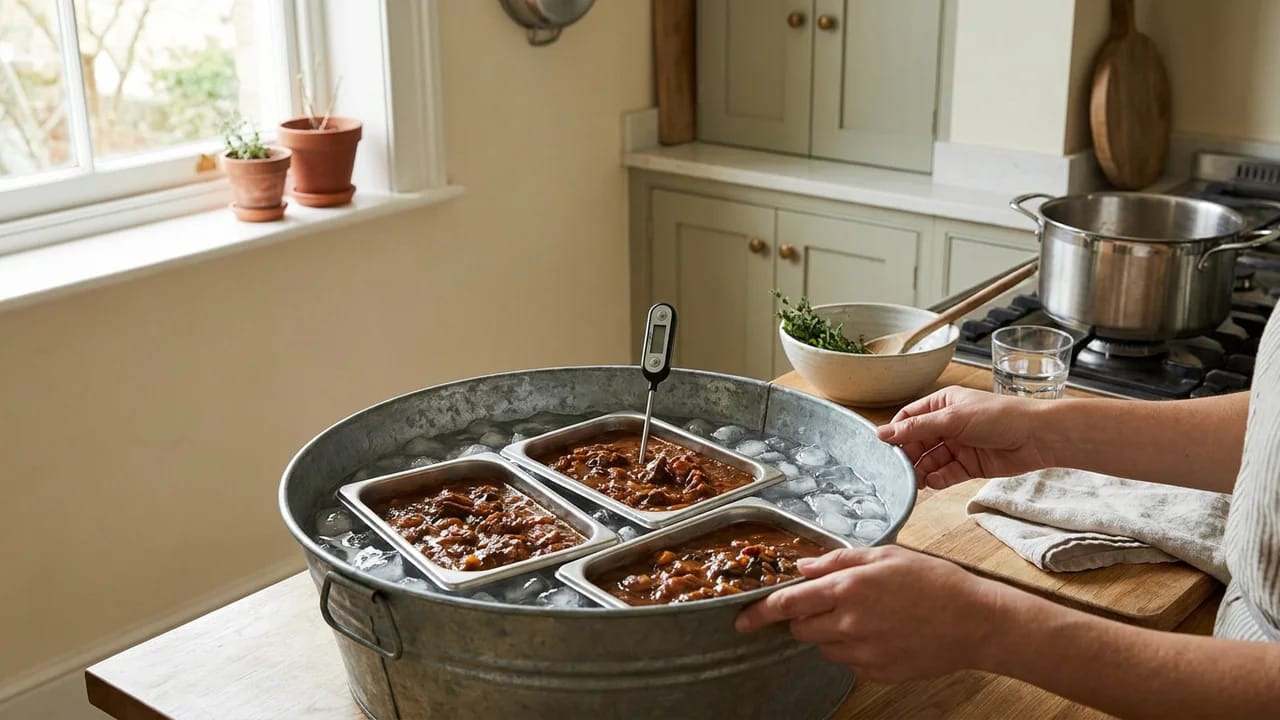
Getting out of the zone is as important as staying out of it, and big batches are the trap: a stockpot cools from the outside in and can sit warm at its center for hours. The fix is surface area and airflow.
The "let it cool completely before refrigerating" habit is a myth worth dropping. A warm covered container reaches the fridge faster and safer than one left out to hit room temperature, which is just extra time in the zone. Fast cooling also protects flavor and cuts food waste, since properly chilled leftovers keep their full fridge life, about 3-4 days for most cooked dishes according to Health Canada.
What temperatures keep food safe?
The two safe harbors are cold storage and thorough cooking. Below are the numbers worth memorizing, from Health Canada's storage and cooking temperature guidance:
| Target | Temperature | Applies to |
|---|---|---|
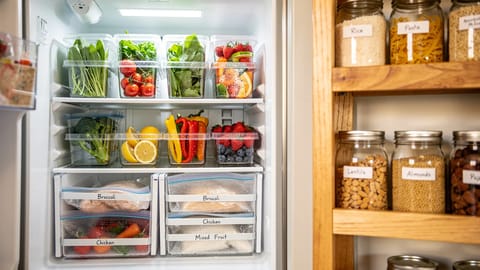
| Fridge | At or below 4°C (40°F) | All perishable storage |
| Freezer | At or below -18°C (0°F) | Long-term storage |
| Poultry pieces, leftovers, egg dishes | 74°C (165°F) | Chicken pieces, reheated leftovers, casseroles |
| Whole poultry | 82°C (180°F) | Whole chicken or turkey |
| Ground meat, pork | 71°C (160°F) | Burgers, sausages, meatloaf, pork |
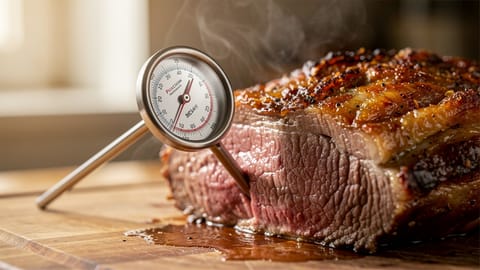
| Whole cuts of beef and lamb | 63°C (145°F) | Roasts and steaks |
| Hot holding | 60°C (140°F) or above | Buffets, slow cookers, warming |
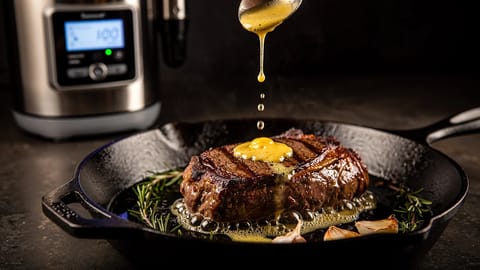
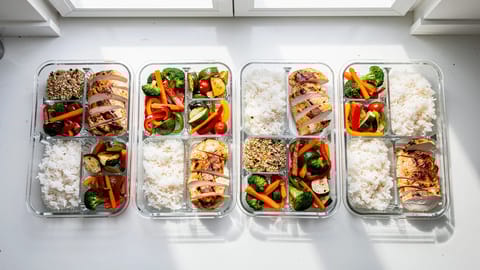
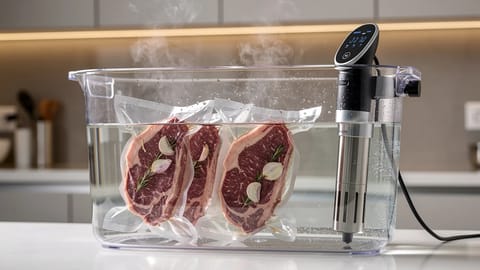
Note the tension with steak: a medium-rare beef cut is pulled at 52-54°C, below the danger-zone ceiling. Whole muscles are safe there because their bacteria live only on the surface, which the sear destroys; ground meat mixes surface bacteria throughout, so it needs the full 71°C. Sous vide leans on the other half of the same idea, holding food inside this range long enough that time does the work temperature normally would; our sous vide beginner's guide has the time and temperature chart. Below -18°C the freezer stops growth entirely, though long storage there risks freezer burn. The cold side of safety is covered in the food storage guide, and it's the backbone of safe meal prep.
What are the most common danger-zone mistakes?
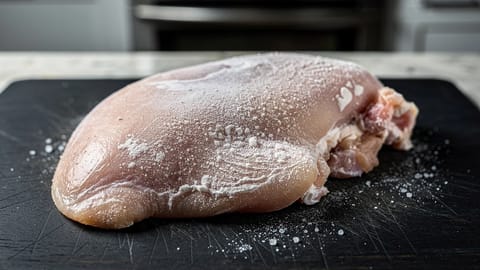
The thaw-on-the-counter habit is the sneakiest one: the outside of a chicken enters the danger zone hours before the frozen center thaws. Defrost in the fridge, in cold water changed regularly, or in the microwave straight into cooking.
The danger zone in Fond
Fond hasn't launched yet. This is how it will work at launch. Join the waitlist for early access.
The 2-hour rule is a timer problem, and timers are what Cook Mode does. Add a final step to your party and batch-cooking recipes ("refrigerate leftovers within 2 hours") with a 2-hour timer on it, start it when the food hits the table, and the app tells you when the budget is up. Cooling steps ("chill the stock in an ice bath, 30 minutes") get their own timers the same way, and the screen stays awake while you work.