 Bastien
How to cook rice perfectly every time
Rice is the most consumed grain on the planet, yet it trips up even confident home cooks. Too sticky, too mushy, burned on the bottom. The failures are predictable, and so are the fixes. Learning how to cook rice well comes down to the right water ratio, proper heat control, and leaving it alone while it cooks.
Most people learn how to cook rice by eyeballing the water and hoping for the best. That's why the bottom burns, the top stays crunchy, and the whole pot turns to mush on alternating Tuesdays. The fix isn't a better pot or a fancier brand. It's knowing the exact rice to water ratio for the type you're cooking.
I used to wreck rice constantly. Basmati came out gluey, brown rice crunched in the middle, and jasmine stuck to the pot like cement. Then I started weighing the water on a kitchen scale and timing with an actual timer instead of guessing. The difference was immediate. Now rice is the one thing I never worry about.
This page covers white long grain, jasmine, basmati, brown, short grain, and sushi rice. You'll get a ratio table worth bookmarking, step-by-step stovetop instructions, and four cooking methods so you can use whatever equipment you have. Specific numbers, specific times.
Rice to water ratio by type
The rice to water ratio determines everything. Too much and you get porridge. Too little and it burns. Every rice type absorbs water differently, so there's no universal number.
A few notes on ratios:
- These ratios assume rinsed rice. Unrinsed rice may need slightly less water because surface starch absorbs some.
- If you're cooking more than 2 cups, reduce water slightly. Use about 1.25 cups water per additional cup of white rice. The ratio isn't perfectly linear because less steam escapes proportionally in larger batches.
- For precision, weigh your rice and water with a kitchen scale. One cup of white rice weighs roughly 185g. Use Fond's unit converter to switch between cups and grams.
Why rinsing matters (the science)
Rinsing isn't fussy. It's functional. Milled rice is coated in loose surface starch (amylopectin) left over from processing. When that starch hits hot water, it gelatinizes into a paste that glues grains together. That's why unrinsed rice cooks up gummy.
Place rice in a fine-mesh strainer and run cold water over it for 30-60 seconds, swirling with your hand, until the water goes from milky to mostly clear. You're washing off the starch that would otherwise turn your pot into a sticky block.
I've tested this side by side with basmati more times than I can count. Rinsed basmati comes out with long, separate grains. Unrinsed turns into a clump you'd need a spatula to break apart. The 30-second rinse is the single easiest upgrade you can make.
Tip: The only time to skip rinsing is when you want sticky rice, or when making risotto, where that surface starch creates the creamy texture.
How to cook rice on the stove (step by step)
The stovetop absorption method works for every rice type. You adjust the water and time. Start with white rice, then see the adjustments for other varieties below.
How to cook white rice
How to cook brown rice
Brown rice follows the same process with two differences: more water (1:2 ratio) and longer cook time (40-45 minutes for long grain, 45-50 for short grain). The bran layer takes longer to hydrate. Rest for 10-15 minutes before fluffing.
Short grain and sushi rice
Short grain rice is starchier by nature. You want it slightly sticky, not fluffy. Use a 1:1.25 ratio, cook for 15 minutes, and rest for 10 minutes. For sushi rice, season with rice vinegar, sugar, and salt while the rice is still warm (traditional ratio: 3 tablespoons vinegar, 2 tablespoons sugar, 1 teaspoon salt per 2 cups dry rice).
How to cook rice the Asian way
Many Asian home cooks skip measuring cups entirely. The most common technique: place rinsed rice in the pot, level it, then add water until it reaches the first knuckle of your index finger when the tip touches the surface of the rice. The distance from fingertip to first knuckle is roughly 1 inch (2.5 cm), the right depth of water above the rice regardless of quantity.
The method is self-correcting. It scales naturally because water depth stays constant relative to the rice surface, not the pot size. Works best with medium and short grain white rice (the types most commonly cooked in Asian households). For long grain varieties, the fingertip method tends to give slightly too much water.
Another approach: rinse the rice aggressively, 5-6 times, until the water is nearly transparent. The extra rinsing produces distinctly separate grains and a cleaner, less starchy texture. Many Japanese cooks also soak the rinsed rice for 30 minutes before cooking. This gives a more even texture throughout.
Other methods: rice cooker, Instant Pot, and microwave
Rice cooker
Rice cookers are foolproof once you know your machine. Most come with a measuring cup (which is 3/4 of a standard US cup, about 180ml) and marked water lines inside the pot.
Basic process: Rinse rice, add to the pot, fill water to the corresponding line, close the lid, press cook. The machine handles temperature and timing automatically, switching to "keep warm" when done. Let it rest 10 minutes before opening.
If your rice cooker doesn't have water lines, use the same ratios from the table above.
Instant Pot (pressure cooker)
Pressure cooking is fast and produces consistent results. Use a 1:1 water ratio for white rice (pressure traps more steam, so you need less water) and 1:1.25 for brown rice.
White rice: Set to manual/pressure cook, high pressure, 3 minutes. Natural release for 10 minutes, then quick release.
Brown rice: High pressure, 22 minutes. Natural release for 10 minutes.
How to cook rice in the microwave
The microwave works in a pinch but requires attention to avoid boiling over. Use a large microwave-safe bowl, at least 3 times the volume of the dry rice.
Combine 1 cup rinsed rice and 1.75 cups water (slightly more than stovetop to account for evaporation). Cover loosely with a microwave-safe plate. Microwave on high for 5 minutes until boiling, then reduce to 50% power for 15 minutes. Rest covered for 5 minutes. The microwave method produces decent results for white rice, though the texture won't match stovetop or rice cooker quality.
How long to cook rice (quick reference)
After the rice to water ratio, timing is the second variable people get wrong.
HP = High Pressure. All Instant Pot times exclude the 10-minute natural release.
Resting is not optional. Skipping it means the bottom layer overcooks while the top stays underdone. Set a timer for the rest, too.
Rice troubleshooting
Too much water. Reduce the ratio next time. For now, spread the rice on a sheet pan and bake at 175°C (350°F) for 5 minutes to dry it out. Also check that your lid fits tightly, as a loose lid lets steam escape and tricks you into adding more water.
Not enough water, or the lid was lifted during cooking. Steam escapes every time you peek, dropping the temperature. Add 2-3 tablespoons of water, re-cover, and cook on the lowest heat for another 5 minutes.
Heat was too high after reducing. The lowest setting means the lowest setting. Also check your pot: thin-bottomed pots create hot spots. A heavy-bottomed pot or one with a thick aluminum core distributes heat evenly.
You probably didn't rinse. Surface starch from milling acts like glue when heated. Rinse for 30-60 seconds under cold water before cooking. If you're making long grain rice and it's still sticky after rinsing, reduce the water by a tablespoon or two.
Add salt. A half teaspoon of salt per cup of dry rice makes a noticeable difference. Add it with the water before cooking, not after.
How to make fluffy rice
For basmati, soaking the rinsed rice in cold water for 20-30 minutes before cooking produces noticeably longer, more separate grains. The pre-soak lets the grain absorb water gradually, so it expands lengthwise instead of cracking during the rapid heat of cooking. After testing this over dozens of batches, I'd call it optional for weeknight meals but worth it when you're serving rice as the star of the plate.
Storing and reheating cooked rice
Rice is a meal prep staple. It stores and reheats well. Food safety matters here, though.
Refrigerator storage
Cool cooked rice to room temperature within one hour, then transfer to an airtight container. According to the USDA, cooked rice should be refrigerated within 2 hours of cooking (1 hour if the room is above 32°C / 90°F). It keeps 4-6 days in the fridge.
Spread rice on a sheet pan to cool it faster. Packing hot rice into a container traps steam and creates a breeding ground for Bacillus cereus, a bacteria that causes food poisoning.
Freezer storage
Cooked rice freezes well for up to 6 months. Portion it into freezer bags, press out the air, and lay them flat. Flat bags thaw faster and stack neatly. I freeze rice in 2-cup portions, which is the right amount for two servings and defrosts evenly in the microwave.
Reheating
Microwave: Add 1-2 tablespoons of water per cup of rice. Cover and microwave for 1-2 minutes, fluffing halfway through.
Stovetop: Add a splash of water, cover, and warm over low heat for 3-5 minutes. Stir once halfway through.
From frozen: Microwave in the bag (unsealed) for 3-4 minutes, or drop the sealed bag in boiling water for 5 minutes.
Day-old refrigerated rice is better for fried rice. The drying in the fridge gives grains a firmer texture that won't turn mushy when stir-fried at high heat. If you're planning a batch cooking session, cook extra rice specifically for fried rice the next day.
- The rice to water ratio is everything: 1:1.5 for white, 1:1.25 for jasmine, 1:2 for brown
- Rinse for 30-60 seconds to remove surface starch and prevent gummy results
- Cook on the lowest heat with the lid on, no peeking
- Rest for 10 minutes off heat before fluffing with a fork
- Store safely: cool within 1 hour, refrigerate within 2 hours, keeps 4-6 days
Have your mise en place ready before you start: rice measured, water measured, pot and lid out. Save your go-to ratios and methods in Fond so you can pull them up mid-cook without scrolling through ads and life stories.
Sources
Cook smarter
Join the waitlist for Fond. Recipes, meal plans, and a little AI sous-chef that learns how you cook.
Related articles
Batch cooking for beginners: how to cook once and eat all week
Batch cooking means dedicating a few hours to cooking large quantities of food that you portion and store for the week ahead. It's not the same as meal prep — instead of assembling complete meals, you cook versatile building blocks (grains, proteins, sauces, roasted vegetables) that mix and match into different dishes every night. This guide covers everything you need to start: planning, cooking, storing, and scaling.
How long to boil eggs for soft, medium, and hard yolks
The difference between a runny, jammy, or fully set yolk comes down to minutes. Knowing how long to boil eggs removes the guesswork and gives you the exact result you want, every single time.
How to meal prep: a practical guide for beginners
Meal prep means dedicating about 2 hours on a Sunday to planning, cooking, and portioning complete meals for the week ahead. Unlike batch cooking, which produces versatile components you mix and match, meal prep gives you finished meals ready to grab and eat. This guide covers everything from equipment and shopping lists to a minute-by-minute prep day timeline and safe storage practices.
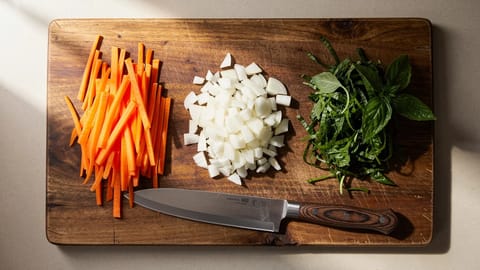
Types of knife cuts: the complete guide for home cooks
Professional chefs learn 12+ standard knife cuts in culinary school. Home cooks usually learn zero. That gap shows up on the plate — in uneven cooking, mushy textures, and dishes that never quite look like the recipe photo.
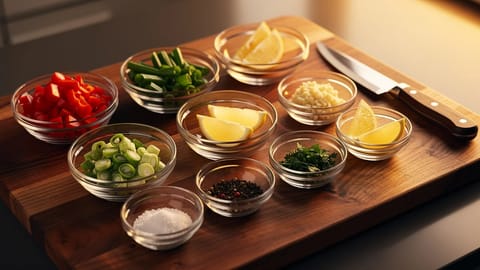
What is mise en place and why it matters
Mise en place is the practice of preparing and organizing every ingredient and tool before you start cooking. It's the single habit that separates chaotic, stressful cooking from calm, confident meals, and it works just as well in a home kitchen as it does in a professional one.
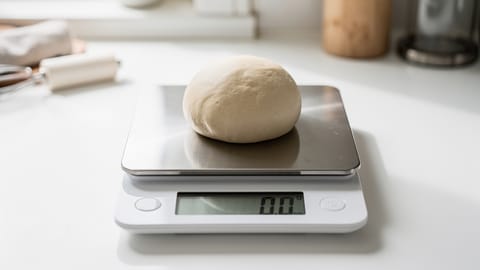
Kitchen Scale
A digital scale for measuring ingredients by weight — far more accurate than cups and spoons, especially in baking.
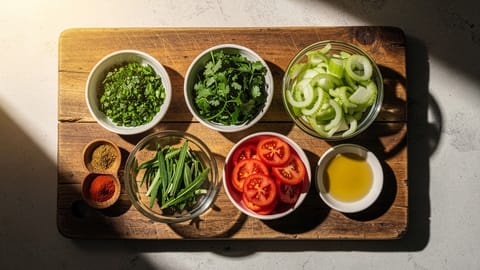
Mise en Place
The practice of preparing and organizing all ingredients before cooking — everything in its place.
Meal Prep
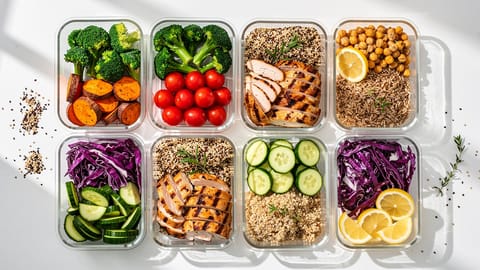
Preparing meals or meal components in advance, typically for the week ahead, to save time and reduce daily cooking effort.