 Bastien
Crumb Structure
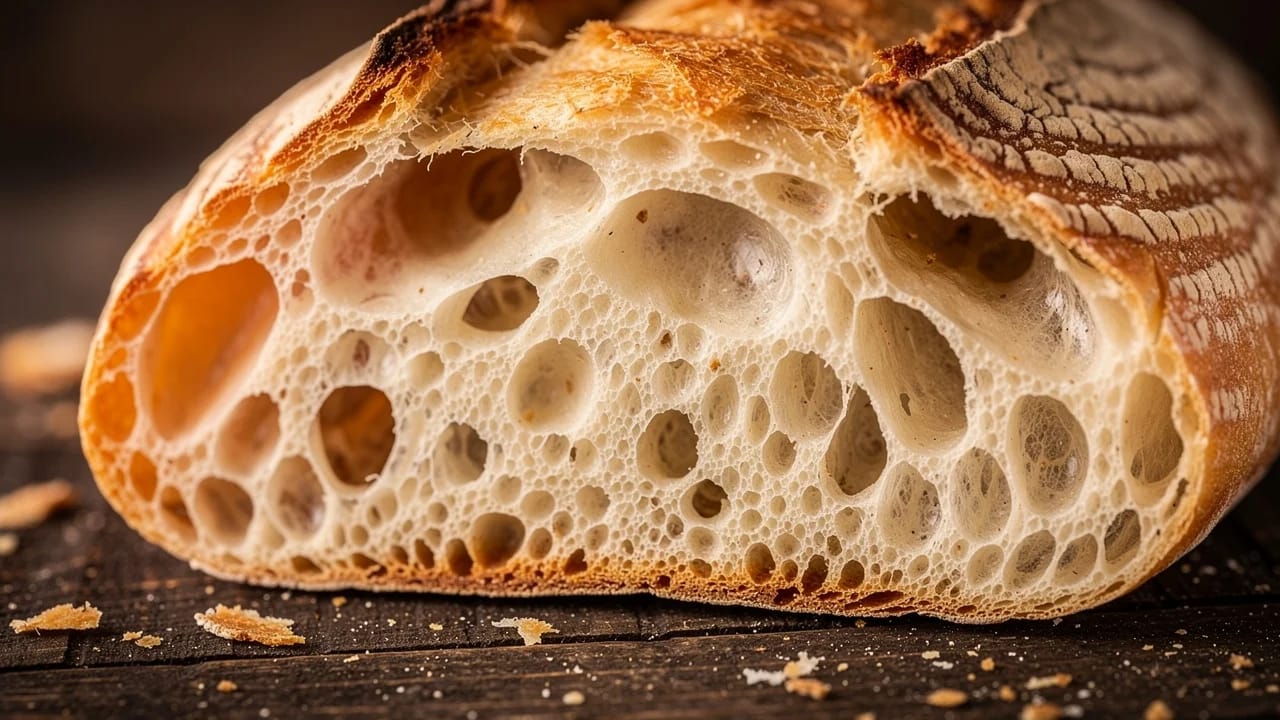
Crumb structure is the internal texture of bread: the size, shape and distribution of the holes (alveoli) you see when you slice a loaf, from tight and even in sandwich bread to open and irregular in ciabatta and high-hydration sourdough.
Crumb structure is the pattern of holes (alveoli) inside a loaf of bread once it is sliced. Tight, even crumb suits sandwich loaves; open, irregular crumb is the signature of ciabatta, focaccia and naturally leavened sourdough. The crumb records every decision made along the way: flour, water, fermentation, shaping and bake. Each cross-section is a report on the process.
Crumb is not about looks. A wild, open crumb photographs well and makes a terrible sandwich. The goal is always the right crumb for the bread you are making.
What is the difference between open crumb and tight crumb?
These terms describe the two ends of a spectrum:
Most bread sits between the extremes. A country sourdough around 70% hydration usually shows a moderately open crumb, holes of roughly 3-15 mm with a few larger pockets. That is the sweet spot for a loaf you can both toast and tear.
What does a good sourdough crumb look like?
Use this chart when you read your sourdough or yeasted loaf after baking. The target depends entirely on what you were trying to bake.
What determines crumb structure?
Four levers control the crumb. Move one and the result shifts, and none of them works alone. King Arthur Baking puts it plainly: an open loaf is the sum of good flour, sufficient hydration, strong fermentation, gentle handling and a full proof.
1. Hydration
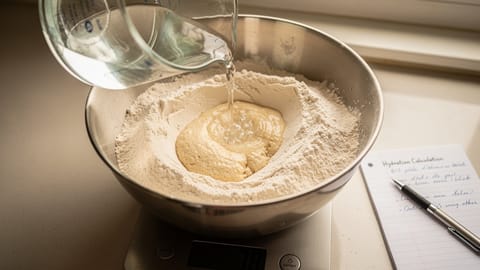
Water makes dough more extensible, so gas cells can expand further before the crust sets. It is the lever most people reach for first, and the one most often overrated. King Arthur's baker works at 70-80% hydration but is explicit that hydration alone does not decide the crumb: you can get an open crumb at lower hydration and a tight one at high hydration if the other levers are off.
| Hydration | Expected crumb | Example breads |
|---|---|---|
| 55-60% | Very tight, fine | Bagels, pretzels |
| 60-65% | Tight, even | Sandwich loaves, dinner rolls |
| 65-70% | Moderate, some openness | Country bread, pain de campagne |
| 70-75% | Moderately open | Sourdough boules, bâtards |
| 75-80% | Open, irregular | Baguettes, high-hydration sourdough |
| 80-85%+ | Very open, large holes | Ciabatta, focaccia, pan de cristal |
Wetter dough is harder to handle. If you are chasing openness, raise hydration by 2-3% per bake, not 10% in one jump, so that your shaping skills keep pace with the dough.
2. Fermentation
Fermentation produces the gas that becomes your crumb. Under-ferment and there is not enough gas: tight, dense crumb. Over-ferment and the gluten network weakens and collapses: flat loaves with tunnels and a gummy interior.
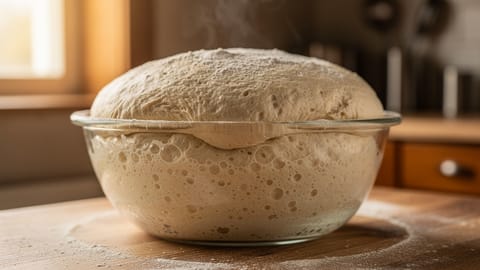
During bulk fermentation the leavening organisms produce CO2 that the gluten network traps. The starter matters as much as the time: King Arthur's baker feeds it every 12 hours and uses it as it turns ripe, because an over-acidic starter tends toward a more closed interior. Watch the dough rather than the clock. Many sourdough bakers look for a 50-75% rise in bulk with visible bubbles, then a final proof to about 75-80% of full height so that some energy remains for oven spring.
3. Gluten development
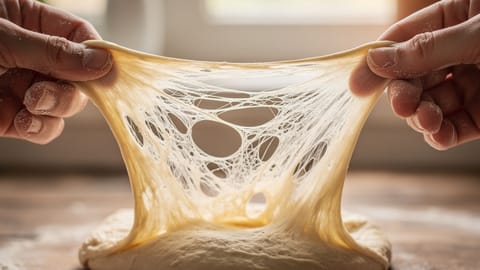
The gluten network is the scaffold that holds gas in place. Strong gluten keeps the gas where it formed and gives an even crumb. Weak gluten lets gas migrate and merge into uneven holes, or lets the loaf collapse.
Build gluten through:
- Kneading (roughly 5-8 minutes by hand, 4-6 by mixer for a standard dough)
- Stretch and folds during bulk (3-4 sets, about 30 minutes apart)
- Autolyse (a 30-60 minute flour-and-water rest before salt and starter go in)
- Time: gluten keeps developing on its own during fermentation
Flour strength sets the ceiling. King Arthur's baker uses flour in the 11-13% protein range and suggests adding some bread flour if the crumb refuses to open. Whole wheat and rye carry bran that cuts through gluten strands, so the higher the whole-grain share, the harder an open crumb becomes. Sifting out some bran or giving whole-grain flour a long autolyse to soften it both help.
4. Shaping and handling
Shaping is where most home bakers lose their open crumb. Heavy degassing during pre-shape or final shape pushes out gas you spent hours building.
For tight crumb, reverse the approach: degas thoroughly during pre-shape, shape with firm surface tension, and roll the dough out with a pin if the style calls for it. Shape choice plays a small role too: King Arthur notes that a bâtard tends to come out slightly more open than a boule from the same dough.
How does flour affect crumb structure?
| Flour type | Protein content | Crumb tendency |
|---|---|---|
| Cake flour | 7-9% | Very tight, tender |
| All-purpose | 10-12% | Moderate, versatile |
| Bread flour | 12-14% | Open capable, chewy |
| High-gluten flour | 14-15% | Very open capable, strong chew |
| Whole wheat | 13-14% | Tighter because of bran, denser |
| Rye | 8-12% | Tight and moist; high-rye loaves are meant to be dense |
Bread flour gives the best chance at an open crumb because it builds a strong, elastic network. All-purpose flour works for a moderate crumb. Mixing 10-20% whole wheat into bread flour adds flavor without giving up much openness.
How do you read your crumb to diagnose problems?
Slice the loaf through the middle and read it like a map. The crumb tells you what happened during fermentation, shaping and baking better than any recipe note can.
Cause: Under-fermented or under-hydrated.
Fix: Extend bulk fermentation or raise hydration by 3-5%. Check that the starter was ripe when you mixed.
Cause: Gas migrated upward during the proof. The dough was under-shaped or over-proofed.
Fix: Shape with more tension and shorten the proof.
Cause: An air pocket trapped during shaping.
Fix: Shape more carefully, and degas gently before the final shape.
Cause: Under-baked, over-fermented, or sliced too early.
Fix: Bake to at least 88°C (190°F) inside, and toward 96-99°C (205-210°F) for sourdough and hearty loaves. Shorten bulk if the dough was slack and sour. Let the loaf cool fully before cutting.
Cause: Low hydration or heavy-handed shaping.
Fix: Raise hydration 2-3% and handle the dough more gently.
Cause: Cut too soon. The interior was still steaming.
Fix: Wait at least 1 hour before cutting, and 2 hours for a large sourdough.
Cause: Inconsistent folding or uneven fermentation.
Fix: Fold more consistently during bulk, and check dough temperature with an instant-read thermometer so the whole mass ferments at the same pace.
What crumb should you aim for by bread style?
| Bread style | Target crumb | Hole size | Key techniques |
|---|---|---|---|
| White sandwich loaf | Tight, uniform | 1-2 mm | ~60% hydration, thorough kneading, tight shape |
| Brioche / enriched | Very tight, pillowy | 1-2 mm | Butter and eggs tighten the crumb naturally |
| Country sourdough | Moderately open | 3-15 mm | 68-72% hydration, full bulk, gentle shaping |
| Baguette | Open, irregular | 5-20 mm | 70-75% hydration, long cold proof, gentle handling |
| Ciabatta | Very open, glossy | 10-30 mm | 80%+ hydration, minimal shaping, wet dough |
| Focaccia | Open, airy | 5-25 mm | 75-80% hydration, olive oil, dimpling spreads the gas |
| Whole wheat | Moderately tight | 2-8 mm | Bran limits openness; a long autolyse helps |
| Rye bread | Tight, moist | 1-3 mm | Rye gluten is weak; a tight crumb is correct |
| Pizza dough | Moderately open in the cornicione | 3-15 mm in the rim | 65-70% hydration for Neapolitan, cold fermentation |
There is no universal "good" crumb. A ciabatta with a tight crumb failed as surely as a sandwich loaf with huge holes. Know what you are baking and aim for that texture.
What are the best tips for better crumb?
Be patient with cooling. Crumb structure is not set when the bread leaves the oven. Starch is still firming and moisture is still moving. Cutting a sourdough boule after 30 minutes gives you gummy crumb no matter how well it fermented. Wait at least an hour, two for a large loaf.
Use a thermometer. King Arthur Baking looks for at least 190°F (88°C) inside a finished loaf, and notes that baguettes, hearty whole-grain rounds and rye do better at 205-210°F (96-99°C). ThermoWorks gives 190-210°F (88-99°C) for lean doughs and 180-190°F (82-88°C) for enriched ones. Pull a lean loaf early and no amount of good fermentation saves it from gumminess.
Score with purpose. Scoring controls where the loaf expands. A single deep score lets the loaf open on one side and tends to lift the crumb beneath the ear; several shallow scores spread the expansion and give a more uniform crumb.
Keep notes. Track hydration, bulk time, dough temperature and proof time. When you get a crumb you love, the notes let you repeat it. When something goes wrong, the notes tell you what changed.
Preheat thoroughly. A hot oven (230-250°C / 450-480°F) with steam gives strong oven spring, the last burst of gas expansion before the crust sets. Weak oven spring means a tighter crumb regardless of how well you fermented and shaped.
- Crumb structure comes from flour, hydration, fermentation, gluten development and shaping working together
- Higher hydration helps open the crumb, but it is one lever among several; raise it gradually
- Watch the dough, not the clock: a ripe starter, a full bulk, and a proof to about 75-80% of full height
- Gentle shaping keeps gas for an open crumb; firm shaping builds structure for sandwich loaves
- Bake a lean loaf to at least 88°C inside and cool it fully before slicing