 Bastien
Instant-Read Thermometer
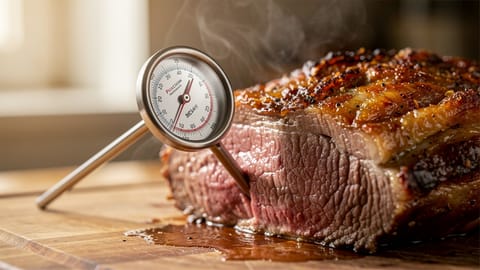
An instant-read thermometer is a probe thermometer that shows the internal temperature of food within a few seconds. It is the reliable way to check meat, bread, and frying oil.
An instant-read thermometer is a probe thermometer you push into food for a few seconds to read its internal temperature, then pull out. It is the reliable way to know whether chicken is safe, a steak is medium-rare, a loaf is baked through, or frying oil is ready. No cutting into the meat, no pressing it with a finger, no trusting the clock.
Recipes tend to call it a meat thermometer, a food thermometer, or a probe thermometer. They mean the same handheld tool. This entry covers how it works, how to use it, and the temperatures worth knowing.
What is an instant-read thermometer, and how does it work?
A meat thermometer measures the internal temperature of meat and other foods; "instant-read" means the handheld kind that gives a reading in seconds rather than staying in the food. Inside the probe tip is one of two sensors:
- Thermistor: a tiny resistor whose resistance changes with temperature. Cheaper, accurate, and the sensor in most home models. The tip is a little thicker and takes a few seconds longer to settle.
- Thermocouple: two different metal wires joined at the tip; the junction produces a small voltage that depends on temperature. The tip can be very thin, so it responds fastest and reads well in thin cuts. Thermocouple models cost more.
Either way, the sensor sits in the last centimeter or so of the probe, which is why placement matters: the reading is the temperature at the tip, not along the shaft.
How long does a meat thermometer take to read?
- Digital instant-read: typically 2–5 seconds; thin thermocouple models are at the fast end.
- Dial (analog) instant-read: 15–30 seconds, and the sensor spans a longer section of the stem, so it needs deeper insertion.
- Leave-in probe: continuous; it stays in the roast and reports to a base unit or app.
Hold the probe still until the number stops climbing. If it is still rising after five seconds, wait; if it never settles, the tip is probably touching bone or the pan.
How do you use a meat thermometer?
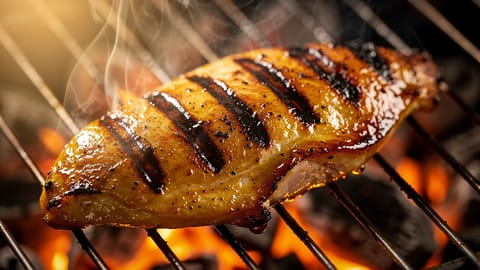
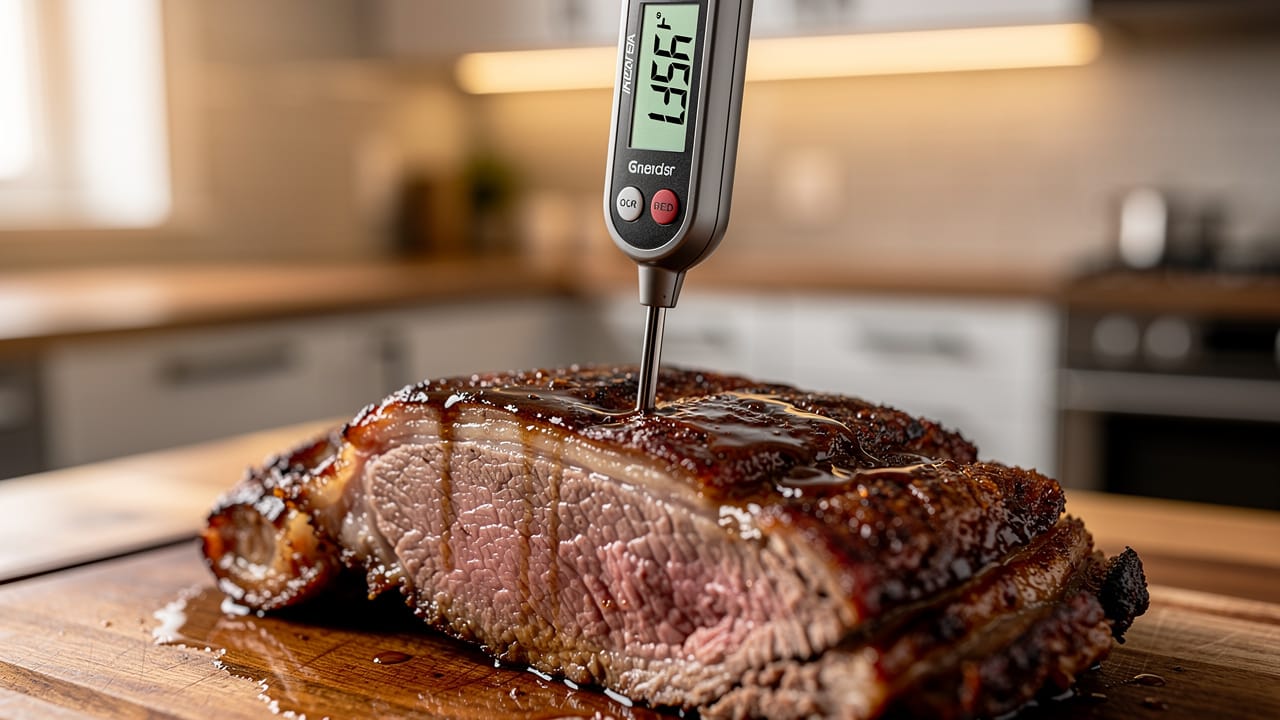
For a chicken breast, slide the probe in from the thick end toward the center. For a steak or chop, go in from the side, parallel to the board. For a whole bird, check the thickest part of the thigh without touching bone, then the breast. For a roast, the center of the thickest section.
How to calibrate
What are the target temperatures for meat?
The pull temperatures below are our cooking targets, chosen so that carryover cooking during resting lands the meat on the final number. The final numbers for poultry, pork, and ground meat follow published food-safety minimums; the beef, lamb, and fish rows are doneness preferences. For grate-level heat zones and a fuller chart by cut, see the grilling temperature guide.
| Protein | Doneness | Pull temp | Final temp (after rest) |
|---|---|---|---|
| Chicken / turkey (breast) | Done | 71°C (160°F) | 74°C (165°F) |
| Chicken / turkey (thigh) | Done | 79°C (175°F) | 82°C (180°F) |
| Beef | Rare | 49°C (120°F) | 52°C (125°F) |
| Beef | Medium-rare | 53°C (128°F) | 56°C (133°F) |
| Beef | Medium | 57°C (135°F) | 60°C (140°F) |
| Beef | Medium-well | 63°C (145°F) | 66°C (150°F) |
| Pork (chops, loin) | Done, slightly pink | 60°C (140°F) | 63°C (145°F) + rest |
| Pork (shoulder, pulled) | Done | 90–96°C (195–205°F) | — |
| Lamb | Medium-rare | 54°C (130°F) | 57°C (135°F) |
| Fish (salmon) | Medium | 49°C (120°F) | 52°C (125°F) |
| Fish (white, flaky) | Done | 54°C (130°F) | 57°C (135°F) |
Published minimums. The USDA lists 165°F (74°C) for poultry, 145°F (63°C) with a rest for whole cuts of beef, pork, and lamb, and 160°F (71°C) for ground meat. Health Canada is more conservative: 63°C for whole cuts of beef, 71°C for pork and ground meat, 74°C for poultry pieces, 82°C for a whole bird, and 70°C for fish. The beef and fish rows above sit below those figures because they are doneness preferences; pick the number that fits who you are feeding.
Other key temperatures
| Application | Temperature |
|---|---|
| Bread (most loaves and rolls) | 88°C (190°F) at the center |
| Bread (dense whole-grain, rye) | 96–99°C (205–210°F) |
| Oil for deep frying | 177–191°C (350–375°F) |
| Poaching liquid | 70–80°C (158–176°F) |
| Simmering liquid | Above poaching, below 100°C (212°F) |
| Sugar syrup (soft ball) | 112–116°C (234–241°F) |
| Sugar syrup (hard crack) | 146–154°C (295–309°F) |
| Tempered chocolate | See the tempering entry for working temperatures |
| Sous vide water bath | Varies by protein (see above) |
King Arthur Baking's testing found 190°F a sound benchmark for most yeast loaves, with baguettes and large dense whole-grain rounds better at 205–210°F.
What are the types of kitchen thermometers?
| Type | Speed | Best for |
|---|---|---|
| Digital instant-read | 2–5 sec | Spot-checking meat, bread, oil |
| Leave-in probe | Continuous | Roasting, braising, smoking |
| Infrared (surface) | Instant | Surface temperature of pans, grills, pizza stones |
| Dial (analog) | 15–30 sec | Backup, frying |
| Wireless probe (Bluetooth or Wi-Fi) | Continuous | Hands-off monitoring, smoking |
For most home cooks, one digital instant-read thermometer covers everything. If you roast or smoke often, add a leave-in probe. An infrared thermometer reads surfaces only; it is handy for checking a pan before searing but useless for the inside of a roast.
When should you check temperature?
During searing or pan-cooking: check toward the end. Repeated early pokes let juices out.
During roasting: start checking about three-quarters of the way through the estimated time. Ovens vary; the thermometer is the only reliable doneness indicator.
For poaching: check the liquid before the food goes in, then the food near the end.
For bread: insert into the bottom or side of the loaf toward the center. Most loaves are done at 88°C / 190°F; dense whole-grain and rye loaves benefit from 96–99°C / 205–210°F. A dark crust is not proof the center is baked.
For frying oil: check before adding food, and start slightly above target because the oil cools when food goes in. Clip a thermometer to the pot or use a leave-in probe.
Instant-read thermometer vs other doneness methods
| Method | Reliability | When it works |
|---|---|---|
| Thermometer | Very high | Always |
| Touch/finger test | Low-medium | Only with a lot of practice on the same cuts |
| Cutting into meat | Medium | Works but loses juices |
| Timer only | Low | Too many variables (thickness, starting temp, oven accuracy) |
| Color (pork, chicken) | Unreliable | Pork at 63°C is often still pink; chicken can look done and be under near the bone |
Instant-read thermometer in Fond
Fond hasn't launched yet. This is how it will work at launch. Join the waitlist for early access.
Fond's Cook mode shows one recipe step at a time, and steps that mention a duration carry a tappable timer. Target temperatures appear as the recipe writes them in the step, so keep the thermometer next to the phone and check when the step says to.