 Bastien
How long to let steak rest, and what the rest actually does
Resting meat is letting cooked meat sit before you cut it, usually 5 to 30 minutes depending on size, so the fibers relax and carryover cooking finishes the job instead of the juice finishing on the board.
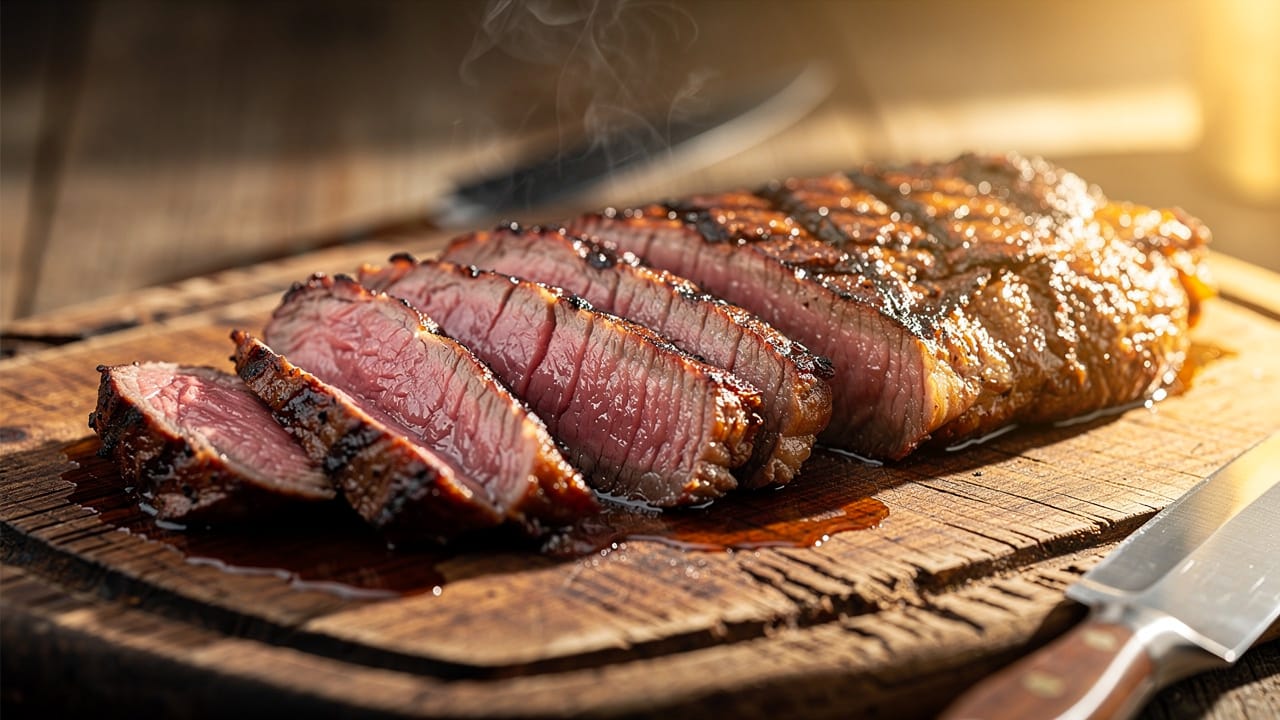
Resting meat means letting cooked meat sit for a few minutes before you cut into it. While it sits, the contracted muscle fibers relax and the pressure inside the cut drops, and the residual heat in the outer layers keeps flowing inward (carryover cooking). The visible payoff is a cutting board that stays dry instead of flooding; the reliable one is doneness that lands where you aimed.
It is also the step people skip most often, and the one most confidently oversold. Both of those are worth sorting out.
The effect on the board is measurable. America's Test Kitchen grilled four steaks, sliced two straight away and let two rest, and found that the rested steaks shed 40 percent less juice at slicing. Whether that translates into a juicier mouthful is a more interesting question, and a 2025 study says the honest answer is "less than you have been told." That is further down the page.
Why does resting meat work?
Heat makes muscle fibers shrink, and shrinking fibers squeeze water out. Measured on beef, transverse shrinkage runs from about 35°C to 62°C and lengthwise shrinkage from 55°C to 90°C, with cooking loss climbing from 7-11% of weight at 50°C to 29-40% at 80°C depending on the muscle. The hotter you push the exterior, which is exactly what searing does, the harder that squeeze gets.
Take the meat off the heat and two things unwind:
- Fibers relax. As the temperature gradient flattens, the contracted proteins loosen their grip and the pressure inside the cut drops.
- Temperature evens out. Carryover cooking keeps raising the internal temperature while the surface cools, so the finished doneness is more uniform edge to edge.
Cut into it before either has happened and the still-pressurized center vents onto the board, while the middle sits a few degrees short of where you were aiming.
One part of the standard explanation does not survive contact with the measurements: the idea that juice flows back toward the center and gets reabsorbed. It mostly does not. What resting changes is when the liquid leaves, which is the subject of the section below.
How long should you rest meat?
Two different clocks are running here, and they get conflated constantly.
The first is a food-safety rest. USDA FSIS says to cook beef, pork, lamb and veal steaks, chops and roasts to 63°C (145°F) measured before the meat leaves the heat, then allow it to rest for at least three minutes before carving or eating. Poultry has no rest requirement at all: it needs 74°C (165°F), full stop.
The second is the culinary rest, which is longer and is about texture rather than safety. The usual rules of thumb are roughly half the cooking time, or about 5 minutes per 2.5 cm (1 inch) of thickness, capped somewhere around 30 to 45 minutes for the biggest roasts. Both get you to the same place for most cuts.
The temperature window
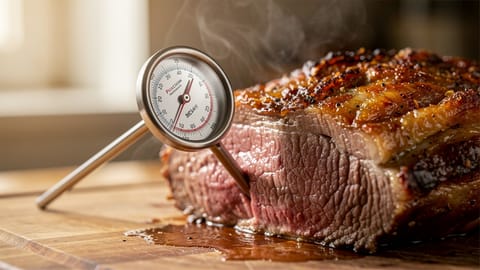
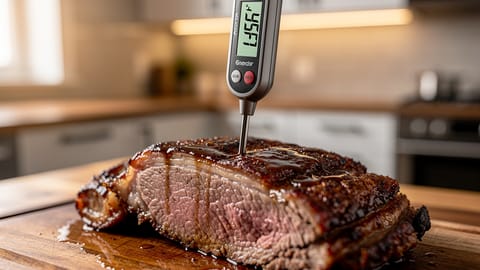
Use an instant-read thermometer to check that rested meat is still in range. America's Test Kitchen puts the practical floor at a surface reading around 49°C (120°F), with 40°C (105°F) already feeling lukewarm on the plate.
Where and how should you rest meat?
| Method | When to use | Effect |
|---|---|---|
| Cutting board, uncovered | Steaks, chops, anything with a crust you care about | Fastest cooling; best for thin cuts and seared surfaces |
| Wire rack over a tray | Steaks, roast chicken, burgers | Air circulates underneath so the bottom does not steam |
| Loosely tented with foil | Beef and pork roasts (1-3 kg) | Slows cooling; keeps the surface warm without sealing steam in |
| Wrapped in foil and a towel | Large roasts, brisket | Maximum heat retention for long rests of 30-60 minutes |
| Turned-off oven, door ajar | Large roasts when service is delayed | Holds temperature without cooking further |
Roast poultry is the exception to tenting. Foil over crisp skin softens it, so America's Test Kitchen leaves chicken and turkey uncovered and tents beef and pork roasts loosely instead.
How does resting interact with carryover cooking?
Resting and carryover cooking happen at the same time. While the meat sits, the hotter exterior keeps handing heat to the cooler center, and the internal temperature climbs 3-8°C (5-15°F) depending on the size of the cut.
That is why you pull meat off the heat below your target rather than at it. Pull temperatures by cut live in the carryover cooking guide.
| Cut type | Expected carryover during rest |
|---|---|
| Thin steak (2.5 cm) | 3-5°C (5-9°F) |
| Thick steak (5 cm) | 5-8°C (9-15°F) |
| Roast (2+ kg) | 5-8°C (9-15°F) |
| Whole poultry | 3-5°C (5-9°F) |
After a reverse sear the rise is smaller, because the meat came up to temperature slowly and the gradient never got steep. Rest it five minutes anyway, but pull much closer to your target than the table suggests.
How much liquid ends up on the board?
The clearest published numbers come from an America's Test Kitchen experiment on pork loin. Five boneless loins were roasted to 60°C (140°F); one was sliced immediately and the others rested for 10, 20, 30 and 40 minutes. The immediately sliced roasts shed about 10 tablespoons of liquid at the knife; the ones rested 10 minutes shed about 4.
| Rest time | Liquid shed at slicing |
|---|---|
| Sliced immediately | ~10 tablespoons |
| 10 minutes | ~4 tablespoons |
| 20 minutes | ~2.5 tablespoons |
| 30 minutes | ~1 tablespoon |
| 40 minutes | ~2 teaspoons |
The curve is steep early and flat late: the first ten minutes do most of the work, which is why a steak gains nothing from a long rest. Read the column heading carefully though. This is drip at the knife, not water still inside the meat, and the roast was dripping onto its own rack the whole time it rested. The next section is about what happens when you add both columns together.
Is letting meat rest a myth?
The honest answer is that a chunk of it is, and the part that survives is worth keeping.
Start with what the kitchen tests actually count. Both ATK experiments measured liquid shed at slicing, and they collected whatever the meat dripped during the rest separately. That is a reasonable way to answer "will my board flood," and it is not the same question as "did the meat keep more water."
Someone finally measured the second question. In 2025, researchers at Agriculture and Agri-Food Canada put beef roasts through rests of 0, 8 and 13 minutes and weighed both kinds of loss. Rested roasts lost more during the rest and less at slicing. Total moisture loss, resting plus slicing, came out about the same whether the roast rested or not, and a sensory panel found no difference in appearance, moisture, fat content or eating quality. Their conclusion, verbatim: resting beef roasts "provided no significant palatability benefits and, for convenience, consumers may forego this practice without detriment to eating quality."
That is one study on one kind of cut at two short rest lengths, so it does not settle steaks, poultry, or the 30-minute holds people give a prime rib. It does puncture the strongest version of the claim.
What still holds up:
- Carryover is real and it is the reason to wait. The internal temperature keeps climbing for minutes after the meat leaves the heat. If you pull at your target instead of below it, you overshoot, and no amount of resting undoes that.
- The board stays clean. Less liquid at slicing is a genuine, if modest, practical win, especially when you are carving in front of people.
- Big cuts need the pause anyway. A turkey or a brisket has to be handled, carved and plated, and it holds serving temperature for long enough that the rest costs nothing.
What does not hold up: the claim that skipping the rest costs you a large fraction of the meat's juice, and the claim that resting fixes anything else. An overcooked roast rests into an overcooked roast.
How does resting differ across proteins?
The rest scales with thermal mass and with how hot the exterior got. A thin, hard-seared cut has a steep gradient but very little stored heat, so it equalizes fast and then cools fast. A bone-in roast has a shallow gradient and a lot of stored heat, so it keeps working for half an hour. Lean cuts also punish a long rest more than fatty ones, because there is less rendered fat to keep them tasting moist as they cool.
Beef
Beef gains the most, because it is usually taken to medium rare or medium and the gap between a hard-seared exterior and a 54°C center is as wide as it gets. Five to seven minutes covers a 2.5 cm steak. Thin, coarse-grained cuts like flank and skirt want the same short rest and then careful slicing across the grain, which does more for their texture than any extra minute on the board.
Poultry
Chicken and turkey need a rest, but a shorter and drier one. Lean breast meat gives up moisture quickly if it sits uncovered too long, and the skin softens under foil. Whole birds hold heat well because of the bone, so 15 to 20 minutes is comfortable. On safety, cook poultry to 74°C (165°F) verified with an instant-read thermometer before it comes off the heat, which is the same instruction as the grilled chicken breast method. Carryover is a bonus here, not a substitute for hitting the number.
Pork
Chops and tenderloin behave like steaks at 5 to 10 minutes. Pork roasts behave like beef roasts at 15 to 25 minutes, and the ATK pork loin numbers above are exactly this case. Pulled pork and braised shoulder have already spent hours breaking down, so the rest buys much less, though ten minutes still helps a sliced cut hold together.
Ground meat and burgers
Burgers get skipped constantly and they should not be. Grinding destroys the muscle structure that would otherwise hold liquid, so a burger cut or bitten straight off the grill dumps its juice into the bun. Five minutes on a rack, loosely tented, lets the proteins relax and lets excess fat drain instead of soaking the bread. Ground meat also has a different safety number: 71°C (160°F) for ground beef, pork, lamb and veal, and 74°C (165°F) for ground poultry.
Fish
Fish is the one protein where a long rest is a mistake. Carryover is small, the fillet is already cooked to a lower target, and it cools fast. America's Test Kitchen gives fattier fish like salmon five to ten minutes at most under cover or sauce, and says lean white fish, thin fillets and tuna steaks are better served straight away.
Lamb
Racks and loin chops sit in steak territory at 5 to 10 minutes. A bone-in leg or shoulder is a different animal: 2 to 3 kg of dense meat around bone holds a lot of heat, so give it 20 to 30 minutes like a beef roast and expect the same 5-8°C of carryover. Slow-roasted shoulder taken to shreddable can rest longer without penalty, because there is enough rendered fat and collagen to keep it moist as it cools. Lamb fat also firms up faster than beef fat on the plate, which is a good argument for warm plates.
Should you let steak rest before cooking?
This is a different question that gets asked with the same words, and it deserves a straight answer. Pulling a steak out of the fridge 20 to 40 minutes before it hits the pan gives a slightly less cold center, which can mean marginally more even cooking on a thick cut. It does not do much for a thin one: a refrigerated steak left on the counter barely moves toward room temperature in half an hour, because meat is a poor conductor and the surface warms long before the middle does.
The limit is a safety one rather than a culinary one. USDA guidance is that perishable food should not sit out of refrigeration for more than two hours, or more than one hour above 32°C (90°F), because 4-60°C is the food danger zone where bacteria multiply fastest. Thirty minutes on the counter is well inside that. An afternoon is not.
If even cooking is what you are after, a thermometer and a gentler cooking method will do more than counter time.
How do you keep meat warm while resting?
"My steak gets cold" is the standard objection, and it is mostly a solvable one. Large cuts hold heat far better than people expect. In one America's Test Kitchen check, a whole roast chicken that came out of the oven at 71°C in the breast was still above 60°C (140°F) twenty minutes later, and almost too hot to carve.
- Warm plate. Heat a plate in a 65°C (150°F) oven for a few minutes and rest the steak on it. Gentle warmth slows cooling without cooking anything further.
- Loose foil tent for roasts. Drape foil over a beef or pork roast with gaps at the sides so steam escapes. Leave poultry bare.
- Foil and towel for brisket. Wrap tightly, then in a towel, then into an empty cooler. Brisket holds serving temperature for over an hour this way.
- Turned-off oven. For big roasts when dinner runs late, a switched-off oven with the door cracked keeps things warm without pushing them further.
What are the most common resting mistakes?
You cut too soon. Rest at least 5 minutes for steaks, 15 or more for roasts. The fibers need that time to relax before they will hold the liquid.
You wrapped the steak tightly in foil. Rest uncovered or on a wire rack. Trapped steam undoes the Maillard crust you built during searing.
You cooked to your target instead of your pull temperature. Carryover adds 3-8°C (5-15°F) during the rest, so come off the heat that far below where you want to land.
Rest on a warm plate, not a cold board, and keep thin steaks to 5-7 minutes. If the meal is delayed, hold in a turned-off oven rather than extending the rest on the counter.
The foil did it. Poultry rests uncovered; save the tent for beef and pork roasts.
Those juices are concentrated flavor. Spoon them over the sliced meat or stir them into a pan sauce.
Tips
- Collect the resting juices and add them to your pan sauce or spoon them straight over the slices
- Use the rest productively: finish a sauce, dress a salad, get plates warm
- For holiday roasts, the 30-45 minute rest is the window that makes gravy possible, not dead time
- An instant-read thermometer is the only way to know whether carryover actually landed where you wanted it
Resting meat in Fond
Fond hasn't launched yet. This is how it will work at launch. Join the waitlist for early access.
When a recipe step includes a rest, Fond's cook mode picks up the duration written into that step and starts a timer with one tap, so the rest gets tracked the same way the sear did instead of being guessed at. Keeping the rest in the recipe rather than in your head is most of the battle, because the step that has no timer is the step that gets skipped.
Sources
- Resting Meat — America's Test Kitchen
- Resting Meat Is Worth It, and We've Got the Data to Prove It — America's Test Kitchen
- Prieto et al., Effect of resting time on beef roast moisture retention and palatability, Meat Science 227 (2025)
- Vaskoska et al., Muscle, Ageing and Temperature Influence the Changes in Texture, Cooking Loss and Shrinkage of Cooked Beef, Foods 9 (2020)
- Safe Minimum Internal Temperature Chart — USDA Food Safety and Inspection Service
- The Color of Meat Depends on Myoglobin — Michigan State University Extension