 Bastien
Poaching
Poaching is a gentle cooking technique that holds food in liquid at 160-180°F (71-82°C), below boiling and with no bubbles breaking the surface, to protect the texture of eggs, fish, and poultry.
Poaching is a gentle cooking technique where food cooks submerged in liquid held at 160-180°F (71-82°C), below the boiling point, with barely a shimmer on the surface. The low temperature protects proteins like eggs, fish, and chicken that tighten and dry out under higher heat.
Where searing and the Maillard reaction depend on aggressive heat, poaching works in the opposite direction. Nothing browns, nothing crisps, and the food tastes mostly of itself and of whatever went into the liquid. That is the trade, and it is why the technique survived centuries of French cooking largely unchanged.
What is the right poaching temperature?
Poaching liquid sits at 160-180°F (71-82°C). Wayne Gisslen's Professional Cooking, the standard culinary-school textbook, defines the verb as "to cook gently in water or other liquid that is hot but not actually bubbling, 160°-180°F (71°-82°C)", and the Auguste Escoffier School of Culinary Arts gives the same range. The book's chapter on submersion poaching stretches the top end slightly, to 185°F (85°C), for meat and poultry.
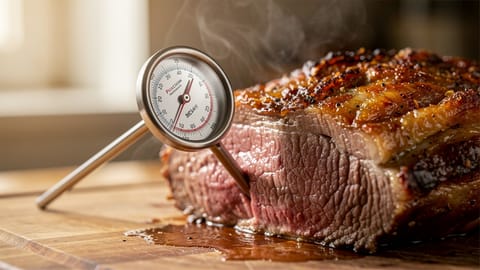
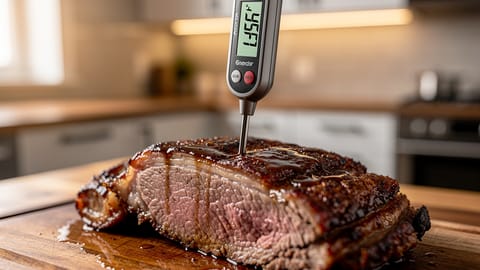
An instant-read thermometer settles the question in a second, and it is worth using until the visual cues become automatic.
The cue to watch is the surface: steam and a faint shimmer, but no bubbles breaking through. Once bubbles arrive you have crossed into a simmer, which runs 185-205°F (85-96°C) and is too aggressive for eggs and most fish. Go the other way and you stop cooking altogether. Below about 140°F (60°C) you are simply holding food at the top edge of the food danger zone.
What are the types of poaching?
Deep poaching
Also called submersion poaching. The food is fully covered by liquid, which cooks it evenly from every side. This is the method for poached eggs, whole chicken breasts, whole fish, and fruit.
Shallow poaching
The liquid comes no more than halfway up the food, and a lid traps steam to cook the exposed top. The classical procedure butters the pan, scatters chopped shallots across the bottom, and lays a sheet of buttered parchment over the fish before the lid goes on. Because so little liquid is used, what remains is concentrated enough to reduce into the sauce, which kitchens on both sides of the Atlantic call the cuisson. That final reduction is close cousin to deglazing.
Butter poaching
The food cooks in warm butter, or in a butter-and-water emulsion, at the low end of the range. Lobster, shrimp, and delicate fish take well to it. The fat carries heat gently and bastes the protein at the same time.
Should you start in cold or hot liquid?
Both are correct, for different reasons, and the classical procedure picks one per ingredient:
| Food | Start | Why |
|---|---|---|
| Fresh meat and poultry | Hot, seasoned liquid | Keeps more flavor inside the food |
| Cured or smoked meat | Cold, unsalted water | Draws excess salt and smoke out |
| Shellfish, small fish, portion cuts | Hot liquid | Short cook, no time needed to even out |
| Large whole fish | Cold liquid | Cooks evenly and avoids sudden contraction that splits the skin |
Home cooks often start chicken breasts cold anyway, since a slow climb through the temperature range is more forgiving on a thick piece of meat and leaves you with a better-flavored broth. You are choosing between flavor in the food and flavor in the liquid.
How do you poach an egg?
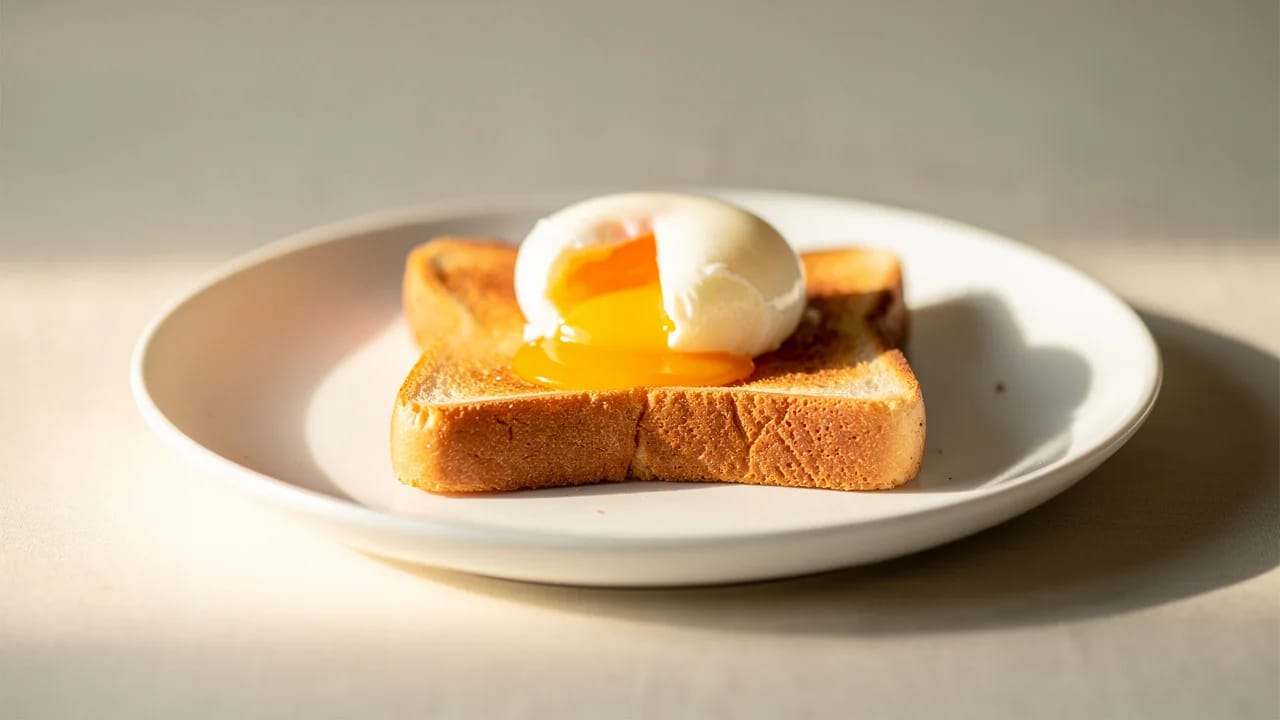
Poached eggs are the part of this technique most people struggle with. The goal, in the textbook's words, is a compact round mass rather than an egg spread all over the pan.
Two of those steps are worth pausing on. Straining is the one most people skip, and it does more for the shape of the egg than any swirling trick. Vinegar is the one most people over-apply: Professional Cooking is blunt that it is unnecessary with very fresh eggs and should be left out in that case, because whites cooked with vinegar come out tougher and less shiny.
How long to poach an egg by doneness?
| Doneness | Time | Yolk result |
|---|---|---|
| Very runny | 2-3 min | Fully liquid, warm through |
| Soft (classic) | 3-4 min | Liquid center, white fully set |
| Medium | 4-5 min | Yolk set at the edges, liquid core |
| Firm | 5-6 min | Yolk mostly set with a slight give |
Times assume a large egg going into 170-180°F (77-82°C) water. Egg size, fridge-cold versus room temperature, and how many you add at once all move the number, so treat the first egg of a batch as the test.
Note: A runny yolk is not a fully cooked egg. US guidance is to cook eggs until the yolk and white are firm, and egg dishes to 160°F (71°C). Soft-poached eggs carry a small salmonella risk that matters most for young children, older adults, pregnant people, and anyone immunocompromised. Pasteurized shell eggs are the way around it.
What liquid is best for poaching?
The liquid is a seasoning, not just a heat medium. Pick it for what you are cooking:
| Liquid | Best for | Flavor contribution |
|---|---|---|
| Water + vinegar | Eggs | Clean, neutral |
| Court-bouillon | Fish, shellfish | Aromatic (herbs, peppercorns, bay leaf, wine) |
| Stock / broth | Chicken, dumplings | Savory depth |
| Milk / cream | Smoked fish, eggs | Silky texture, gentle flavor |
| White wine | Fish fillets | Acidity, complexity |
| Red wine | Pears, beef | Rich, tannic |
| Sugar syrup | Fruit (pears, peaches) | Sweet, aromatic |
| Olive oil | Fish, vegetables | Mediterranean richness |
Court-bouillon is the classic poaching liquid for fish. Gisslen defines it as water with seasonings, herbs, and usually an acid, used for cooking fish; the name is French for "short broth", so called because it comes together quickly rather than simmering for hours like a stock. A working version is water with onion, carrot, celery, peppercorns, bay leaf, parsley stems, and a splash of white wine or vinegar. Strain it before use, and freeze what you do not need.
How do you poach a chicken breast?
Poaching is the method to reach for when chicken breast is headed into a salad, a sandwich, or a soup. No browning, no dry edges, and you get a light broth out of it.
Strain the poaching liquid and keep it. It is a light chicken stock, good for three days in the fridge or several months frozen.
How do you poach fish?
Fish is what poaching was built for. The gentle heat cooks it through without drying it or breaking the fillet apart.
| Fish | Poach time | Liquid temperature |
|---|---|---|
| Salmon, 1-inch (2.5 cm) fillet | 10-12 min | 170°F / 77°C |
| Halibut | 8-10 min | 170°F / 77°C |
| Cod | 8-10 min | 170°F / 77°C |
| Sole or flounder | 5-7 min | 165°F / 74°C |
Doneness cues matter more than the clock here: the flesh should feel firm and turn opaque all the way through. US guidance for fish is 145°F (63°C) internal, or flesh that is opaque and separates easily with a fork. Restaurant kitchens routinely pull salmon well before that, around 125-130°F (52-54°C), for a translucent center. That is a doneness preference rather than a safety target, and it carries the risk that comes with undercooked fish.
For shallow poaching, set the fillets in a buttered pan in a single layer, add liquid halfway up, cover with buttered parchment and a lid, bring it just to a simmer, then finish in a moderate oven. Thin fillets take only a few minutes.
How does poaching compare to other wet-heat methods?
| Method | Temperature | Time | Best for |
|---|---|---|---|
| Poaching | 160-180°F (71-82°C) | Short-medium | Delicate proteins, fruit |
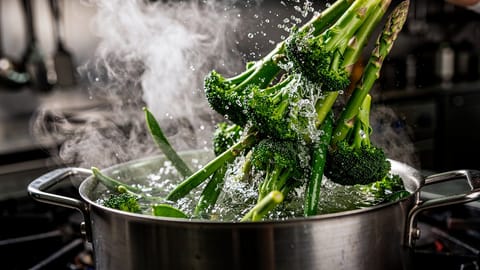
| Blanching | 212°F (100°C) + ice bath | Very short | Vegetables, peeling |
| Simmering | 185-205°F (85-96°C) | Medium-long | Soups, sauces, grains, tough cuts |
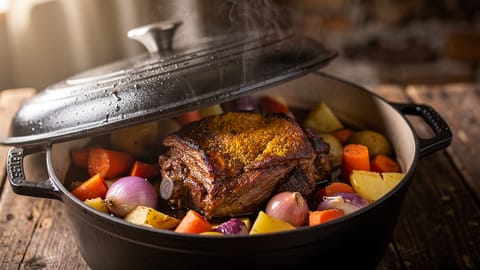
| Braising | 300-325°F (150-165°C) oven | Long | Tough cuts, root vegetables |
| Sous vide | Precise (any temp) | Long | Precise doneness, hands-off |
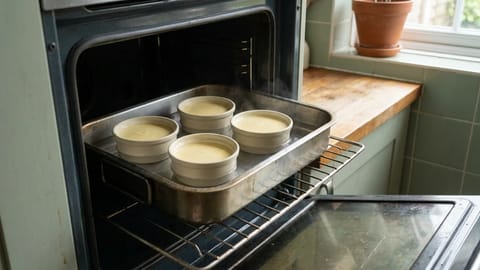
Poaching is the gentlest of the submersion methods. The line between it and simmering is bubbles: a simmer has them, a poach does not. Sous vide is more precise still, but it needs equipment and hours. For custards and other heat-shy mixtures, cooks reach for a bain-marie instead, so the food never touches direct heat.
What are the advantages and disadvantages of poaching?
The main disadvantage of poaching is that nothing browns. No crust, no roasted flavor, no Maillard reaction, which is exactly why the technique was never used for the dishes people cook for those qualities. Poached food also takes its character from the liquid, so plain water gives plain results, and the temperature window is narrow enough that a stovetop needs watching.
What goes wrong when poaching?
The liquid is too hot and has crossed into a simmer. Pull the pan half off the burner until only steam and a shimmer are left. Boiling toughens proteins and knocks delicate food apart.
The thin outer white was not drained off. Strain the egg through a fine-mesh sieve before it goes in, and use the freshest eggs you can find.
There was not enough liquid. Deep poaching needs the food fully submerged; shallow poaching needs liquid halfway up and a lid. Anything sticking out of the liquid cooks at a different rate.
Plain water seasons nothing. Salt the liquid at minimum, and add aromatics: herbs, peppercorns, a little acid, or use stock instead of water.
They were moved too much. Set them in gently, leave them alone while they cook, and lift them out with a slotted spoon rather than a solid one.
Don't. It has picked up flavor from the food and the aromatics. Strain it and use it as a sauce base, a soup base, or a light stock.
Poaching in Fond
Fond hasn't launched yet. This is how it will work at launch. Join the waitlist for early access.
Fond's cook mode walks a recipe one step at a time and keeps a timer on each step that needs one, which is most of what poaching asks for: get the liquid right, then leave the food alone for a known number of minutes. Step notes are where the temperature cue lives, so the number stays in front of you instead of in the method paragraph you already scrolled past.
Sources
- Gisslen, Wayne. Professional Cooking (moist-heat methods, simmering and poaching procedures)
- Auguste Escoffier School of Culinary Arts — 25 Cooking Techniques Every Cook Should Know
- Escoffier Online — The Difference Between Poaching, Simmering, and Boiling
- Minnesota Department of Health — Proper Cooking Temperatures for Safe Food at Home