 Bastien
Bread Flour
Bread flour has more gluten-forming potential than typical all-purpose flour. It can make dough stronger and chewier, but protein levels and performance vary by brand.
Bread flour is wheat flour chosen for greater gluten-forming potential than typical all-purpose flour. In the same bread recipe, it will usually produce a stronger, more elastic dough and a chewier crumb. It does not guarantee a taller or more open loaf on its own: hydration, mixing, fermentation, shaping, and the flour's specific properties still matter.
Protein is the easiest clue on a bag, but it is not a universal classification. Brands and countries use different wheat blends and specifications, so a fixed protein range cannot describe every product sold as bread flour or strong flour.
Bread flour vs all-purpose flour: what is the difference?
Bread flour usually contains more gluten-forming protein than all-purpose flour. Once water and mixing bring those proteins together, the resulting gluten network helps a dough stretch and retain fermentation gases. All-purpose flour has a broader brief: enough structure for many breads, but moderate enough for cakes, cookies, sauces, and other everyday cooking.
These are tendencies, not promises. A high-protein whole-wheat flour, for example, can behave differently because bran interferes with the gluten network. Two white flours with similar protein labels can also absorb water or balance elasticity and extensibility differently.
How much protein is in bread flour?
There is no single percentage that applies to every bread flour. In one useful brand-specific comparison, King Arthur lists its bread flour at 12.7% protein and its all-purpose flour at 11.7%. Those figures describe those products, not a worldwide standard.
In the United States, divide the grams of protein per serving by the serving weight to estimate the percentage, remembering that Nutrition Facts values are rounded. Elsewhere, protein is often listed directly per 100 g. Use that number as a screening tool, then check whether the mill recommends the flour for bread, pizza, bagels, brioche, or long fermentation.
Protein quantity indicates potential, not the complete performance of a flour. Wheat variety, protein quality, milling, absorption, and dough process all affect the result.
When should you use bread flour?
Use the flour named by a tested recipe when possible. Bread flour is especially useful when the formula depends on a resilient dough, such as a chewy bagel, some pizza styles, or a wet loaf designed around high hydration. It may also help dough carry the butter, eggs, or sugar in an enriched bread, though many enriched recipes are deliberately developed for all-purpose flour.
All-purpose flour can make excellent bread. It is often suitable for sandwich loaves, rolls, lower-hydration doughs, and recipes designed around its softer texture. Bread flour is not an automatic upgrade, and it is rarely the best default for tender cakes or pastry.
Can you substitute all-purpose flour for bread flour?
Usually, yes. Start with the same flour weight, follow the recipe's process, and judge the dough rather than assuming the result will be identical. An AP dough may feel looser, absorb less water, or bake with a softer and tighter crumb. If the dough is very wet, reserve a little of the recipe's water and add it only as the dough can take it.
Do not rely on a universal teaspoon-of-vital-gluten formula. The calculation depends on the starting flour, the gluten product, and the target flour. Extra gluten can also change elasticity and texture without reproducing the original bread flour.
The reverse swap also needs judgment. Bread flour in a recipe written for AP may need slightly more liquid and can produce more chew. For cake, biscuits, pie dough, or another tender bake, use the specified flour unless you are prepared to test the formula.
Is bread flour the same as strong flour?
The terms overlap, but they are not a single international standard. In the UK, "strong flour" commonly labels flour intended for bread. In other markets, strength may be expressed with a W value measured by an alveograph. Protein can help you compare bags, but it does not replace the mill's baking specification.
This matters when adapting a recipe from another country. Match intended use and technical details where available instead of translating the flour name literally.
How is bread flour different from 00 flour and semolina?
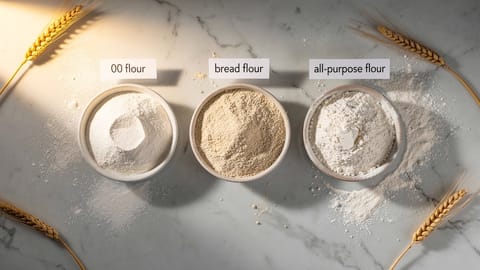
These labels describe different things. Bread flour describes intended performance. Italian 00 is a refinement grade, so a 00 flour can be weak or strong depending on its protein and W specification. Semolina is a granular product usually made from durum wheat and behaves differently from white bread flour.
| Label | What it mainly tells you | What to check next |
|---|---|---|
| Bread flour | Intended for stronger bread dough | Protein, absorption, recipe use |
| 00 flour | Italian refinement grade | Protein, W value, pizza or pasta use |
| All-purpose flour | Broad household use | Brand protein and recipe fit |
| Semolina | Grain product and texture | Wheat type and intended use |
For pizza, temperature, fermentation time, and style matter as much as the label. Use the pizza flour guide to match the flour to the dough rather than assuming every 00 or bread flour is interchangeable.
Common bread flour problems
Flour is only one possibility. Check fermentation, dough temperature, shaping, and gluten development before changing flour. The windowpane test can help assess development in suitable wheat doughs.
Give the dough a short covered rest before shaping again. If it remains unusually stiff, compare its hydration with the formula and your flour's absorption.
The replacement flour may absorb less water. Avoid burying the dough in extra flour; use folds, time, and a small water adjustment if the recipe allows.
Check flour measurement, baker's percentage, mixing, and bake time. A strong flour cannot compensate for too little water or overbaking.
A practical bread flour checklist
Bread flour in Fond
Fond hasn't launched yet. This is how it will work at launch. Join the waitlist for early access.
Fond's recipe scaling adjusts ingredient quantities while preserving the recipe's proportions. When a recipe specifies bread flour, keep that flour choice unless you intentionally test a substitute and record any water adjustment.