 Bastien
Which flour to use for pizza dough, and how to read the numbers on the bag
00 vs. bread flour vs. all-purpose: what actually matters is protein content and gluten strength, and how they match your pizza style. Includes the AVPN flour specification, what a W value really measures, and a style-to-flour matching table.
TL;DR: Match the flour to the style and the oven. Neapolitan wants Italian type 00 at W 250-320 and 11.5-13.5% protein, the range the AVPN International Regulation sets. New York-style and pan pizzas want bread flour at 12-14%. Thin and crispy wants less protein, not more. Protein tells you how much gluten a flour can build; the W value tells you how much work and fermentation it can take before it gives up. Once the flour is settled, the pizza dough calculator handles the ratios.
Why pizza flour matters
Flour is the biggest single component of pizza dough by weight. At Neapolitan proportions, 1.6 to 1.8 kg of flour per litre of water, it comes to roughly 60% of the finished dough. Everything else, water and salt and a fraction of a gram of yeast, is acting on it.
Which flour you pick decides how the dough feels in your hands, how far it stretches before it fights back, how it browns, and how long it can ferment before it slackens. Three properties do most of that work: protein quantity, gluten quality, and grind fineness. They are measured on different scales in different countries, which is most of why flour shopping feels confusing.
Once you can read those numbers, the choice gets simple. The sections below explain what each one measures and which pizza style it points to.
Types of pizza flour
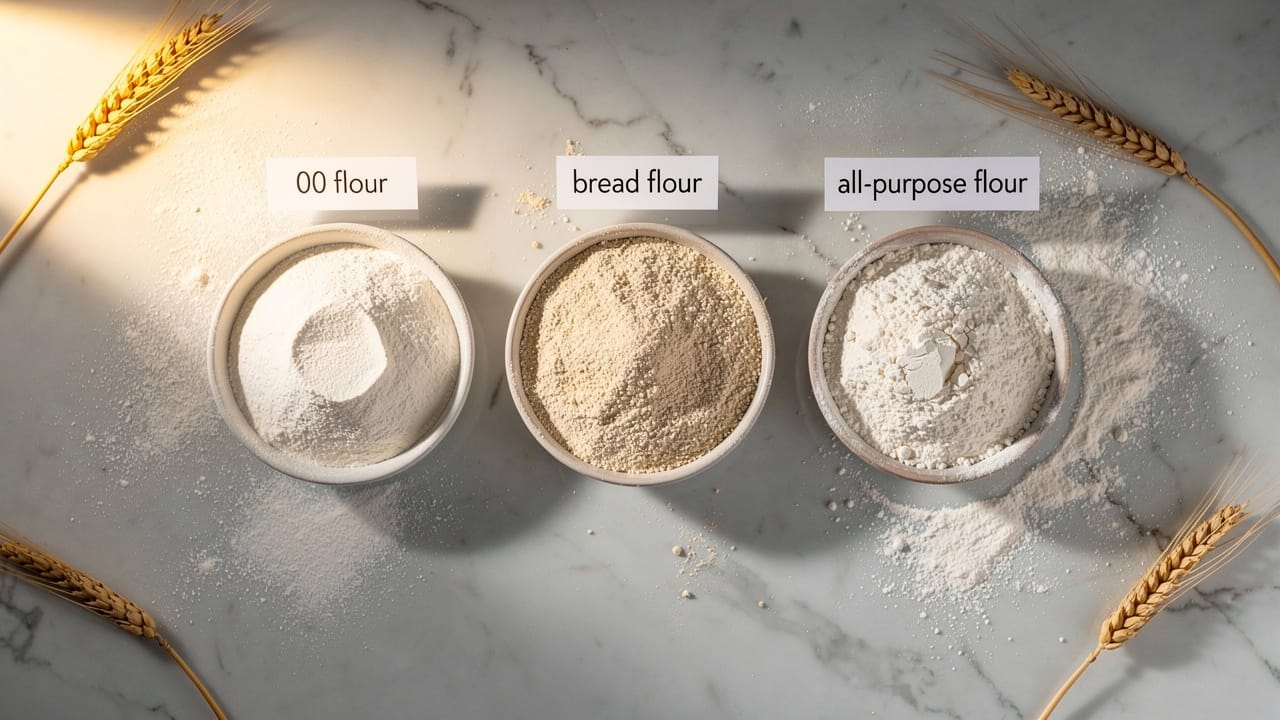
The four flours below cover nearly all home pizza. What separates them is not a single quality ranking but two independent axes that different countries chose to label. Italy grades wheat flour by how finely it is milled and how much mineral ash it retains, which is what "00", "0" and "1" mean. English-speaking mills grade by protein content instead, which is what separates "bread flour" from "all-purpose". A bag labelled 00 can be weak or strong; a bag labelled bread flour can be fine or coarse. Reading both axes is the whole skill.
Semolina is the outlier here. It is milled from a different species of wheat entirely, and it behaves less like a base flour than like a seasoning you add by percentage.
Type 00 flour (doppio zero)
Origin: Italian milling grade, based on ash content and grind fineness
Characteristics:
- Ultra-fine grind: silky, almost powdery in the hand
- Protein content: 11.5-13.5% for the AVPN pizza specification
- Ash content: under 0.55% for type 00, under 0.65% for type 0
- Gluten behavior: extensible and elastic, with a P/L ratio of 0.50-0.70
- Texture: soft, tender crusts with an open, delicate crumb
Best for: Neapolitan pizza, thin-crust pizzas, high-temperature baking (800°F+/425°C+)
The AVPN International Regulation is the most precise published target for pizza flour anywhere, so it is worth quoting rather than paraphrasing. For a long rise, it asks type 00 flour to hit W 250-320, a P/L ratio of 0.50-0.70 (ideal 0.6), water absorption of 55-62%, dry gluten of 9.5-11.5 g% and protein of 11.5-13.5 g%. The regulation describes that combination as "a medium strength flour, balanced". Type 0 is permitted on almost the same numbers, and a small amount of type 1 flour is allowed at 5 to 20%.
Two things in that list surprise people. The first is that Neapolitan flour is explicitly medium strength, not the strongest thing on the shelf. The second is the absorption figure: a flour that takes up 55-62% of its weight in water is telling you where your hydration can reasonably sit before the dough turns to soup.
Bread flour
Origin: English-language grade, based on protein content
Characteristics:
- Coarser grind: more texture between the fingers than 00
- Protein content: 12-14%, against an all-purpose average of about 11%
- Stronger gluten: chewier, more structured dough
- Water absorption: takes up more water and tolerates longer mixing
- Browning: darker crust than 00 at the same bake
Best for: New York-style pizza, thick crusts, pan pizzas, longer fermentations, home ovens (500-550°F/260-290°C)
BAKERpedia describes bread flour as a high-protein patent flour milled from the endosperm of hard red spring or hard red winter wheat, and puts its protein at 12-14% against all-purpose flour's average of 11%. That extra protein is what lets the dough absorb more water, take a longer mix, and hold structure through a two-day ferment. For the wider picture on protein bands and brand variation, see the bread flour glossary entry.
Outside the US the same flour goes by other names. In the UK look for strong bread flour; in France, T65 or farine de gruau; in Spain, harina de fuerza.
All-purpose flour
Origin: general-purpose white wheat flour
Characteristics:
- Protein content: roughly 9-12%, and it varies a lot by brand
- Milled from: hard red wheat, or a hard and soft blend at around 80:20
- Moderate gluten: less chew than bread flour, less delicacy than 00
- Widely available: every grocery store carries it
- Cheapest option of the four
Best for: home pizza, beginner bakers, thin to medium crusts, standard home oven temperatures
BAKERpedia lists pizza among all-purpose flour's normal applications, which is a useful corrective to the idea that you need something special to start. What you give up is margin. At 10% protein the gluten network has less to work with, so a long cold ferment is riskier and the crust comes out softer. Details on the protein band and how brands sit inside it live in the all-purpose flour glossary entry.
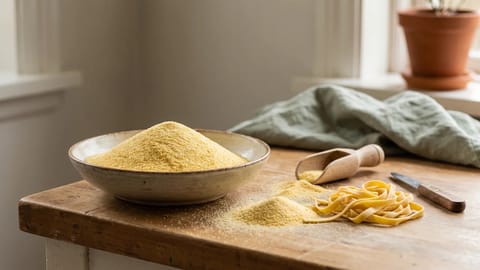
Semolina
Origin: durum wheat, a different species from bread wheat
Characteristics:
- Coarse texture: gritty and sandy, closer to fine sand than powder
- Protein content: around 12-13%, though the gluten quality is poor
- Yellow color: from carotenoid pigments in the durum endosperm
- Slow hydration: the coarse particles take time to absorb water
- Flavor: nutty and slightly sweet
Best for: blending at 10-20%, dusting peels and work surfaces, Detroit-style pizza, Roman pizza al taglio
Semolina is the one flour here that genuinely cannot carry a dough alone, and the reason is specific rather than a matter of taste. BAKERpedia puts it plainly: durum's protein fraction is weak and less extensible than bread wheat's, so at high levels the gluten cannot form the stable network a good rise needs. High protein, poor gluten quality. That is exactly the gap that the W value exists to describe.
Used at 10-20% it adds color and a little crunch. It is also the best thing to dust a peel with, because the coarse grains roll under the dough instead of absorbing into it. More on the grain itself in the semolina glossary entry.
Comparison table: pizza flour types at a glance
| Flour type | Protein % | Grind | Best for | Texture | Price |
|---|---|---|---|---|---|
| Type 00 | 11.5-13.5% (AVPN) | Ultra-fine | Neapolitan, thin crust | Soft, delicate, extensible | $$$ |
| Bread flour | 12-14% | Medium | NY-style, thick crust | Chewy, structured | $$ |
| All-purpose | 9-12% | Medium-fine | General use, beginners | Moderate chew | $ |
| Semolina | ~12.7%, weak gluten | Coarse | Blending, dusting | Crunchy, nutty | $$ |
| Whole wheat | ~12.7% | Varies | Artisan blends (10-20%) | Dense, nutty | $$ |
00 flour vs bread flour: head-to-head
This is the comparison most home pizza makers are actually stuck on.
The row that matters most is the first one. These two labels answer different questions, so a bag can be both, and comparing them as if they sat on one scale is where most of the confusion starts.
Understanding protein in pizza flour
Protein percentage is the number most bags will tell you, and it is a reasonable first filter. It sets a ceiling on how much gluten the dough can build, which in turn sets how much gas it can hold and how much handling it can take. Higher protein means more potential structure and more chew; lower protein means a softer, more tender result that stays where you put it.
What protein percentage does not tell you is gluten quality, and two flours at 12.5% can behave nothing alike. That gap is why the W value exists, and it is covered in the next section. Read protein first, then check strength if the bag reports it.
What is protein in flour?
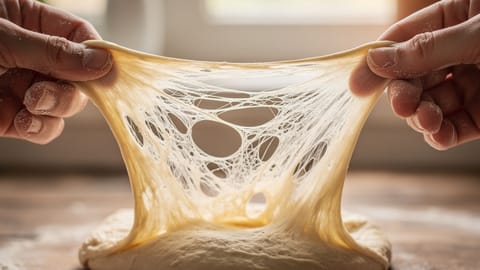
Flour protein is mostly glutenin and gliadin, two proteins that combine into gluten once they meet water and get worked. Glutenin contributes elasticity, gliadin contributes extensibility, and the balance between them is much of what makes one dough springy and another slack. How much water the flour actually takes up depends on the protein level and on the water itself, since mineral content and temperature both change how the dough comes together. The finished gluten network traps the CO2 that fermentation produces, which is where rise and chew come from.
Protein percentage ranges
- 9-11%: tender, snappy results. Good for thin and crispy, short ferments, and beginners
- 11-12.5%: balanced. The Neapolitan and thin-crust band
- 12.5-14%: strong structure. Chewy crusts, heavier toppings, long fermentation
A note on protein labeling
Something that trips up a lot of home pizza makers: protein content is often not printed on retail flour bags. Consumer packaging usually shows grams of protein per serving on the nutrition panel, which you can convert, while professional bakery flour frequently lists nothing at all on the sack. That leaves you learning your local flours by feel, which sounds unsatisfying but works. After a handful of batches with the same bag you will read the dough faster than you would read a spec sheet.
Tip: To get protein percentage from a nutrition label, divide grams of protein per serving by grams per serving and multiply by 100. Four grams of protein in a 30 g serving is 13.3%.
Bleached or unbleached for pizza?
This one comes up constantly and matters less than the internet suggests. Freshly milled flour is described as "green" and does not make well-behaved dough, so mills either age it or treat it. BAKERpedia describes what bleaching does: it oxidizes the sulfhydryl groups in the protein, which improves dough elasticity, whitens the flour, and improves its baking characteristics.
For pizza, either works. Unbleached flour is naturally aged and tends to carry slightly more wheat flavor, which is why most pizza makers reach for it, and bleached flour is a touch softer and paler. Neither will decide whether your crust is good. Protein and fermentation will.
Matching protein to fermentation length
Protein has to survive the schedule you give it. Enzymes in the flour keep breaking down the gluten network for as long as the dough sits, so a weak flour on a long ferment ends up slack and sticky.
- Up to 36 hours: 12-13% protein holds up comfortably through an overnight or day-long cold ferment.
- 36-48 hours: step up toward 13-14%. More hours mean more enzymatic breakdown, and the extra protein is what maintains structure.
If a dough has ever gone slack and unstretchable after two days in the fridge, the flour was probably too weak for that timeline rather than the yeast being wrong. These are practical starting points rather than a published standard; adjust one variable at a time and see. The fermentation guide covers the yeast side of the same problem, and the troubleshooting guide covers what to do when a dough has already gone.
Matching pizza flour protein to style
- Neapolitan (800-900°F/425-480°C): 11.5-13.5% protein, type 00
- New York-style (550-600°F/290-315°C): 12-14% protein, bread flour
- Detroit / pan pizza: 13-14.5% protein, high-gluten bread flour
- Thin & crispy: 9-11% protein, all-purpose or low-protein 00
W values explained
W is the number that tells you what protein percentage cannot: how good the gluten is, not just how much of it there is. It is printed on Italian and Spanish flour bags as a matter of course, appears on some French ones, and is almost never on American packaging. If you have ever bought two 12.5% flours and found one stretched beautifully while the other tore, W is the difference you were feeling.
The definition gets mangled a lot, including in places that should know better, so it is worth being precise about what the test actually measures.
What is the W value?
W comes from the Chopin alveograph, a rheology instrument Marcel Chopin invented in 1920. The test inflates a thin disc of dough with air until the bubble bursts, which simulates gas pressure during fermentation and oven spring, and records pressure against time.
Three numbers come out of it:
- P is the maximum pressure needed to deform the dough. This is tenacity, the dough's resistance to being stretched.
- L is how much air the bubble held before it burst. This is extensibility.
- W is the total area under the curve, the deformation energy: the total work required to expand the dough to bursting.
That distinction matters. W is not "the force needed to break the dough", which is closer to P. It is the total energy the dough absorbed along the way, which is why a flour can have a high W without being stiff. P/L is the ratio between the two, and it describes the balance. The AVPN asks Neapolitan flour for P/L 0.50-0.70, meaning noticeably more extensible than tenacious, which is exactly what hand-stretching a 12-inch base needs.
W value ranges
| W value | Strength | Typical fermentation | Best use |
|---|---|---|---|
| 90-160 | Very weak | 2-4 hours | Biscuits, pastry |
| 160-200 | Weak | 4-8 hours | Short-ferment pizza |
| 200-250 | Medium | 8-24 hours | Everyday pizza and bread |
| 250-320 | Medium-strong | 12-48 hours | The AVPN Neapolitan band |
| 350+ | Very strong | 48-72+ hours | Panettone, bagels, extended ferments |
These bands are working conventions from bakery practice rather than a single published standard, with one exception: the 250-320 row is the AVPN specification and can be taken literally.
Reading W when the bag doesn't print it
Most American flour gives you protein and nothing else, so you are estimating. Two anchors help. The AVPN's medium-strength target of W 250-320 lands at 11.5-13.5% protein, and Spain's national flour standard sets its "fuerza" grade at protein of at least 12.5% together with W of at least 250. Both point the same way: somewhere around 12.5% protein is where a wheat flour starts being genuinely strong.
Treat that as a rough bridge rather than a conversion. Wheat variety and growing season move gluten quality independently of the protein number, which is the entire reason the alveograph exists.
Best flour for pizza dough by style
Style is really shorthand for oven temperature, bake time and crust thickness, and those three decide which flour works. A 90-second bake at 900°F wants a flour that stretches thin and puffs fast. A ten-minute bake at 500°F wants a flour that holds structure while it slowly dries out. A pan pizza wants the strongest gluten you can find, because it has to lift a thick, oil-rich dough.
Below is each style with the numbers to look for and the reason behind them.
Neapolitan pizza
Recommended: type 00 or type 0, W 250-320, 11.5-13.5% protein, P/L 0.50-0.70
Why: the fine grind hydrates quickly and the extensible gluten opens by hand without snapping back, which is what gives the puffed, blistered cornicione its shape in a 90-second bake. This is the AVPN specification, not a rule of thumb.
What to use: any Italian 00 sold for pizza that publishes a W in that band. Ash under 0.55% and absorption of 55-62% are the other two numbers on the spec sheet worth a glance.
New York-style pizza
Recommended: bread flour, 12-14% protein
Why: a NY slice has to fold in half without cracking and hold up under more sauce and cheese than a Neapolitan pizza carries. That takes a stronger, more tenacious gluten network, and the same strength is what survives a 24-48 hour cold ferment.
What to use: a strong bread flour. High-gluten flour at 13.5%+ is better still if a restaurant supplier is within reach.
Detroit-style and pan pizza
Recommended: high-protein bread flour, 13-14.5%
Why: the crumb is thick and focaccia-like, and the dough has to rise against its own weight in an oiled pan while the base fries crisp. Weak gluten collapses under that.
What to use: the strongest bread flour available, labelled high-gluten or very strong.
Roman pizza al taglio
Recommended: strong 00 or bread flour at 12-14%, plus 10-20% semolina
Why: the very high hydration that gives al taglio its open, airy crumb needs a gluten network strong enough to hold that much water in suspension. Semolina contributes color and crunch to the base.
What to use: a 00 at the top of its W range, or a strong bread flour, with semolina blended in.
Thin and crispy pizza
Recommended: all-purpose or a low-protein 00, 9-11%
Why: here you actively want less gluten. A weaker network means the dough stays where it is rolled instead of contracting and puffing, so the base bakes flat and snaps.
What to use: any all-purpose flour, ideally at the lower end of its protein band.
What flour do pizzerias use?
A certified Neapolitan pizzeria is working to a published spec rather than to a preference. The AVPN regulation requires type 00 or type 0 wheat flour meeting the numbers above, and allows up to 20% type 1 flour blended in. That is why Italian pizzerias tend to talk about W values rather than brands, and why two pizzerias using different mills can produce very similar dough.
American pizzerias work the other way around, from protein. Most NY-style shops run high-gluten bread flour at 13-14.5%, the same class of flour that bagels and hearth breads are built on. It handles a multi-day ferment, supports a heavy topping load, and delivers the fold-and-chew that the style is defined by. Most of it arrives in 50-lb sacks from a foodservice distributor, which is part of why the retail bag you can buy rarely matches exactly.
For a home cook the practical conclusion is that neither answer is a shopping list. Match the protein level and the flour type to your style and your oven, and a supermarket bread flour with a no-knead method will beat an expensive imported 00 in an oven that cannot get hot enough to use it.
How to choose the right pizza flour
Choosing well takes about three decisions. Start with the oven, because it constrains everything else: a 900°F oven can use a fine, extensible 00 the way it was designed to be used, and a 500°F oven mostly cannot. Then pick the protein band that matches the style you want. Then, if the bag reports a W value, use it to separate two flours that look identical on protein alone.
Everything below is the detail behind those three steps.
What to look for on the label
Protein content first, W value second if it is printed.
| Pizza style | Protein % | Flour type | W value |
|---|---|---|---|
| Neapolitan | 11.5-13.5% | Type 00 or 0 | 250-320 (AVPN) |
| New York-style | 12-14% | Bread flour | 250-320 if printed |
| Detroit / pan | 13-14.5% | High-gluten bread flour | 320+ if printed |
| Roman al taglio | 12-14% | Strong 00 or bread flour + semolina | 300+ if printed |
| Thin & crispy | 9-11% | All-purpose or low-protein 00 | Under 200 if printed |
W values in the right-hand column are only reliable for the Neapolitan row, which comes from the AVPN spec. The rest are practical targets, and most bags in those categories will not print a W at all.
Sourcing by country
- Italy: flour is sold by W, which makes it the easiest market to shop in. W 250-320 is your everyday pizza flour.
- France: T55 is the rough equivalent of all-purpose and T65 of bread flour. Farine de gruau is the strong option.
- Spain: flour is sold by strength class. "Fuerza" is the bread flour equivalent, "gran fuerza" the high-gluten one.
- UK: strong bread flour matches bread flour; very strong bread flour at 14%+ suits pan pizzas and long ferments.
- US: bread flour is everywhere. High-gluten flour at 14%+ usually means a specialty baking supplier or a restaurant supply store.
Budget-friendly options
Most supermarket bread flours land at 12-13% and make good pizza. Check the nutrition panel, buy the same bag twice, and learn how it behaves. Understanding protein and fermentation will do more for the crust than an expensive import will. Use the pizza dough calculator to get the baker's percentages right with whatever you end up with.
Ancient grain and alternative pizza flours
Everything so far has been modern bread wheat, which is what the specifications and the W values are built around. Step outside it and the rules loosen: older wheat species and non-wheat grains bring flavor that bread wheat cannot, and gluten that is weaker, more fragile, or in some cases barely there. None of them will carry a pizza dough on their own.
The workable approach is blending by percentage, keeping bread wheat as the structural base and treating everything else as flavor. The numbers below are practical starting points from baking convention rather than tested formulas, so treat them as a place to begin.
Ancient grain flours
- Khorasan (Kamut): rich, buttery, slightly sweet, with a golden color. Try 15-25% of total flour weight blended with bread flour or 00.
- Einkorn: the oldest cultivated wheat, earthy and almost honeyed. Its gluten is weak, so keep it to 10-20% in a blend.
- Sprouted wheat: sweeter and faintly malty. Sprouted flour absorbs water differently, so expect to pull hydration back by around 5-10% from your usual formula.
These grains want shorter mixing and gentler handling, and they give a denser, more irregular crumb than modern wheat. That is the character rather than a fault, but it is worth knowing before you commit a whole batch.
Multigrain dough
Small percentages of whole wheat, rye or spelt in the base flour make a legitimate pizza style rather than a health compromise.
- 10-15% whole wheat: subtle earthiness and a darker crumb, with structure largely unchanged. Works with any style.
- 5-10% rye: a distinct tangy, almost sour note. Rye carries very little gluten-forming protein, so keep the percentage low.
- 10-20% spelt: nutty and sweet, and more delicate than whole wheat. Spelt's gluten is fragile, so handle gently and stop mixing early.
Keeping alternative flours to 10-20% of total flour weight is the general guidance, and above roughly 25% you start fighting the dough rather than working with it. The same ceiling applies to semolina, and for the same reason: weak or absent gluten diluting a network that has to hold gas for hours.
A note on gluten-free flour
Gluten-free pizza blends are a genuinely different craft, not a substitution. Without gluten there is no elastic network to trap gas, so these doughs lean on starches and binders to do that job, and they are mixed and shaped by completely different rules. Nothing on this page transfers to them, and a gluten-free blend swapped one-for-one into a wheat pizza recipe will not work.
Pizza flour storage tips
Flour looks stable and mostly is, but it does degrade, and the way it degrades depends on what is still in it. White flour keeps well because milling removes the germ and most of the bran, which is where the oils live. Whole grain and specialty flours have those oils intact, so they go rancid rather than simply getting old.
That single difference decides everything below: where a bag should sit, how long it has, and which flours are worth refrigerating.
Storage conditions
Temperature: somewhere cool and dry, around 60-70°F (15-21°C).
Moisture: away from humidity, steam and water. Damp flour clumps and can grow mold.
Container: transfer to something airtight as soon as the bag is open. Glass, plastic and metal all work, and any of them beats a folded-over paper sack. A kitchen scale matters more than the container does for actually using the flour well.
Shelf life: the commonly cited guidance is 6-8 months for white flour at room temperature and 3-4 months for whole grain, with refrigeration roughly doubling both. These are conventions rather than a tested standard, and the mechanism is the reliable part: BAKERpedia notes that whole wheat flour has a shorter shelf life than white flour because of the oil present in the bran and germ. Trust your nose over any date.
Fridge or pantry?
Room temperature is fine for flour you will finish within a few months, which covers most white flour. The fridge or freezer is worth the space for whole grain flours, specialty flours you use rarely, bulk purchases, and anywhere hot and humid.
One caveat: let refrigerated flour warm up before mixing. Cold flour drops the dough temperature, which slows fermentation and shifts the schedule you planned.
Tip: Label containers with the purchase date and the protein percentage. When a flour works well, note the mill too, so you can buy the same thing again.
Signs of flour gone bad
Cause: oils in the flour, especially in whole grain, have oxidized. A musty note instead usually means moisture and mold.
Fix: discard it. Rancid flour carries an off-flavor straight into the crust, and baking will not fix it.
Cause: moisture got into the container and bound the starch.
Fix: a few small clumps with no smell will sift out and are fine to use. Widespread clumping means the whole container is compromised.
Cause: flour beetles or pantry moths, often arriving as eggs already in the bag.
Fix: discard the flour and clean the storage area thoroughly. Freezing new flour for 48 hours before decanting prevents a repeat.
Final pizza flour tips
Start with bread flour or all-purpose while you learn the process. The specialty bag is worth it later, once you know what the dough is supposed to feel like. Our beginner pizza dough guide walks through a first recipe.
Match the flour to the oven before anything else. A 700°F+ oven can use 00 properly; a standard 500-550°F home oven usually does better on bread flour. The pizza equipment guide covers what your oven can and cannot do.
Try blends once you are comfortable. Bread flour with 20% semolina, or 00 with some bread flour, are both worth a batch.
One factor people overlook is the water. Hard water tightens gluten and soft water loosens it, so if your dough is consistently stiffer or slacker than the recipe suggests, mineral content may be part of the answer.
Get the flour right and the difference shows up immediately, in how the dough opens and how the crust eats. Whether you are planning an overnight dough, a sourdough pizza, or a poolish or biga pre-ferment, this is the decision everything else is built on. Quick answers to everything adjacent live in the pizza dough FAQ.
- Italian grades measure grind and ash; English-language grades measure protein. A bag can be 00 and weak, or bread flour and fine
- The AVPN specification for Neapolitan pizza flour is W 250-320, 11.5-13.5% protein, P/L 0.50-0.70 and ash under 0.55%
- W is the deformation energy from a Chopin alveograph, the area under the curve, not the force at which dough breaks
- Protein sets the ceiling on gluten quantity; W describes gluten quality, which is why two 12.5% flours can behave differently
- Supermarket bread flour makes very good pizza. Matching flour to oven and fermentation length matters more than the brand