 Bastien
The 8 best meal planning apps in 2026, compared
A comparison of eight meal planning apps, from free options to paid planners. Which ones plan from your own recipes, which hand you a catalogue, and which turn a week of meals into one grocery list.
Most meal planning apps fall into one of two camps, and picking the wrong camp is why people abandon them after a couple of weeks.
The first camp plans from a catalogue. You answer a few questions about diet and household size, and the app hands you a week of its own recipes plus a shopping list. The second camp plans from your recipes. You bring the collection you already have, drop meals onto a calendar, and the app turns that into a list.
Neither is better in the abstract. They suit different kitchens. If you have a folder of recipes you actually cook, a catalogue app will feel like it is ignoring you. If you are staring at an empty planner on a Sunday night with no idea what to make, a bring-your-own-recipes app hands you the same blank page you already had.
This comparison covers eight apps across both camps, with what each costs and where each one gets awkward.
Note: Fond is our app, and it is not released yet. It is listed first because planning from your own recipes is the problem we are building it for, not because it beat the others in a test. You can join the waitlist today; every other app on this page is available now.
Quick comparison
How to choose in one question
Where do your recipes come from?
If the answer is "the internet, my mum, and a photo of a cookbook page," you want an app that imports well and plans from what you own. If the answer is "I do not have any yet," you want a catalogue app that decides for you. Everything else, including price, matters less than getting this right.
1. Fond
Best for: People who cook from a collection they have gathered themselves.
Disclosure: We make Fond, and it is not released yet. What follows describes how it is designed to work at launch. Join the waitlist to hear when it opens.
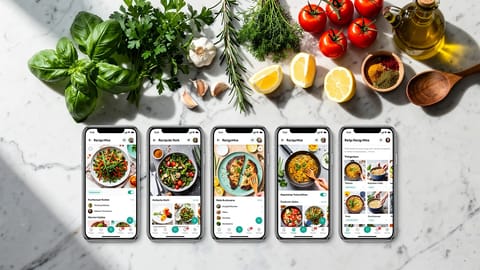
Fond starts from your recipes rather than a catalogue. Recipes come in by URL, photo, or pasted text, and the AI import turns them into structured ingredients and steps, which is what makes scaling and accurate lists possible later. If most of your collection currently lives in bookmarks, our guide to importing recipes from websites covers moving it across.
Planning works by describing the week rather than filling a grid. You can ask for something like three quick dinners and one longer weekend meal, or ask it to use the chicken first, and the planner drafts a week from recipes available in your account. The draft appears as a preview, so you approve or swap before the calendar changes.
The part that matters most for weekly cooking is what happens next. Approving a plan builds a single grocery list: repeated ingredients get combined, quantities scale to your servings, and leftovers do not get counted a second time. Planning and shopping stay one task instead of two.
The catch is the same as its strength. Fond assumes you have recipes worth planning around. If you are starting from zero, you will spend the first evening importing before the planner is useful.
Platforms: Not released yet. Web, iOS, Android, macOS, and Windows are planned.
Price: Launch pricing is a Free plan with 10 AI recipe imports a month, meal planning and grocery lists included, or Cook at $49 for the first year (then $59/year) or $7.99/month. See pricing for current plan details.
Worth waiting for if: You already collect recipes and want planning and shopping to come from them. At launch, the Free plan includes planning and the grocery list, which is enough to see whether the workflow fits before paying.
2. Mealime
Best for: Starting from nothing and wanting the week decided for you.
Mealime is the clearest example of the catalogue approach. You set dietary preferences, allergies, dislikes, and serving sizes, then it builds a week from its own tested recipes and generates a categorized shopping list. The recipes lean toward quick weeknight cooking.
For a free tier, it is genuinely usable. Planning and shopping lists are not paywalled, which is unusual. Pro, at $2.99 a month according to its App Store listing, mainly adds nutrition detail and search by nutrient.
The limitation is ownership. Importing and managing your own recipes is not what Mealime is built for, so a collection you have spent years gathering does not really come along with you. It is a meal planning service more than a recipe manager.
Platforms: iOS, Android, web.
Price: Free. Pro $2.99/month.
Worth it if: You want plans handed to you and do not have a recipe collection to bring. Explore Mealime alternatives.
3. Plan to Eat
Best for: People who think in calendars and want planning as the main event.
Plan to Eat is planning-first and recipe-management-second. A browser clipper pulls recipes in from the web, you drag them onto a calendar, and the shopping list builds itself from whatever is scheduled. You can plan weeks ahead, reuse past plans, and add notes for the evenings when nobody is cooking.
The calendar is the strongest part. If you like seeing a month laid out and moving meals around, this is the most direct expression of that idea in the list.
Two things to weigh. There is no free tier, though the 14-day trial does not ask for a card. And the recipe side stays basic: the clipper depends on well-structured recipe pages, so blogs that bury a recipe under a long story import less cleanly than they would through an AI parser.
Platforms: Web, iOS, Android.
Price: $5.95/month or $49/year. 14-day free trial, no card required.
Worth it if: Calendar planning is the job and you are happy clipping recipes yourself. Explore Plan to Eat alternatives.
4. Paprika
Best for: Avoiding a subscription entirely.
Paprika is a recipe manager that happens to include meal planning, and it has been doing both for years. You get a clipper, categories, search, a planning calendar, and grocery lists, in an interface that prioritizes function over polish.
The appeal is the pricing model. You buy it once per platform and own it, with no recurring charge. Its own site notes that each version is sold separately, which is the detail people miss: buying it on a phone does not cover a laptop.
Planning is competent but plain. There is no AI import, no photo import, and sync between devices can lag.
Platforms: iOS, Android, Mac, Windows.
Price: $4.99 one-time on iOS. Sold separately for each platform.
Worth it if: You want to pay once, you clip mostly from recipe sites, and you only need it on one or two devices. Explore Paprika alternatives.
5. Samsung Food
Best for: Browsing a very large recipe catalogue.
Samsung Food, formerly Whisk, combines a big public recipe library with a planner and shopping list. You can save recipes from the web, use its own collections, and build a week from either. Despite the name, it is not restricted to Samsung devices.
The meal planner is included at no cost, which puts it among the more generous free options here. A paid Food+ tier exists and adds extra features on top, and Samsung device owners are sometimes given an extended trial of it.
The trade-off is focus. The catalogue is broad, and recipe quality varies more than in a curated set like Mealime's. It is a discovery tool with planning attached rather than a planner built around your own cooking.
Platforms: iOS, Android, web.
Price: Free, including the meal planner. Paid Food+ tier available.
Worth it if: You want a large library to browse and a free planner sitting next to it.
6. AnyList
Best for: A shared grocery list that several people edit at once.
AnyList began as a shopping list app, and that heritage still shows in the best way. Lists sync in real time, sort themselves by aisle, autocomplete as you type, and work with Siri and Alexa. For households where two people shop, it is the most natural fit in this list.
Meal planning is included in the free version, which is more generous than it is often given credit for. The free tier does cap recipe storage at five, so the planning side only opens up properly on the paid plan.
AnyList Complete costs $9.99 a year for one person or $14.99 for a household, which is the cheapest paid option here by a wide margin. It adds unlimited recipe imports, recipe scaling, photos, location reminders, and multi-store lists.
Platforms: iOS, Android, Mac, web.
Price: Free with a five-recipe cap. Complete $9.99/year individual, $14.99/year household.
Worth it if: The shopping list is the part you care about and the meal plan is a means to it.
7. Cozi
Best for: Families already coordinating a shared calendar.
Cozi is a family organizer first. The color-coded shared calendar is the center of it, with lists, reminders, and a recipe box and meal planner alongside. Meals sit inside the same place the school run and football practice already live, which is the whole argument for it.
The free version carries ads, and the free calendar now only shows a 30-day window. Cozi Gold, listed at $39 on Cozi's site, removes ads, restores the full calendar, adds search and extra reminders, and improves the shopping mode.
As a meal planner in isolation, it is the thinnest option here. Recipe management is basic and there is no serious import. Its value comes from meals being one tab in a system the household already opens daily.
Platforms: iOS, Android, web.
Price: Free with ads. Cozi Gold $39.
Worth it if: Your family already runs on a shared calendar and meals should live beside it.
8. Mealie
Best for: Self-hosting, and wanting to own the data.
Mealie is a free, open-source recipe manager and meal planner that you run on your own server. It imports from URLs, plans weeks, generates shopping lists, and supports multiple users in a household.
Because you host it, there is no subscription and no company holding your collection. For anyone already running a home server, it slots in easily.
The cost is your time. Getting it running means dealing with Docker, storage, backups, and remote access if you want it away from home. There is no native mobile app, so phones use the browser. This is the right pick for a narrow group and the wrong one for everybody else.
Platforms: Self-hosted web, works in mobile browsers.
Price: Free and open source. You pay for hosting.
Worth it if: You already self-host and you would rather spend an evening configuring than pay monthly. Explore Mealie alternatives.
Best meal planning app for importing recipes from websites and photos
A good share of the people who land on this page are not asking about planning at all. They want to know which app can take a recipe from a website, a screenshot, or a photo of a cookbook page and then plan from it. That narrows the field quickly, because the catalogue apps do not need import and mostly do not offer it.
Fond, our app, is built to import by URL, photo, or pasted text and turn the result into structured ingredients and steps for the planner and the grocery list. It is not released yet; at launch the Free plan includes 10 AI imports a month. Paprika pulls recipes from the web through its built-in browser and is the reliable no-subscription option for that job, though it does not read photos. Plan to Eat and AnyList also import from recipe sites, with AnyList capping free recipe storage at five.
If import quality is the deciding factor, test it with the ugliest recipe you own before paying for anything. Our guide to importing recipes from websites explains what each method does with a messy page.
Which meal planning apps are actually free?
Free means different things across these apps, so it is worth being precise.
The pattern worth noticing: apps that plan from their own catalogue tend to be free, because the catalogue is the product. Apps that plan from your recipes tend to charge, because storage and import cost them something per user.
Meal planning apps with grocery lists
Every app here produces a shopping list, so the feature itself is not a differentiator. How the list behaves is.
The test that separates them is consolidation. Plan three recipes that each need garlic, and a weak list gives you three garlic lines. A good one gives you a single line with the quantities added up. Plan to Eat and AnyList both consolidate across a plan, and Fond is built to. AnyList additionally sorts by aisle and handles more than one store.
Two smaller behaviors matter more than people expect. Whether the list scales quantities when you change servings, and whether it skips staples you always have in the cupboard. Adding salt to a shopping list every week is a fast way to stop reading it. If the list is the part you care most about, our comparison of the best grocery list apps covers the dedicated options in depth, and our grocery shopping guide covers the trip itself.
AI meal planning apps vs asking ChatGPT
It can draft a week of meals, and for inspiration alone that is often enough. Ask for five weeknight dinners using chicken and rice and you will get a reasonable answer.
Where it stops short is everything after the draft. A general chatbot does not know which recipes you have saved, cannot put the plan onto a calendar you will see on Wednesday, and cannot turn it into a consolidated shopping list with quantities that match your household. You copy the output somewhere else and do that part yourself.
This is the gap AI features inside planning apps are aiming at. Fond's planner, once released, works from recipes already in your account and hands the approved plan to the grocery list, so the AI output lands somewhere useful instead of in a chat window. The distinction is not intelligence, it is whether the plan is connected to your recipes and your list.
What this list does not cover
Three categories were left out deliberately, because they answer a different question.
Done-for-you menu services such as eMeals and PlateJoy sell you a weekly menu on subscription. They are closer to a magazine than a tool, and you are buying somebody else's plan rather than organizing your own.
Calorie and macro planners such as Eat This Much build plans around nutrition targets. If hitting a protein number is the goal, those belong on a different list.
Grocery delivery apps plan around a shop rather than around cooking. Useful, but a different job.
If your real question is which app should hold your recipes rather than which should plan your week, our comparison of the best recipe apps is the better starting point.
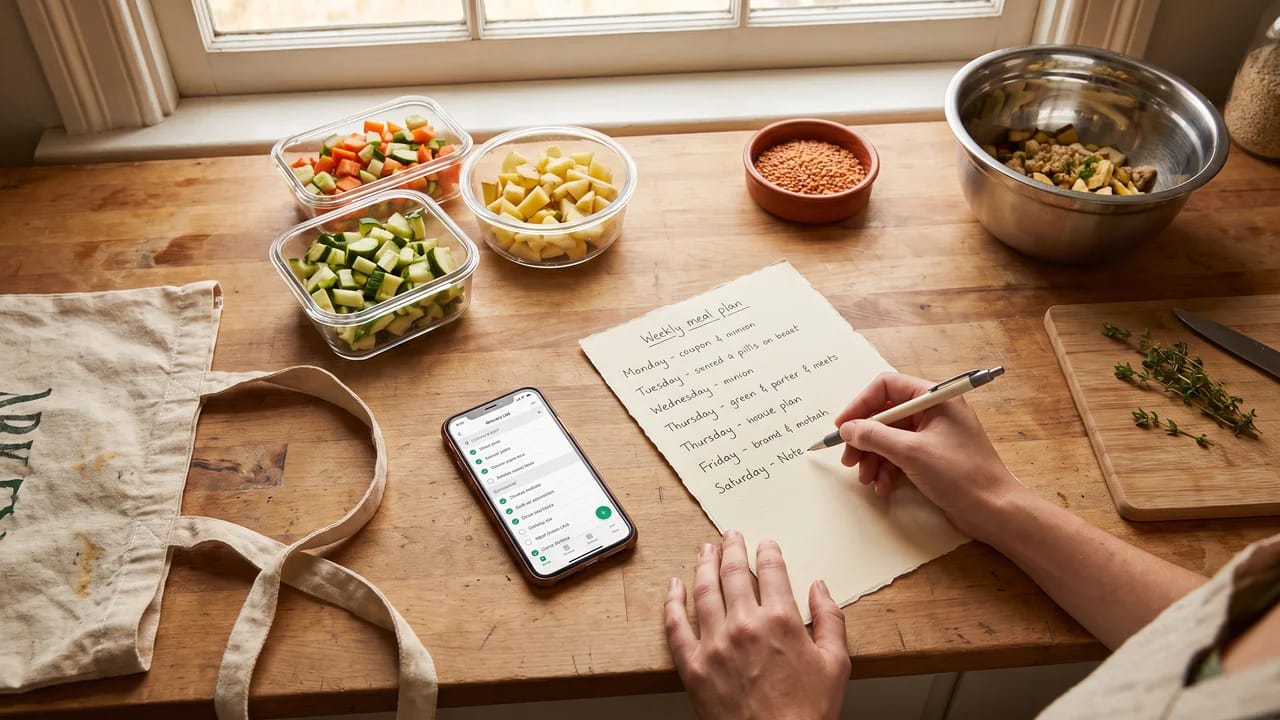
If you are setting up a weekly routine for the first time, the app matters less than the habit. Our guide to weekly meal planning for beginners covers the routine itself, and planning meals around recipes you already have covers the workflow this comparison assumes.