 Bastien
Grilling temperature guide for every meat
A complete meat temperature chart for grilling. Internal target temps for beef, chicken, pork, burgers, and fish, the grill temperature to use for chicken and steak, official safe minimums, and carryover cooking explained.
TL;DR: Pull beef steaks at 52°C/125°F for medium-rare, chicken at 71°C/160°F (carryover finishes it), burgers at 68°C/155°F, and pork at 60°C/140°F. Use a thermometer. Rest your meat. That's 90% of grilling success.
Most people who grill by feel are overcooking. Pressing the meat with a thumb, cutting into it to peek, going by the clock: none of it works. Put a thermometer into a "medium-rare" ribeye cooked by feel and it often reads 70°C or more, which is medium-well at best.
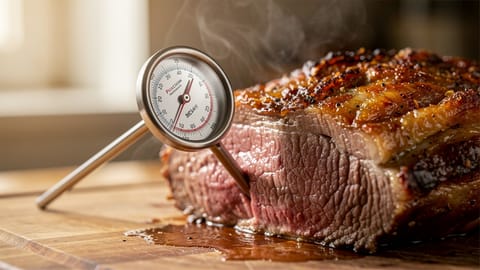
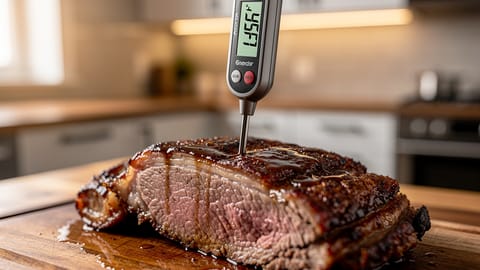
The thermometer is the fix. Pull steaks at 52°C (125°F), knowing carryover cooking will bring them up to 55°C (130°F) during the rest. No guessing, no cutting, no dried-out meat.
This meat temperature chart covers every protein you're likely to throw on the grill, plus the grill temperature to use for each. Bookmark it, print it, tape it to the fridge.
Safe minimums vs doneness
Two different numbers show up in any temperature chart, and it helps to keep them apart. Safe minimum internal temperatures come from food safety agencies. Health Canada's chart lists 63°C (145°F) for medium-rare whole cuts of beef, veal, and lamb, 71°C (160°F) for ground meat and for pork, 74°C (165°F) for poultry pieces, 82°C (180°F) for a whole bird, and 70°C (158°F) for fish. The USDA's chart is similar, with pork at 63°C plus a 3-minute rest.
Doneness temperatures are what cooks aim for to get a particular texture, and for beef, pork, and fish they often sit below those minimums. A 55°C medium-rare steak or a 52°C piece of salmon is a choice, not a guarantee. The risk is low with fresh, well-handled whole cuts, because bacteria live on the surface that the sear reaches, but it is not zero. Anyone pregnant, older, or immunocompromised should follow the official minimums. Ground meat and poultry are the exception where there is no real debate: cook them to the minimum.
The charts below give both numbers where they differ.
Grill heat zones explained
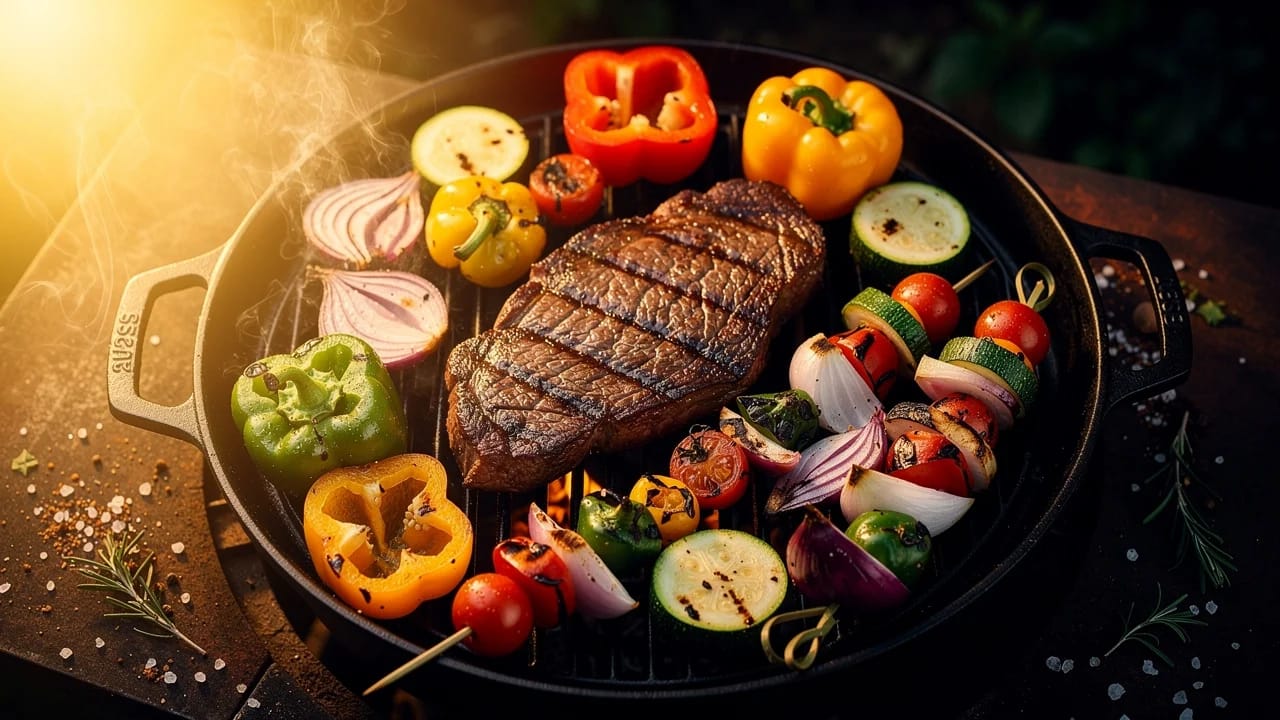
Before we get to internal temps, you need to understand how your grill works. Every grill should be set up with two heat zones: direct and indirect.
Direct heat is where the burners are on or the coals are piled. Food sits right over the flame. This is your searing zone. Temperatures range from 230-290°C (450-550°F) at grate level.
Indirect heat is the other side, with no flame underneath. Food cooks by convection, like a hot oven. Temperatures sit around 120-175°C (250-350°F) depending on your setup.
Why does this matter? Because most grilling failures come from using only direct heat. A thick chicken breast over direct heat will burn on the outside before the center hits a safe temperature. Searing over direct heat and then finishing over indirect solves that problem.
Tip: Your grill lid thermometer reads air temp at the dome, not grate temp. It can be off by 25-50°C (50-100°F). Trust your instant-read thermometer instead.
Steak grilling temperature chart
Beef is where doneness matters most. A steak cooked to medium-rare tastes completely different from one cooked to medium-well. The Maillard reaction gives you the crust, but internal temp controls the texture and juiciness.
The "pull" temperatures account for carryover cooking. After you take a thick steak off the grill, residual heat from the exterior continues traveling inward. Expect a rise of 3-5°C (5-10°F) during the rest.
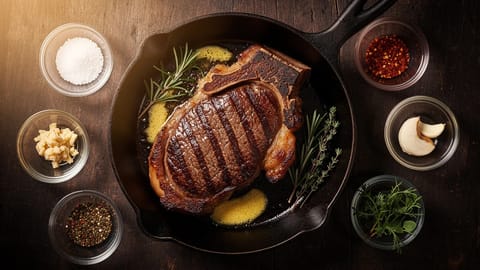
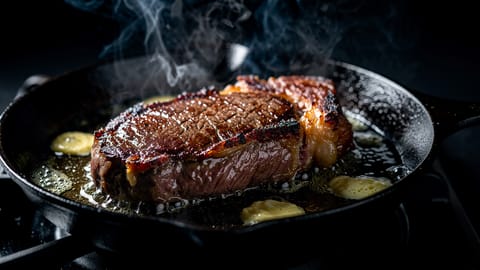
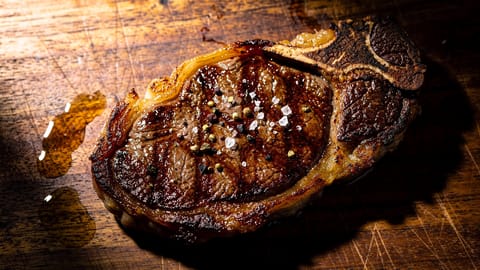
Grill temperature for steak: high direct heat, 230-260°C (450-500°F) at the grate. Sear ribeye, strip, or filet 2-4 minutes per side. Move to indirect if thicker than 3cm (1.25 inches). Rest 5-8 minutes.
Roasts (tri-tip, prime rib): Sear all sides over direct heat, then finish over indirect at around 120°C (250°F) until the center hits your target. This can take 30-60 minutes depending on size. Rest at least 10 minutes.
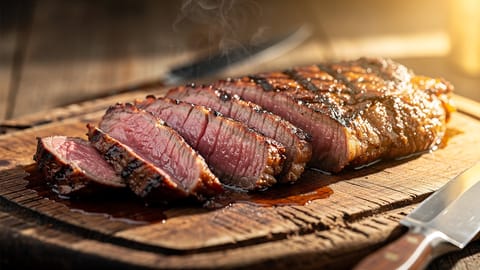
Resting meat makes more difference than any seasoning trick. A steak sliced immediately loses juice all over the cutting board. One rested for 7 minutes stays juicy with every bite.
Grill temperature for chicken
Health Canada and the USDA both put poultry pieces at 74°C (165°F), and Health Canada lists 82°C (180°F) for a whole bird. That's the safe minimum, but it doesn't mean every piece of chicken wants exactly that number. Different cuts have different sweet spots, and they want different grill setups too.
What temperature to set the grill:
- Boneless breasts: medium-high direct heat, 200-230°C (400-450°F), 5-6 minutes per side, then the indirect zone if the thickest part is over 2.5 cm.
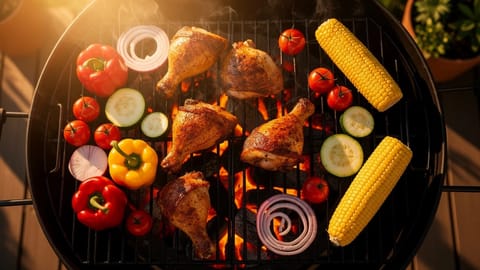
- Thighs and drumsticks (bone-in): medium heat, 175-200°C (350-400°F), mostly over indirect heat with the lid closed for 30-40 minutes, then 3-5 minutes over direct heat to crisp the skin. Bone-in pieces over direct heat the whole time burn outside before the inside is done.
- Wings: medium heat, 175-200°C (350-400°F), turning every few minutes, 20-25 minutes total. Sauce them in the last 5 minutes so the sugar doesn't burn.
- Whole chicken: indirect heat at 175-190°C (350-375°F) with the lid closed, 60-90 minutes depending on size. Spatchcocking it flat cuts that time and evens out the cook.
Chicken breasts dry out fast. Pull them at 71°C (160°F) and let carryover bring them to 74°C. That 3-degree window is the difference between juicy and cardboard. The key is even thickness: if one end is twice as thick as the other, butterfly the breast or pound it to roughly 2cm (3/4 inch) so it cooks evenly. The full how to grill chicken breast guide walks through the butterfly, brine, and two-zone routine step by step.
Thighs and drumsticks are different. They have more connective tissue that needs higher heat to break down. Thighs cooked to only 74°C still feel rubbery. Push them to 77-82°C (170-180°F) and they're silky and tender.
Tip: For bone-in pieces, measure temp in the thickest part of the meat, not touching bone. Bone conducts heat differently and gives false readings.
Pork temperature chart
Pork used to mean "cook it to death." Current US guidance is different: the National Pork Board and the USDA put fresh whole cuts at 63°C (145°F) followed by a 3-minute rest, and ground pork at 71°C (160°F). Health Canada still lists 71°C for all pork. Pork at 63°C is slightly pink in the center and juicy; if you prefer the more conservative number, cook to 71°C and accept a firmer chop.
Pork chops are the steak of the pork world. Treat them the same way: sear over direct heat, pull a few degrees early, and rest. They go from perfect to dry quickly because they're lean.
Ribs and pulled pork are the opposite. They need long, slow cooking at low temperatures to break down tough connective tissue into gelatin. That's why their target temps are so much higher. On a grill, this means indirect heat with the lid closed, maintaining about 107-120°C (225-250°F) for hours.
Burger temperature chart
Burgers are ground meat, which means bacteria can be mixed throughout rather than sitting only on the surface like whole muscle cuts. Health Canada and the USDA both set 71°C (160°F) as the safe internal temperature for ground meat. Anything lower carries real risk; some cooks accept it with beef they ground themselves from a fresh whole cut, but it is a personal call and not one to make for guests.
A few rules for burgers: make the patties slightly wider than the bun because they shrink. Press a thumb indent into the center so they don't puff into a ball. And don't press them flat on the grill. Every time you smash a burger with a spatula, you squeeze out juice.
Season generously with salt and pepper right before grilling, not hours ahead. Early salting draws moisture out and changes the texture of ground meat, making it dense like a sausage.
Fish and seafood temperature chart
Fish is the trickiest protein on the grill because it cooks fast and sticks easily. Oil the fish, not the grate. Use medium-high direct heat, and don't move it until it releases naturally.
Salmon at 52°C (125°F) still has a translucent, almost creamy center, which is how many cooks prefer it. If you like it more cooked, go to 57°C (135°F). Past 60°C it starts drying out and turning chalky. Health Canada's 70°C is the conservative number and gives a firm, fully opaque fillet.
For white fish, a grill basket or cedar plank prevents the fillets from falling apart. They're too delicate for direct grate contact unless the skin is on.
Carryover cooking: why you pull early
"Pull temperature" comes up throughout this guide, so here's the science. When you remove meat from the grill, the outside is much hotter than the center. That heat energy doesn't vanish. It travels inward, continuing to cook the meat for several minutes.
The thicker the cut, the more carryover you get:
- Thin cuts (burgers, thin steaks under 2cm): 1-2°C (2-3°F) rise
- Medium cuts (standard steaks, chicken breasts): 3-4°C (5-7°F) rise
- Thick cuts (roasts, bone-in pieces): 5-8°C (8-15°F) rise
This is why resting meat isn't optional. The rest period lets carryover cooking finish while juices redistribute throughout the meat. Cut too early and you lose both: the center will be undercooked and the juice runs out onto the cutting board.
Common grilling temperature mistakes
The most common mistake is treating the grill like a stovetop, flipping and moving food every 30 seconds. Put it down, leave it alone, and let the heat do its job. Flip once. Check the temp. Pull when it's ready. That's it. Constant flipping is only one of the 12 most common grilling mistakes; the other eleven have equally simple fixes.
For more on the science behind cooking, including why the Maillard reaction needs high heat and why resting meat works at a molecular level, check out the linked guides. And if you're still deciding which grill to buy in the first place, the charcoal vs gas grill comparison breaks down the real differences. For the full veggie side of the story, the how to grill vegetables guide covers prep, marinade, and timing by vegetable type.
- A meat thermometer is the single most important grilling tool
- Set up two-zone heat on every cook: direct for searing, indirect for finishing
- Pull meat 3-5°F before your target temp to account for carryover cooking
- Rest all meat after grilling: 5 minutes for thin cuts, 10+ for thick ones
- Chicken breasts pull at 71°C/160°F, beef steaks at 52°C/125°F for medium-rare
- Ground meat and poultry go to the official minimum (71°C and 74°C); lower doneness on whole cuts is a choice, not a guarantee
- New to grilling? Start with our grilling for beginners guide for setup, tools, and first-cook advice