 Bastien
Poolish
A wet pre-ferment made with equal weights of flour and water plus a small amount of yeast, fermented 8-16 hours to develop flavor and make dough more extensible.
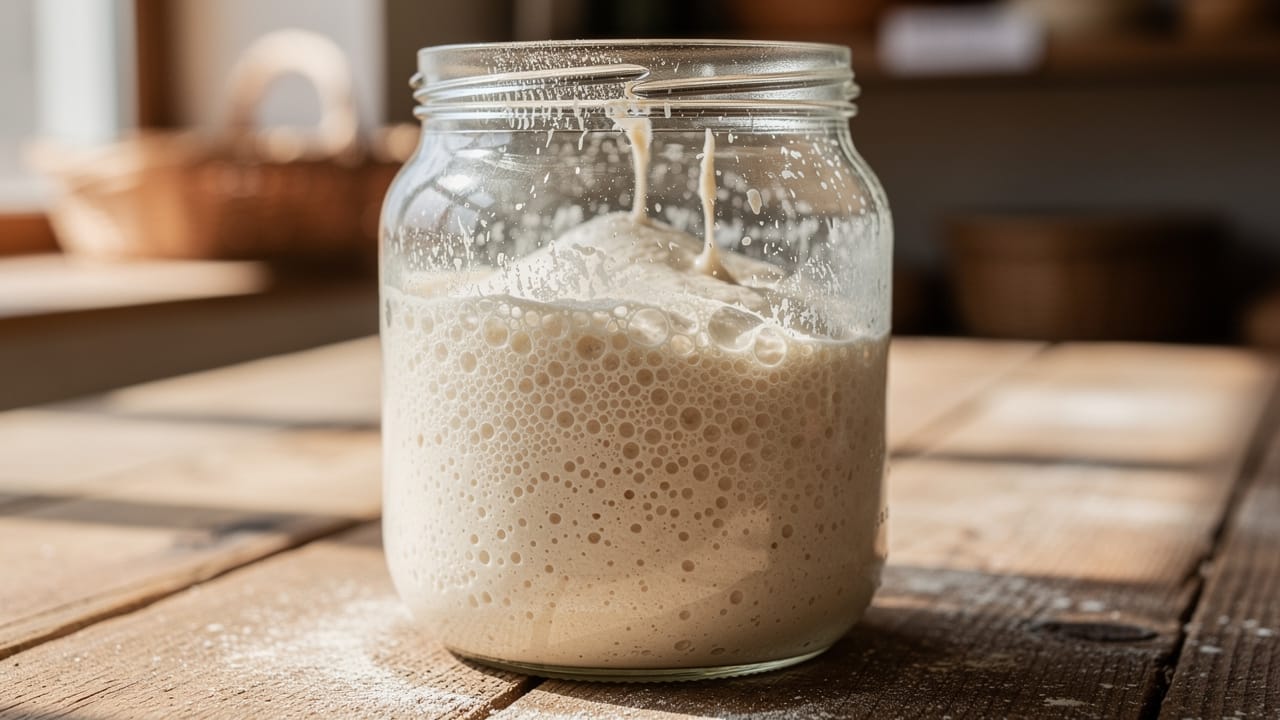
Poolish is a wet pre-ferment made with equal weights of flour and water plus a tiny amount of yeast, fermented for 8 to 16 hours before it is mixed into the final dough. Its 100% hydration gives it a batter-like consistency, thinner than a biga but thicker than water. Bakers use it for bread and pizza dough with deeper flavor, better extensibility and a more open crumb than a direct-method dough.
The name suggests a Polish origin, but that story is undocumented. What is better established is that the technique spread through Viennese-trained bakers in 19th-century Paris and became the standard pre-ferment for French bread (BAKERpedia, Wikipedia). Today it is as common in pizzerias as it is in bakeries.
Why use a poolish?
Pre-fermenting a portion of the flour and water before mixing the final dough changes the bread in ways you can see and taste:
| Benefit | What happens | Why it matters |
|---|---|---|
| Flavor complexity | Extended fermentation produces organic acids, alcohols and aromatic esters | Bread tastes more complex, with mild tang and wheaty sweetness |
| Extensibility | Long hydration and enzyme activity relax the gluten | Dough stretches without tearing, ideal for pizza and ciabatta |
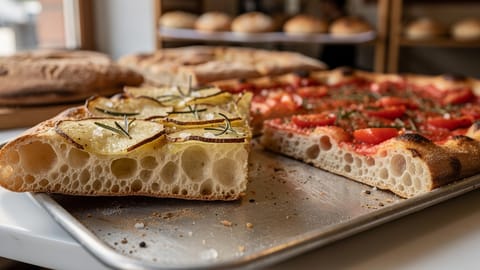
| Open crumb | A softened gluten network traps gas in larger, irregular pockets | The airy interior of baguettes and focaccia |
| Better keeping | Acids and the breakdown products of long fermentation slow staling | Bread made with a pre-ferment tends to keep better than straight dough |
| Reduced mixing | Pre-fermented flour needs less mechanical development | Less time in the mixer, lower risk of over-mixing |
BAKERpedia also notes that a poolish supplies amino acids that feed the Maillard reaction, which is why poolish crusts brown so well. The trade-off is time. A poolish adds 8 to 16 hours of planning, but nearly all of it is hands-off: the yeast does the work while you sleep.
What is the poolish formula?
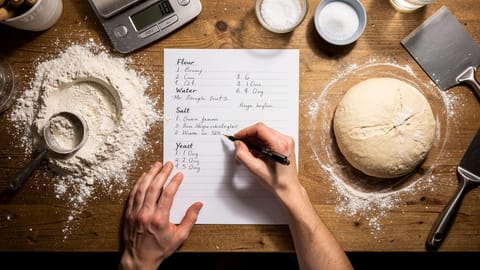
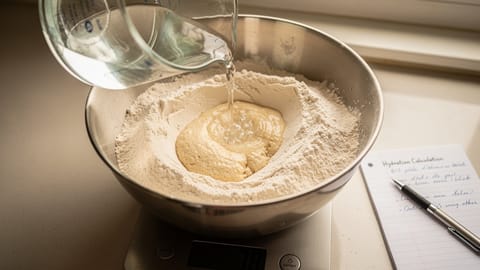
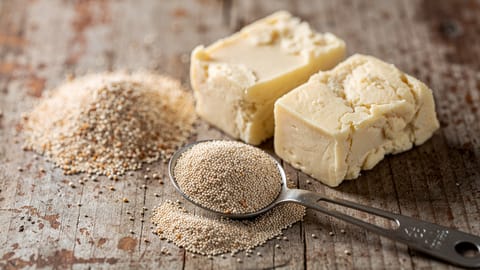
The standard poolish recipe uses equal weights of flour and water with a very small amount of yeast. The yeast quantity sets the fermentation speed, so you choose it according to how long you want the poolish to sit. These amounts come from a baker's yeast prediction model (TXCraig1's, widely used for pizza dough), scaled for a poolish used at its peak, at about 21°C / 70°F:
| Fermentation time | Flour | Water | Instant yeast | Temperature |
|---|---|---|---|---|
| 8 hours | 100 g | 100 g | 0.2 g | 20-22°C / 68-72°F |
| 12 hours | 100 g | 100 g | 0.1 g | 20-22°C / 68-72°F |
| 16 hours | 100 g | 100 g | 0.07 g | 20-22°C / 68-72°F |
Less yeast means slower fermentation and more flavor development. For an overnight poolish, the most common approach, 0.1 g of instant yeast per 100 g of flour is a good default: mix it before bed and use it in the morning. Temperature matters as much as time: for the same timing, a 20°C / 68°F kitchen needs about a quarter more yeast and a 22°C / 72°F kitchen about a fifth less. In a warm kitchen, cut the yeast or shorten the wait.
How much flour to pre-ferment
Most poolish bread recipes pre-ferment 20-40% of the total flour weight. The percentage shapes the final dough:
| Poolish % | Effect on dough | Best for |
|---|---|---|
| 15-20% | Subtle flavor boost, minimal structure change | Enriched breads, soft rolls |
| 25-35% | Noticeable flavor, improved extensibility | Baguettes, poolish pizza dough, ciabatta |
| 40-50% | Strong fermentation flavor, very extensible dough | Roman-style pizza, high-hydration breads |
Above roughly 50% the dough gets hard to handle, especially if the poolish is over-ripe, because the enzymes have already weakened much of the gluten. Use baker's percentages to split the flour between the poolish and the final mix.
How do you make a poolish?
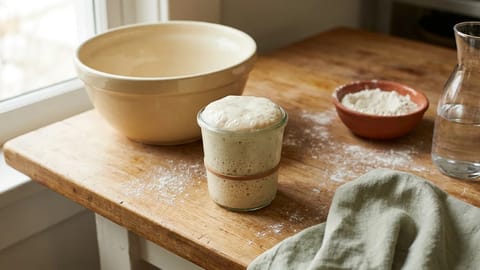
The container should hold at least three times the volume of the fresh mix. A ripe poolish expands a lot.
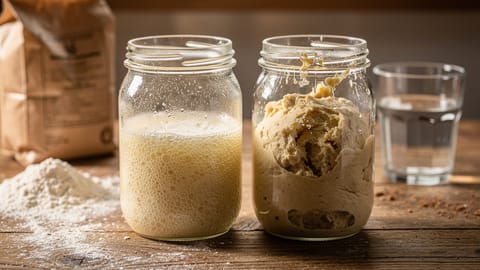
Reading ripeness
A poolish goes through distinct stages. Learning to read them is the single most useful skill for consistent results.
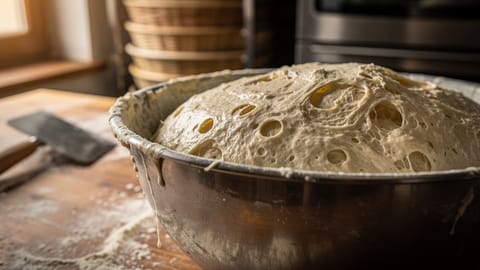
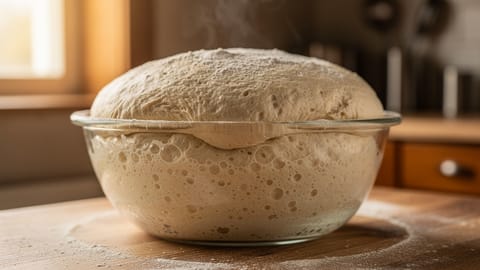
The ideal moment is when the surface is covered in bubbles and has just begun to flatten from its peak dome. BAKERpedia describes the same cue: at its peak the volume recedes slightly and the surface wrinkles. At that point the yeast has produced maximum gas and flavor without exhausting its food.
Slowing down fermentation
If you are not ready to use the poolish when it ripens, refrigerate it. Cold slows fermentation sharply. A ripe poolish holds in the refrigerator for up to about 24 hours. Let it sit at room temperature for 30-60 minutes before mixing it into the final dough.
What does an overnight poolish schedule look like?
Most home bakers run the poolish overnight and bake the next day. A typical plan for a morning mix and an afternoon bake:
For an evening bake, mix the poolish first thing in the morning with 0.2 g of yeast per 100 g of flour and use it 8 hours later. Whatever the plan, decide when you want to bake and count backward.
How do you mix poolish into the final dough?
When the poolish is ripe, combine it with the remaining flour, water, salt and yeast for the final dough:
The final dough feels different from a straight dough: more extensible and slightly sticky. That is normal. The pre-fermented flour has already developed gluten, so the dough needs less mixing, and the bulk rise is usually shorter because the yeast population is already active.
What is the difference between poolish and biga?
These are the two most common yeasted pre-ferments. The key difference is hydration:
Neither is better. They are tools for different results. Many bakers use poolish when they want maximum extensibility (pizza dough that stretches thin) and biga when they want more structure (bread that holds its shape). For a full comparison, see the poolish vs biga guide.
Poolish vs levain
A levain (sourdough starter) relies on wild yeast and bacteria captured from the flour and the environment. Poolish uses commercial yeast only. The practical differences: a poolish is ready in 8-16 hours and gives consistent, mild flavor. A levain takes days to build initially, produces more sour and complex flavor, and behaves differently depending on temperature and feeding schedule. If you want predictability, go with poolish. If you want depth and don't mind the variability, explore sourdough.
What is poolish used for?
Poolish suits any lean dough where you want extensibility and an open crumb. Three uses come up more than any other.
Poolish pizza dough
Poolish is especially popular for pizza dough. Pre-fermenting 25-30% of the flour improves stretch, flavor and browning. Roman-style pizza al taglio traditionally uses poolish, and many Neapolitan-style bakers have adopted it alongside long cold fermentation schedules. The pizza dough calculator splits the flour between poolish and final dough for any pizza style.
Poolish bread (baguettes)
The poolish method is the traditional approach for Parisian baguettes. It gives the crumb its open, irregular holes and the crust its golden color and thin crackle.
Ciabatta and focaccia
Both high-hydration breads benefit from poolish. The pre-ferment relaxes the gluten just enough to create the large, irregular holes that define these breads.
What are the most common poolish problems?
Too little yeast or too cold. Use slightly more yeast or find a warmer spot (22-24°C / 72-75°F). Check that your yeast is fresh and not expired.
Too much yeast, too warm, or left too long. Reduce the yeast, lower the temperature, or shorten the time. A collapsed poolish with a harsh alcohol smell should be discarded.
High poolish percentage or too much water in the final mix. Reduce the poolish to 20-25% of total flour, or hold back some of the final water and add it gradually.
Under-ripe poolish that hasn't fermented long enough. Wait until the surface is fully bubbly and domed before using it.
The poolish went past its peak. Use it when bubbly and just beginning to flatten, not after it has fully collapsed.
What are the best tips for a better poolish?
Use a clear container. Glass or clear plastic lets you see bubble development and rise without opening the lid. Mark the starting level with a rubber band to track expansion.
Weigh your yeast, or dilute it. At 0.1 g, eyeballing is unreliable. A precision scale that reads to 0.1 g makes consistent poolish possible. If you don't have one, dissolve 1 g of yeast in 100 g of water and use 10 g of that solution for 0.1 g of yeast.
Control temperature. Warm rooms speed fermentation up considerably. If your kitchen is warm (25°C / 77°F or more), use less yeast or move the poolish to the fridge after a few hours.
Do not add salt. Salt slows yeast activity. The poolish ferments without salt, and the salt goes into the final dough only.
Plan backward. Decide when you want to mix your dough, then count back 8-16 hours to find when to mix the poolish. For morning baking, mix the poolish the evening before.
Poolish in Fond
Fond hasn't launched yet. This is how it will work at launch. Join the waitlist for early access.
Fond's Pizza Workshop includes dough calculators built on baker's percentages and fermentation tracking. The free pizza dough calculator lets you pick poolish or biga as the pre-ferment, set how much flour goes into it, and suggests a yeast amount for your schedule and room temperature, then lays out the poolish maturation and main-dough steps as a timeline you can follow backward from bake time.