 Bastien
Cold Fermentation
Cold fermentation is the practice of retarding dough in the refrigerator (2–5°C) for 24–72 hours — slowing yeast activity while enzymes break starches into sugars for deeper flavor and better texture.
Cold fermentation (also called cold retarding or cold proofing) is the practice of placing dough in the refrigerator to ferment slowly over an extended period, typically 12 to 72 hours. The cold temperature (2-5°C / 35-41°F) slows yeast activity while enzymatic processes continue, breaking starches into sugars and producing organic acids that give bread and pizza dough deeper, more complex flavor.
What does cold fermentation mean?
The terms overlap, and recipes use them loosely:
- Cold fermentation is the general term: any stage of fermentation that happens in the fridge rather than at room temperature.
- Retarding (or cold retarding) is the baker's word for the same thing. A "retarder" is the refrigerated cabinet bakeries use to hold shaped loaves overnight so they can be baked first thing in the morning.
- Cold proof or cold retard usually means the final rise of shaped dough happens in the fridge.
- Cold bulk fermentation means the first rise, before dividing and shaping, happens in the fridge.
Cold fermentation is not the same as freezing. Freezing stops fermentation entirely; the fridge only slows it, which is the point.
Why use cold fermentation?
| Benefit | What happens |
|---|---|
| Better flavor | Enzymes break starch into sugars; bacteria produce organic acids (lactic, acetic) that create sourdough-like tang |
| Improved browning | More free sugars on the dough surface fuel the Maillard reaction and caramelization in the oven |
| Scheduling flexibility | Mix dough today, bake tomorrow or the day after |
| Easier handling | Cold dough is firmer and less sticky, especially at high hydration (70%+) |
| Better texture | Extended fermentation develops a chewier crumb with larger, more irregular holes |
| Reduced yeast taste | Less yeast needed for long ferments means a cleaner, wheat-forward flavor |
Does refrigeration slow yeast fermentation?
Yes, sharply. Baker's yeast is most active around 25-30°C (77-86°F). Below about 10°C (50°F) its gas production drops to a small fraction of that rate, and at 2-4°C the dough may take a full day to gain the volume it would gain in an hour on the counter. The yeast is not dead, only slow.
Two other things keep working in the cold at a more useful pace. Amylase and protease enzymes in the flour continue converting starch into simple sugars and loosening the gluten network, so the dough ends up sweeter, more extensible, and browner in the oven. Lactic acid bacteria, which are present in every dough and dominant in sourdough, also keep producing acids. That imbalance, slow yeast against steady enzymes and bacteria, is why a cold-fermented dough tastes more complex than a fast one, even with the same ingredients.
What's the difference between cold bulk fermentation and cold proofing?
These two approaches place the dough in the fridge at different stages, and the results differ.
Cold bulk fermentation means refrigerating the dough as one mass before dividing and shaping. The yeast works slowly through the entire bulk, and you shape after removing from the fridge. This works well for sourdough bread, where a slow overnight bulk builds flavor without over-proofing.
Cold proofing (cold retarding) means completing the bulk fermentation at room temperature first, then dividing into dough balls, shaping, and refrigerating the shaped pieces. This is the standard approach for pizza dough and most enriched breads.
For pizza, cold proofing after balling is almost always the better option. The room-temperature bulk develops the gluten network, and the cold rest adds flavor while relaxing the dough for easier stretching.
Time and temperature guide
| Duration | Fridge temp | Flavor impact | Best for |
|---|---|---|---|
| 24 hours | 2-4°C | Mild improvement over same-day | Weeknight pizza, quick bread |
| 48 hours | 2-4°C | Noticeable complexity, sweet notes | Best all-around balance |
| 72 hours | 2-4°C | Peak complexity, slight tang | Special occasions, Neapolitan pizza |
| 96 hours | 2-4°C | Very developed, risk of over-ferment | Experienced bakers only |
| 120+ hours | 2-4°C | Often over-fermented, dough loses structure | Not recommended for most recipes |
The 48-hour sweet spot
For most pizza and bread recipes, 48 hours is the optimal cold fermentation time. You get significant flavor improvement without risking over-fermentation. The dough develops enough sugars for excellent browning and enough organic acids for complexity, while the gluten network remains strong.
How flour type affects timing
Whole wheat and rye flours ferment faster than white flour because their bran and germ contain more enzymes and natural sugars. A whole wheat dough at 48 hours in the fridge can reach the same fermentation level that white flour takes 72 hours to hit. If you're using whole grain flour, check the dough at 24 hours and plan for a shorter cold ferment.
How does the cold fermentation process work?
Step 1: complete bulk fermentation first
Cold fermentation works best when the dough has already completed its bulk fermentation at room temperature. This initial phase activates the yeast and begins gluten development. Typical room-temp bulk: 1-4 hours depending on yeast amount and temperature.
Step 2: divide and ball
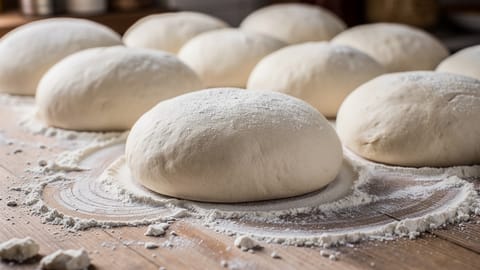
Divide the dough into portions and shape into dough balls. Proper balling creates surface tension that helps the dough hold its shape during the long cold rest.
Step 3: container and storage
| Container type | Pros | Cons |
|---|---|---|
| Individual airtight containers | Best control, easy to remove one at a time | Takes more fridge space |
| Sheet pan with plastic wrap | Efficient for multiple balls | Harder to separate, wrap can stick |
| Oiled dough box (proofing box) | Professional standard, stackable | Requires purchase |
| Large airtight container | Simple, widely available | Balls can merge if too close |
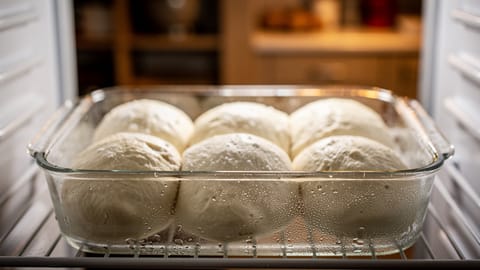
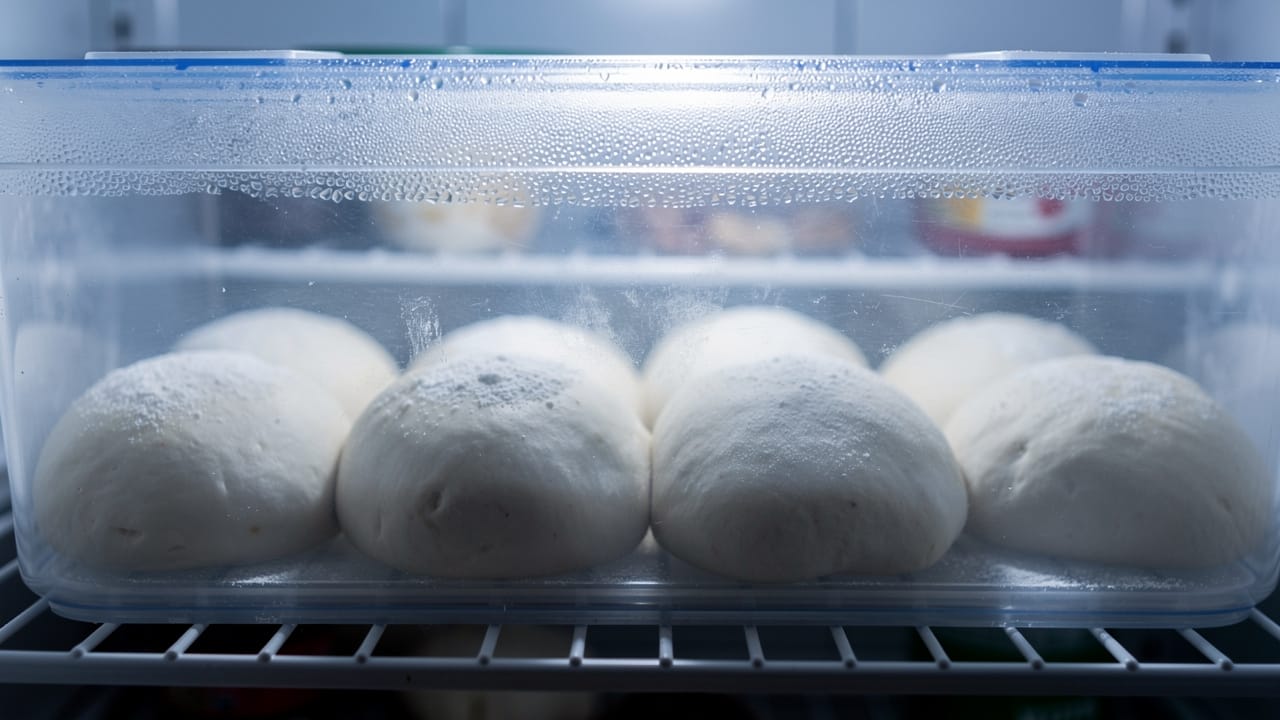
Oil or lightly flour the container. Space dough balls so they do not touch: they will expand 50-100% during the cold rest. Cover tightly to prevent skin formation.
Step 4: refrigerate
Place in the coldest, most consistent part of the fridge, typically the back of a shelf, not the door. Temperature consistency matters: fluctuations between 2°C and 8°C will produce uneven fermentation.
Step 5: bring to room temperature before use
Remove dough 1-2 hours before shaping or stretching. Cold dough is tight and tears easily. Letting it warm up relaxes the gluten and makes it pliable. A quick test after 45 minutes: press a finger into the edge of the dough ball. If the dent springs back slowly and the dough feels pillowy, it is ready to stretch.
| Dough type | Time out of fridge before use |
|---|---|
| Pizza (Neapolitan, thin) | 1-2 hours |
| Pizza (thick, pan styles) | 30-60 minutes |
| Bread loaves | 1-2 hours |
| Rolls and small shapes | 30-45 minutes |
Yeast amounts for cold fermentation
Cold fermentation requires less yeast than same-day recipes because the yeast has more time to work. Too much yeast leads to over-fermentation in the fridge.
| Cold ferment duration | Instant yeast (% of flour) | Active dry yeast (% of flour) |
|---|---|---|
| 24 hours | 0.2-0.3% | 0.3-0.4% |
| 48 hours | 0.1-0.2% | 0.15-0.3% |
| 72 hours | 0.05-0.1% | 0.07-0.15% |
For a 1000g flour batch at 48 hours, that is just 1-2g of instant yeast. Use a kitchen scale: these amounts are too small for measuring spoons.
See the yeast types guide for conversion between instant, active dry, and fresh yeast.
How do you know when the dough is ready?
| Sign | What it means |
|---|---|
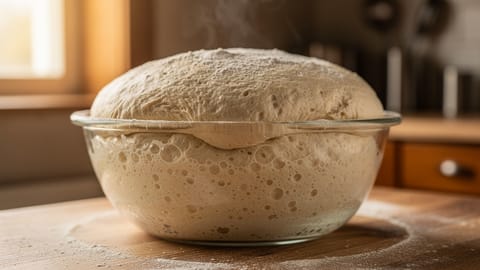
| Volume increased 50-100% | Yeast has produced enough gas |
| Small bubbles on surface | Active fermentation occurred |
| Dough springs back slowly when poked | Good fermentation level, not over-proofed |
| Pleasant, slightly tangy smell | Organic acid development (lactic and acetic acids) |
| Dough feels airy but still has structure | Gluten network intact |
Signs of over-fermentation
| Sign | What it means |
|---|---|
| Dough has more than doubled | Too much gas, structure weakening |
| Strong sour or alcohol smell | Excessive acid or ethanol production |
| Dough collapses when touched | Gluten network has broken down |
| Sticky, slack texture | Structure has degraded |
| Large uneven bubbles on surface | Inconsistent fermentation |
If over-fermented, the dough loses its ability to hold gas during baking, resulting in a flat, dense final product. Reduce yeast or shorten the cold ferment next time.
Cold fermentation by pizza style
| Style | Typical cold ferment | Hydration | Yeast (instant) | Notes |
|---|---|---|---|---|
| Neapolitan | 24-72 hours | 58-65% | 0.1-0.2% | Traditional: room temp bulk then cold |
| New York | 24-48 hours | 63-67% | 0.2-0.3% | Often full cold ferment (skip room temp bulk) |
| Detroit | 24-48 hours in pan | 70-75% | 0.2-0.3% | Ball, oil, and pan before fridge |
| Roman al taglio | 48-72 hours | 75-85% | 0.1-0.15% | Very high hydration, extra long ferment |
| Sicilian / grandma | 24-48 hours | 65-70% | 0.2-0.3% | Pan-style, moderate hydration |
Use the pizza dough calculator to get precise yeast amounts and a fermentation schedule tailored to your chosen style and cold ferment duration. For a full pizza-specific walkthrough, including 24, 48 and 72 hour schedules, see the cold fermentation pizza dough guide.
Cold fermentation for bread
Cold fermentation is not just for pizza. Many bread recipes benefit from an overnight or multi-day cold retard:
- Baguettes: Cold retard shaped baguettes overnight for morning baking. Better flavor and oven spring.
- Sourdough: Cold retard after shaping is standard, 12-48 hours. It enhances tang and makes scoring easier since the dough surface firms up.
- Enriched doughs: Brioche and challah benefit from overnight cold retard for easier handling of buttery, sticky dough.
- Ciabatta: High-hydration ciabatta firms up in the fridge, making it easier to handle.
For sourdough specifically, cold bulk fermentation (refrigerating before shaping) is also common. The slower pace gives you a wider window to catch the dough at peak fermentation, which is forgiving if your starter varies in strength from one feed to the next.
Troubleshooting
Cause: Too little yeast, fridge too cold, or not enough room-temp bulk before refrigerating.
Fix: Make sure the dough shows signs of activity (small bubbles, slight volume increase) after the room-temp bulk before it goes into the fridge. Check yeast freshness and verify fridge temp is 2-4°C.
Cause: Too much yeast or fridge running too warm.
Fix: Reduce yeast. Use a thermometer to verify your fridge is actually at 2-4°C. Many home fridges run warmer than the dial suggests.
Cause: Not enough warm-up time at room temperature.
Fix: Let it sit at room temp for 1-2 hours. Don't force it. If it's still tight, the gluten may need more relaxation time.
Cause: Container not sealed properly.
Fix: Use an airtight lid or press plastic wrap directly onto the dough surface. A thin coat of oil on the dough also helps.
Cause: Placed too close together.
Fix: Space at least 5 cm apart. Each ball can expand 50-100% during the cold rest.
Cause: Over-fermented or under-fermented dough.
Fix: Check the readiness signs before baking. If over-fermented, reduce yeast next time. If under-fermented, extend the cold rest or allow more room-temp bulk beforehand.
Best practices
If your fridge runs warm (5°C+), reduce yeast amounts by 30-50% to compensate. The flavor difference between 24 and 48 hours is significant; the difference between 48 and 72 is subtler.
Cold fermentation in Fond
Fond hasn't launched yet. This is how it will work at launch. Join the waitlist for early access.
Fond's Pizza Workshop calculates your fermentation schedule based on the style you choose, your room temperature, and your fridge temperature. It adjusts yeast amounts for your target cold ferment duration and tells you when to start mixing to hit your bake time. When you change the number of dough balls, all quantities scale automatically using baker's percentages. Ingredients sync to your shopping list.