 Bastien
Pizza water and key ingredients: what actually matters
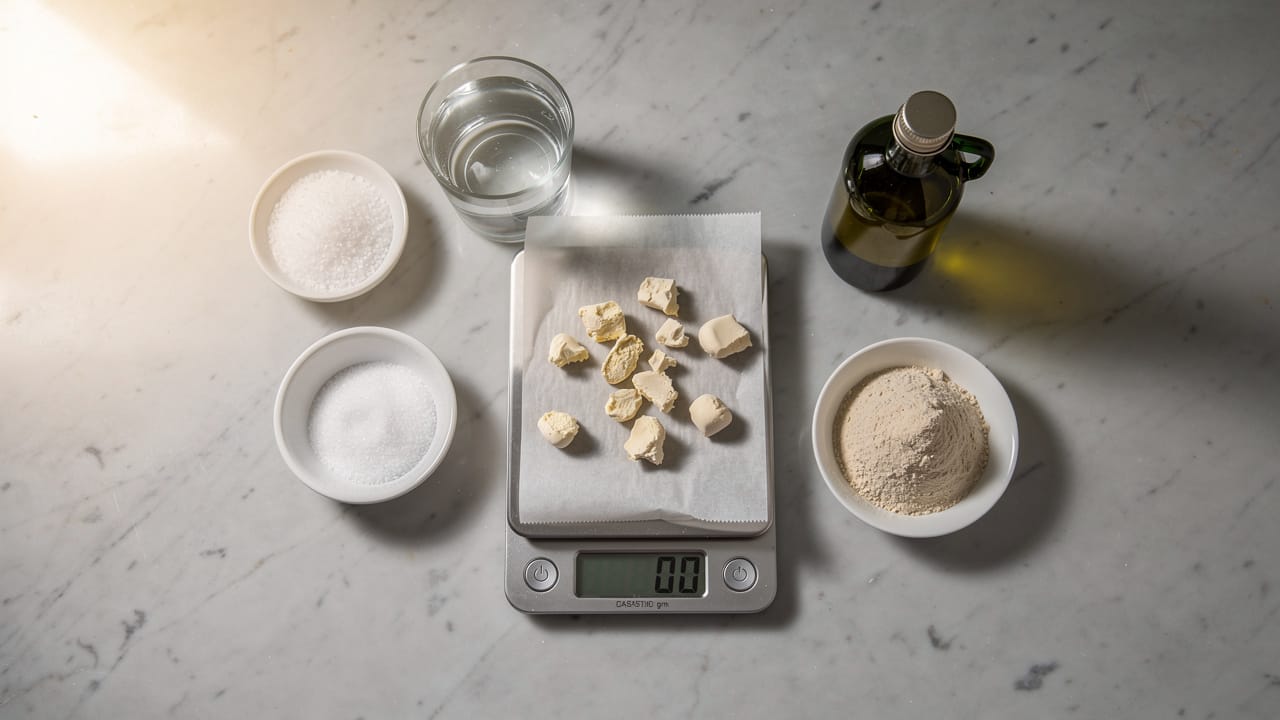
The stuff beyond flour that quietly affects your dough: water hardness, salt percentage, yeast types (instant vs. fresh vs. active dry), diastatic malt, oil, and why a $15 scale beats measuring cups.
TL;DR: Water quality, salt, yeast type, and precise weighing are the often-overlooked factors that separate good pizza dough from great pizza dough. Hard or soft water, chlorine, salt percentage, and yeast choice all directly affect gluten development, fermentation speed, and final flavor. Buy a digital scale, weigh everything in grams, and use baker's percentages.
Why pizza water and ingredients matter beyond flour
Most pizza recipes focus on flour and technique, but the other ingredients in your dough, water, salt, yeast, oil, and even a small amount of diastatic malt, have an outsized effect on your results. Small changes in water hardness, salt percentage, or yeast type can shift gluten structure, fermentation speed, and crust flavor in ways that flour choice alone cannot. This guide covers what each ingredient does, how much to use, and how to troubleshoot when something feels off.
Use the pizza dough calculator to dial in exact weights for any batch size once you've settled on your percentages.
Water quality
Water is the second-largest ingredient in pizza dough by weight, yet most people never give it a second thought. The mineral content of your water directly affects gluten development and dough behavior.
- Hard water (high mineral content) produces a stiffer, tighter dough because minerals like calcium and magnesium strengthen gluten bonds.
- Soft water (low mineral content) produces a slacker, stickier dough because there are fewer minerals to reinforce the gluten network.
- Moderately hard water is the sweet spot for pizza dough, with enough minerals to support gluten without making the dough unworkable. The AVPN disciplinare for Neapolitan pizza (published in Italian, French and Spanish) specifies exactly that: drinking water of medium hardness, pH 6-7, used at 16-22 °C.
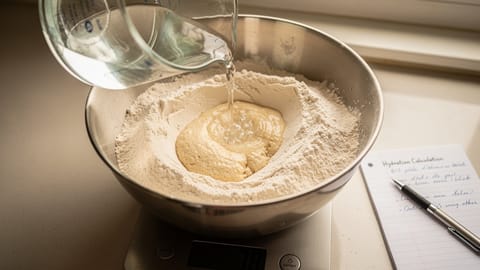
For a deeper dive into how water ratios affect your dough, see the hydration guide.
The simplest rule: if your tap water tastes good to drink, it is good enough to bake with. You do not need bottled water or filtered water unless your tap water has a strong off-taste.
Chlorinated water fix: Chlorine can inhibit yeast activity and leave an unpleasant flavor. The easy solution is to fill a pitcher and leave it uncovered in the fridge overnight. The chlorine will dissipate on its own. Alternatively, a simple carbon filter removes chlorine effectively.
Note that chloramine, used in some municipal water systems, does not dissipate as easily. A carbon filter is the better solution for chloramine.
Water temperature
Water temperature is one of the simplest ways to control your fermentation timeline. Warmer water speeds up yeast activity; cooler water slows it down.
A quick rule of thumb for dialing in water temperature: subtract your flour temperature from 131°F (55°C). If your flour is 72°F, your water should be around 59°F. This targets a final dough temperature of 75-77°F (24-25°C) after mixing. If using a stand mixer, subtract from 122°F (50°C) instead, since the hook generates friction heat.
The rule matters most in summer. A dough mixed with room-temperature water in a 28 °C kitchen can be overfermented in half the expected time; cold water is the fix.
Diastatic malt
Diastatic malt powder is one of the most underrated pizza ingredients, and one of the easiest wins in a home oven.
- What it does: Diastatic malt contains active enzymes (amylase) that break down flour starches into simple sugars during fermentation and baking. These sugars fuel yeast activity and promote enzymatic browning, giving your crust a deeper, more complex color and a subtle sweetness that plain dough cannot achieve on its own.
- Where to buy: Home-brewing supply stores are the best source, both in person and online. You can also find it at specialty baking suppliers. Look for "diastatic malt powder" specifically.
- Usage: Add 0.5-1% of flour weight (5-10g per kg of flour). Mix it in with the flour at the start. Do not add it later.
- Diastatic vs. non-diastatic: This distinction matters. Diastatic malt has active enzymes and actually changes how your dough ferments and browns. Non-diastatic malt (like barley malt syrup) has been heated to deactivate the enzymes. It adds sweetness and color but does not provide the enzymatic benefits. For pizza dough, you want diastatic.
Diastatic malt is particularly valuable for home ovens, where lower temperatures make it harder to achieve the deep browning that wood-fired ovens produce naturally.
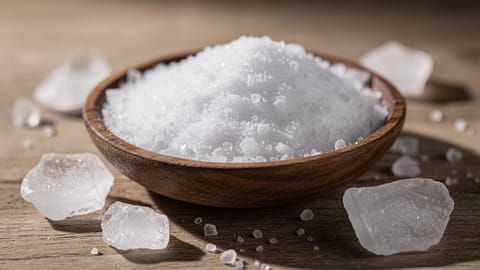
Salt
Salt is the unsung workhorse of pizza dough. It does far more than add flavor.
- Use fine sea salt (or kosher salt if you prefer, just weigh it since flake sizes vary wildly), and always weigh it in grams rather than measuring by volume. A teaspoon of fine salt and a teaspoon of coarse salt can differ a great deal in actual weight, easily enough to throw off your entire dough.
- The standard range is 2-3% of flour weight. Most pizza styles land around 2.5-3%. Neapolitan AVPN standards specify 2.5-3%. New York-style typically uses 2%.
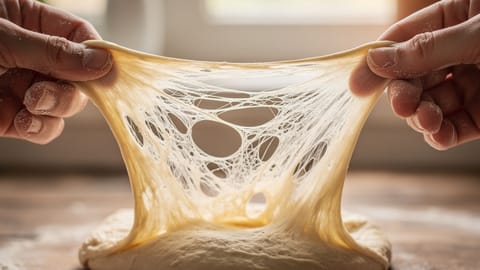
- Salt strengthens gluten by tightening the protein network, giving the dough better structure and elasticity. Without salt, dough becomes slack and sticky and tears easily during stretching.
- Salt controls fermentation speed by slowing yeast activity. This is a feature, not a bug. It gives you a longer, more controlled ferment and better flavor development. Don't leave salt sitting directly on yeast before mixing, though: the AVPN method dissolves the salt in the water, adds about a tenth of the flour, then the yeast, and warns that more than 5 minutes of direct salt-yeast contact damages the yeast cells.
Tip: If you are experimenting with long cold fermentation, consider starting at the lower end of the salt range (2%) and adjusting upward. The extended ferment time gives salt more opportunity to develop flavor, so you may need less than you think.
Yeast types
Not all yeast is created equal, and the type of yeast you choose affects your workflow more than your flavour. Any of the three below makes excellent pizza; the amount and the temperature set the speed of fermentation, not the packaging.
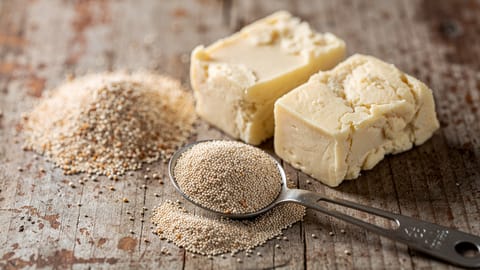
Fresh compressed yeast
Fresh compressed yeast (cake yeast, lievito di birra) is the professional standard in Italy and much of Europe. The AVPN recipe lists it first for Neapolitan dough, at 0.1-3 g per litre of water depending on temperature, humidity and fermentation time, and it gives a gentle, predictable ferment with a clean flavour.
- Use at 0.1-0.3% of flour weight for same-day doughs, or as low as 0.05% for 48-72 hour cold fermentation.
- Storage: Refrigerate at 33-38°F (1-3°C) and use within about 2 weeks.
- It crumbles easily and dissolves quickly in water. No activation step needed.
Active dry yeast
Active dry yeast is the traditional dry form. The cells are dormant and coated in a layer of dead cells that should be dissolved before use.
- Activation: Dissolve in water at 80-85°F (27-29°C), whisk gently, wait 5-10 minutes. If it foams, it's alive. If it sits flat, you need a fresh packet.
- Use about 40% of the fresh weight: 1 g active dry replaces roughly 2.4 g fresh.
- Ferments slightly more assertively than fresh yeast, so watch your timing.
Instant yeast
Instant yeast (also sold as rapid-rise or bread-machine yeast) is dried into finer granules that go straight into the flour with no proofing step, and it is the yeast most home pizza makers actually use. It is not "too fast" for pizza: the dose and the temperature control the speed, and the AVPN standard admits dry Saccharomyces cerevisiae yeast at one third of the fresh weight while ruling out only chemical leaveners with improvers.
- Mix it with the flour. Use about 80% of the active dry amount, or one third of the fresh amount.
- For pre-ferments and long cold fermentation it is the easiest to dose accurately in small amounts.
- Baking powder is not a substitute for any of these. It's a chemical leavener that releases gas in the oven and gives no fermentation flavour.
Yeast type comparison
| Fresh | Active dry | Instant | |
|---|---|---|---|
| Amount for 3 g fresh | 3 g | 1.25 g | 1 g |
| Activation | Dissolve in water | Proof in warm water 5-10 min | Straight into the flour |
| Flavour | Clean, subtle | Slightly more assertive | Clean |
| Shelf life | About 2 weeks refrigerated | Months sealed | Months sealed |
| AVPN standard | Listed first | Admitted as dry yeast, 1/3 of fresh | Admitted as dry yeast, 1/3 of fresh |
Converting between types: 3 g fresh ≈ 1.25 g active dry ≈ 1 g instant, the ratios Fond's pizza dough calculator uses. A recipe calling for 1 g active dry wants about 2.4 g fresh or 0.8 g instant.
Storage rules
Oil
Extra virgin olive oil is the standard oil for pizza dough, but not every style uses it.
- When to add it: Add oil after the salt during mixing, once the flour is partially hydrated. Adding oil too early coats flour particles and prevents them from absorbing water properly, which interferes with gluten development.
- Neapolitan pizza is oil-free by AVPN standards: just flour, water, salt, and yeast. The simplicity is part of what makes it special.
- New York-style uses 2-3% oil (by flour weight), which contributes to a slightly richer, more tender crumb and improved browning in home ovens.
- Detroit and pan styles often use more oil, both in the dough and in the pan, to create that characteristic crispy, fried bottom.
Use a good-quality extra virgin olive oil. You do not need to spend a fortune, but avoid the cheapest options. They are often blended with refined oils and contribute very little flavor.
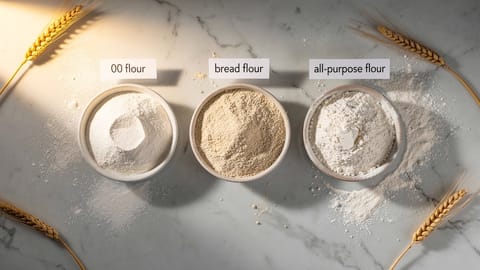
Tip: Unsure which flour to pair with these ingredients? The flour guide breaks down protein content, ash levels, and which flours work best for each pizza style.
Weighing vs. measuring
If you take one thing away from this guide, let it be this: buy a digital kitchen scale and use it for everything.
Why grams matter
The same "cup of flour" can vary by 20-30% in weight depending on how you scoop it. One person dips the cup into the bag and packs it down (150-160g). Another spoons flour into the cup and levels it (120-130g). That 30-40g difference per cup adds up fast, and it is enough to turn a workable 62% hydration dough into a sticky mess or a stiff brick.
Volume measurements are fine for cooking. They are not fine for baking, and especially not for pizza dough, where small percentage changes in hydration, salt, or yeast have outsized effects on the result.
The digital scale
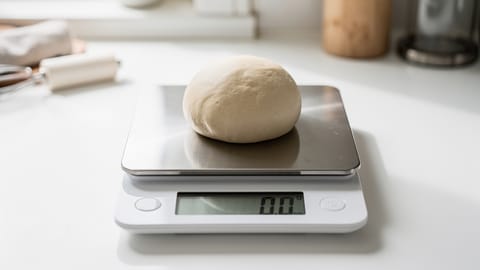
A digital kitchen scale accurate to 1g is essential equipment for pizza making. Not optional, not nice-to-have. Essential. For measuring small amounts of yeast (0.5-2g), a jeweler's scale accurate to 0.1g is even better.
Good digital scales cost $10-20 and last for years. There is no excuse not to have one.
Baker's percentages explained
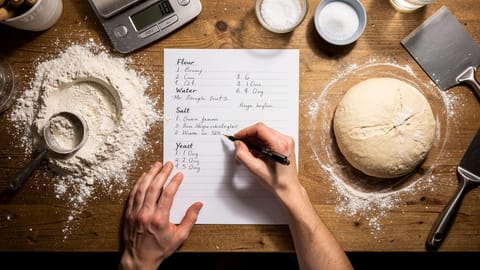
Professional bakers express recipes using baker's percentages, where flour is always 100% and every other ingredient is expressed as a percentage of the flour weight.
For example, a typical Neapolitan dough:
- Flour: 100% (1000g)
- Water: 62% (620g)
- Salt: 2.8% (28g)
- Yeast: 0.1% (1g)
This system makes it trivially easy to scale recipes up or down. Want to make dough with 500g of flour instead of 1000g? Just halve everything. Want 1500g? Multiply by 1.5. The percentages never change, only the absolute weights.
Once you get comfortable with baker's percentages, you will never go back to volumetric recipes. They are the universal language of dough. Use the pizza dough calculator to compute exact weights automatically.
Cheese knowledge
Cheese is not technically a dough ingredient, but choosing the right cheese is just as important as choosing the right flour. Different pizza styles demand different cheeses, and using the wrong one will undermine everything else you have done right.
Dry / low-moisture mozzarella
Best for: New York-style, New Haven-style, coal-fired pizzas
Dry mozzarella (also labeled "low-moisture mozzarella") has had most of its water removed, which means it browns beautifully without releasing excess moisture onto the pizza. It creates that classic golden-brown, slightly blistered cheese surface, a product of the Maillard reaction at work. This is the cheese you want for any style baked at standard oven temperatures where you need browning.
Whole-milk fresh mozzarella (Fior di Latte)
Best for: Neapolitan pizza, Margherita
Fresh mozzarella (fior di latte) is soft, wet, and delicate. It melts into creamy pools on a Neapolitan pizza, adding richness without dominating the other flavors. Because of its high moisture content, it works best in very hot ovens (800°F+ / 425°C+) where the water evaporates quickly. In a standard home oven, fresh mozzarella can make the pizza soggy. Slice it thin, pat it dry with paper towels, and use it sparingly if you are baking below 600°F (315°C).
Brick cheese + white Cheddar
Best for: Detroit-style pizza
Detroit pizza gets its signature frico edge, that lacy, crispy, caramelized cheese crust around the rim, from Wisconsin brick cheese (or a blend of brick cheese and white Cheddar). The cheese is spread all the way to the edges of the pan, where it makes direct contact with the hot, oiled steel and fries into a crunchy, savory crust. If you cannot find brick cheese, a combination of low-moisture mozzarella and mild white Cheddar is the closest substitute.
Provel (processed blend)
Best for: St. Louis-style pizza
St. Louis pizza uses Provel, a processed blend of Cheddar, Swiss, and provolone that was invented in St. Louis. It melts into a gooey, almost liquid layer and has a flavor profile unlike any natural cheese. It is a love-it-or-hate-it regional specialty that is nearly impossible to find outside the St. Louis area. If you want to make authentic St. Louis-style pizza, you will likely need to order it online.
The golden rule: shred your own
Always shred your own cheese from a block. Pre-shredded cheese is coated with anti-caking agents (typically cellulose or potato starch) that prevent the shreds from clumping in the bag. These coatings also prevent the cheese from melting smoothly and can create a gritty, uneven texture on your pizza. It takes 30 seconds to shred a block of mozzarella on a box grater, and the difference in melt quality is immediately obvious.