 Bastien
Umami foods: the list, the numbers, and how to cook with them
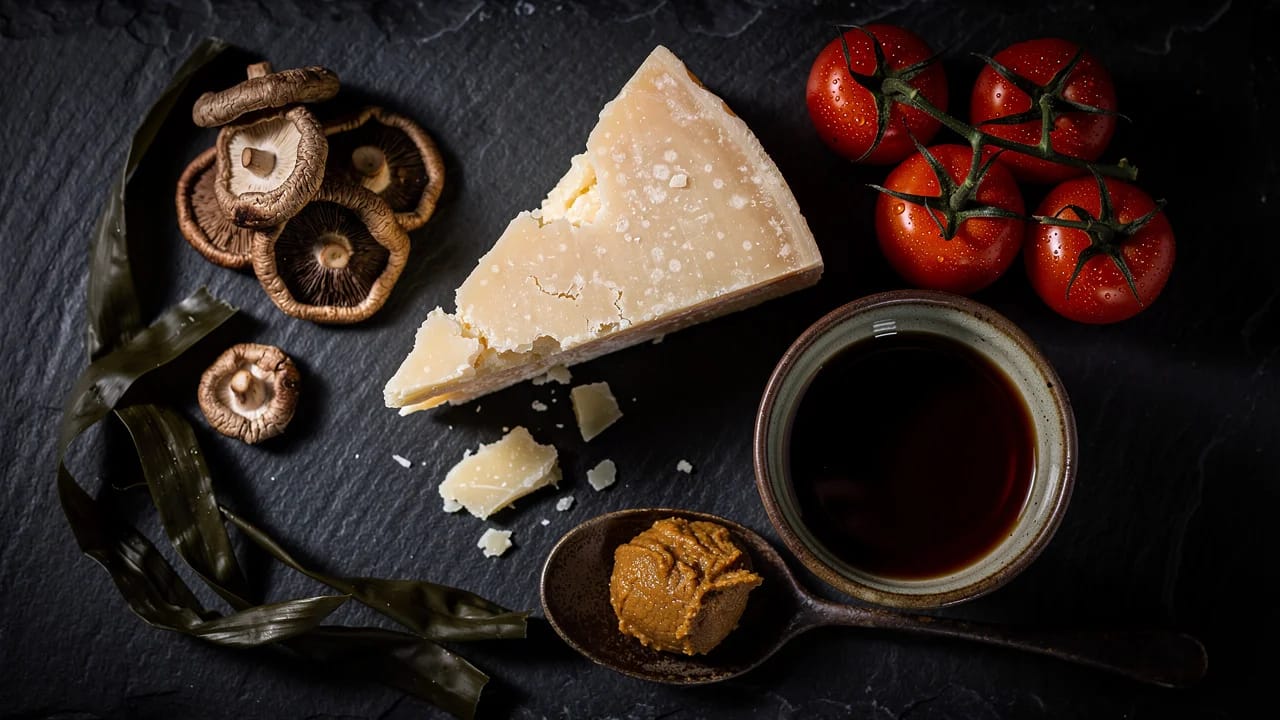
Kombu, Parmigiano Reggiano, soy sauce and dried shiitake carry more free glutamate than almost anything else in a kitchen, and the published figures vary by more than tenfold between them. This is the ranked list, the nucleotide sources that multiply the effect, and what to actually do with both when a soup, a sauce or a stew tastes thin.
A dish tastes flat, so you add salt. Now it tastes salty and flat. That gap is usually umami, and closing it takes an ingredient rather than more seasoning.
Umami is the savory basic taste that free glutamate triggers, helped along by two nucleotides that amplify it. What the taste actually feels like, why it lingers, and where the word came from are covered in the glossary entry. This page handles the shopping and the cooking: which foods carry the most, how much they carry, and what to do with them on a weeknight.
Every figure below is free glutamate in milligrams per 100 g, taken from the Umami Information Center's ingredient database. The center notes that its numbers shift with the individual sample and the season, so treat the ranges as the point rather than the decimals.
Which foods have the most umami?
Dried kelp wins, and it is not close. Everything else worth keeping in a cupboard clusters an order of magnitude below it. Rows are ordered by the top of each published range.
| Ingredient | Free glutamate (mg/100 g) | What it does in a pot |
|---|---|---|
| Kombu (dried kelp) | 1,610-3,380 | Ma kombu at the low end, rausu at the top. Steeped, then removed |
| Soy sauce | 400-1,700 | The range tracks brand and fermentation time |
| Parmigiano Reggiano | 1,200-1,680 | Highest of the everyday Western ingredients |
| Nori | 170-1,350 | Toasted and crumbled over rice or noodles |
| Dried tomatoes | 650-1,140 | Four to five times a fresh tomato |
| Dried shiitake | 1,060 | Also carries 150 mg guanylate, so it brings both halves at once |
| Fish sauce (nam pla) | 950 | Vanishes into anything braised or simmered |
| Oyster sauce | 900 | Built for stir-fries, heavy on its own |
| Miso | 200-700 | Red (aka) near the top, white (shiro) near the bottom |
| Anchovy | 630 | Melts out of existence in a warm pan |
| Dry-cured ham | 340 | The curing is what makes the number |
| Emmental | 310 | Well ahead of cheddar, well behind Parmigiano |
| Tomato | 150-250 | Climbs as the fruit ripens |
| Kimchi | 240 | Lacto-fermentation doing its work |
| Cheddar | 180 | Aging moves it |
Soy sauce sitting above Parmigiano at the top of its range surprises most people, and the width of that range is the reason to taste rather than measure. A cheap soy sauce and a two-year-brewed one are not the same ingredient.
The foods that carry inosinate instead
Glutamate is only half the picture. Meat and fish supply inosinate, dried mushrooms supply guanylate, and those two barely register on a glutamate list even when they taste deeply savory.
| Ingredient | Glutamate (mg/100 g) | Nucleotide (mg/100 g) |
|---|---|---|
| Katsuobushi (dried bonito) | 30-40 | 470-700 inosinate |
| Niboshi (dried sardine) | 40-50 | 350-800 inosinate |
| Tuna | 1-10 | 250-360 inosinate |
| Mackerel | 10-30 | 280 inosinate |
| Sardine | 10-20 | 280 inosinate |
| Pork | 10 | 230 inosinate |
| Chicken | 20-50 | 150-230 inosinate |
| Cod | 5-10 | 180 inosinate |
| Beef | 10 | 80 inosinate |
| Dried shiitake | 1,060 | 150 guanylate |
Katsuobushi is the row that rewrites the usual advice. It has a reputation as an umami powerhouse and almost no glutamate at all. Its job in dashi is to bring inosinate to kombu's glutamate, which is why the broth wants both ingredients rather than a double dose of either.
That pairing is the whole trick. The Umami Information Center puts the peak at seven to eight times the intensity of either compound tasted alone, at a glutamate-to-inosinate ratio of about 1:1. Parmesan over a meat ragù and anchovy in a tomato sauce are the same arrangement in a different kitchen.
Umami foods without meat or fish
The single highest-glutamate ingredient on the list is a seaweed, which makes a vegetarian umami pantry easier to build than most people expect. Kombu with dried shiitake covers both halves of the synergy on its own, since the mushroom carries guanylate alongside its glutamate.
| Plant food | Free glutamate (mg/100 g) |
|---|---|
| Dried tomatoes | 650-1,140 |
| Matcha | 490-700 |
| Green peas | 110 |
| Corn | 70-110 |
| Common mushroom | 40-110 |
| Garlic | 100 |
| Lotus root | 100 |
| Potato | 30-100 |
| Chinese cabbage | 20-90 |
| Carrot | 20-80 |
| Truffle | 60-80 |
| Spinach | 50-70 |
| Broccoli | 30-60 |
| Cabbage | 30-50 |
| Onion | 20-50 |
Nothing here competes with kombu, and that is the useful lesson. Vegetables contribute a base rather than a headline. When a vegetable soup tastes thin, the answer is a concentrated addition (tomato paste, miso, dried mushroom liquid) rather than more vegetables.
Natto lands at 140 mg and green tea covers an enormous 17 to 1,490 mg span depending on grade, which is why a good gyokuro tastes almost brothy.
What raises the umami in a food
Three processes release free glutamate from proteins that were holding it, and each one shows up in the numbers.
Drying is the most dramatic. Fresh shiitake sits at 70 mg per 100 g; dried shiitake reaches 1,060, roughly fifteen times as much. Fresh tomatoes run 150 to 250 mg while dried tomatoes reach 650 to 1,140.
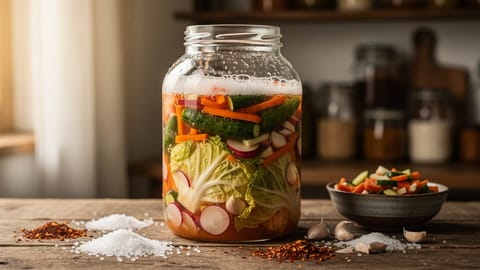
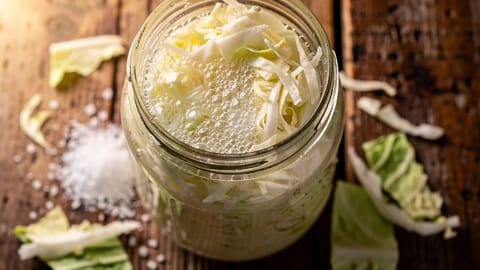
Fermentation explains why soy sauce, miso, fish sauce and kimchi crowd the top of the list while their raw starting materials do not. Soybeans on their own sit at 30 to 70 mg. Turn them into soy sauce and the figure climbs past 1,000. If that process interests you, the fermentation guide covers how it works at home.
Aging does the same to cheese and meat. Parmigiano at 1,200 to 1,680 mg and dry-cured ham at 340 mg both earned those numbers over months, which is also what dry-aging does to beef.
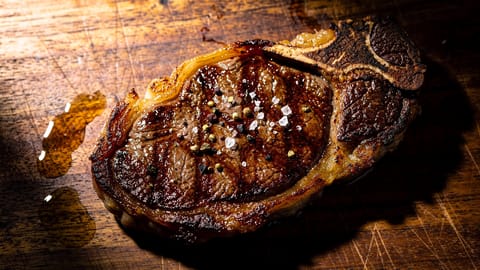
Cooking helps through a different route. The Maillard reaction that browns a seared steak or a tray of roasted vegetables breaks proteins apart and generates savory compounds that were not there before. Long reduction concentrates what a pot already holds, which is part of why a slow stock has more body than a fast one.
How to add umami to everyday dishes
Build a glutamate base, then bring in something with a nucleotide. Most of what follows is that one sentence applied to specific pans.
Soups and broths
Slip a 5 cm piece of kombu into cold water and pull it out before the pot boils hard, which keeps the broth from going slippery. For a meat or chicken soup, that kombu is already meeting inosinate from the bones, so you get the synergy without adding anything else.
Miso goes in off the heat. Boiling it flattens the aroma, though the glutamate survives fine. A teaspoon of fish sauce in a beef or chicken soup reads as more meat, not as fish. Parmesan rinds are the slow version of the same idea and belong in the freezer rather than the bin.
Tomato sauces and pasta
Tomato paste is the most concentrated form of the dried-tomato numbers above. Sear a spoonful of it in oil until it darkens before the liquid goes in, which browns the sugars and deepens what is already there.
An anchovy fillet dissolved into the same pan brings glutamate and disappears completely. Grated Parmigiano at the table does the rest. A long simmer helps for the same reason reduction always does, though the finished sauce is more about concentration than any new chemistry.
Stews, chili and braises
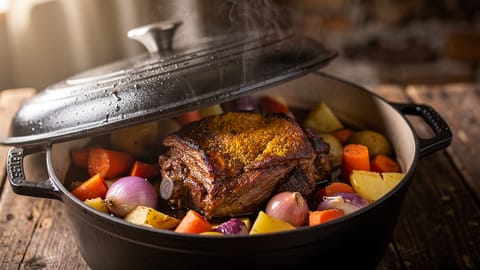
A braise already has the inosinate half from the meat, so what it usually lacks is glutamate. A tablespoon of soy sauce, a spoonful of miso or a squeeze of tomato paste at the start covers that.
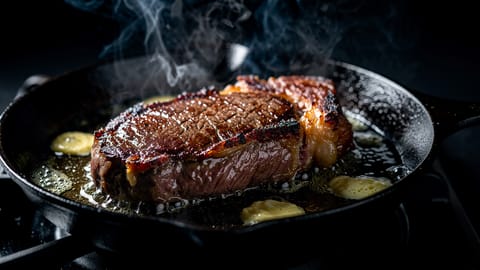
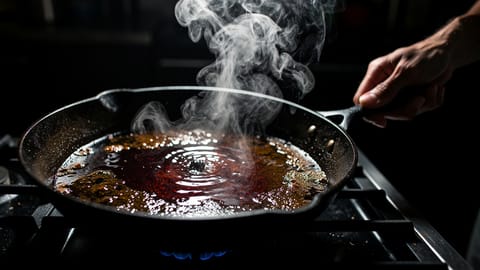
Brown the meat properly first. Then deglaze with stock, wine or soy sauce to lift what the browning left stuck to the pan. Skipping that step throws away the most concentrated flavor in the whole dish, which is also the point of a pan sauce. The full method is in the braising guide.
Stir-fries and quick pans
Oyster sauce and soy sauce together give you a lot of glutamate for very little effort, and the protein in the pan handles the nucleotide side. Dried shiitake soaked in warm water gives you both at once, and the soaking liquid is worth more than the mushrooms.
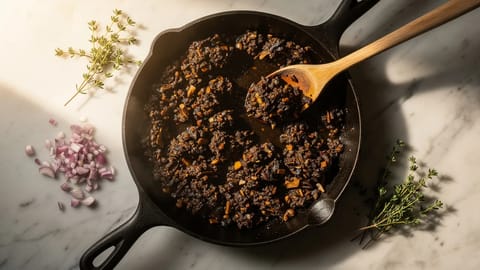
A finely chopped duxelles is the concentrated form of that, useful by the spoonful.
A pantry worth keeping
Eight things cover almost everything above, and none of them spoil quickly.
Where MSG fits
Monosodium glutamate is the sodium salt of glutamic acid, and the glutamate ion your receptors register is the same one that arrives from a tomato or a wedge of Parmigiano. Everything on this page works without it. It is also a reasonable ingredient to keep if you want the glutamate half with no liquid, no aroma and no competing flavor.
On the regulatory side, EFSA re-evaluated glutamic acid and glutamates used as food additives (E 620-625) in 2017 and set a group acceptable daily intake of 30 mg per kilogram of body weight per day, then recommended reviewing the maximum permitted levels. That figure covers glutamates added to food, not the glutamate already present in cheese or a ripe tomato.
The headache story traces back to a 1968 letter to the New England Journal of Medicine rather than to a study. A 2009 review in Clinical & Experimental Allergy worked through the reported reactions, from asthma to hives, and concluded that decades of research had failed to demonstrate a clear and consistent relationship between MSG and those conditions. Some people do report short-term symptoms after large doses taken without food, so this is a question of scale rather than a clean yes or no.
One practical detail: MSG contains about a third of the sodium of table salt, which is why it comes up in sodium-reduction work. If you are already thinking about which salt you cook with, that trade-off is worth knowing.
Keeping track of what worked
Once you start building umami deliberately, the useful record is which recipes ended up carrying it. In Fond, the app we're building (join the waitlist), recipes have a flavor-profile field with umami as one of the values, so a recipe library can be filtered down to the deep savory end of what you've saved. It also makes it obvious when a week of planned dinners is leaning hard in one direction.
- Kombu at 1,610-3,380 mg glutamate per 100 g outranks everything else by roughly a factor of two
- Katsuobushi, meat and fish contribute inosinate rather than glutamate, and the two halves together taste seven to eight times stronger than either alone at a 1:1 ratio
- Drying multiplies glutamate about fifteenfold in shiitake and four to five times in tomatoes
- A thin soup usually wants a concentrated addition, not more vegetables
- MSG supplies the same glutamate ion as Parmigiano; EFSA's 30 mg/kg group ADI applies to the added form only
Sources
- Umami-rich foods: glutamate, inosinate and guanylate content — Umami Information Center
- What is Umami — Umami Information Center
- What is monosodium glutamate and is it bad for you? — European Food Information Council
- EFSA reviews the safety of glutamates added to food — European Food Safety Authority
- Monosodium glutamate 'allergy': menace or myth? — Williams and Woessner, Clinical & Experimental Allergy